Last updated 4mo ago
Log in to add personal notes on this page.
A newborn has severe syndactyly of the hands and feet ("mitten hands") with bony fusion. The skull shows turribrachycephaly and there is midface hypoplasia with proptosis.
AD; FGFR2 (specific variants: p.Ser252Trp or p.Pro253Arg account for ~98%)
- Almost always de novo; advanced paternal age
- Severe symmetric syndactyly (hands and feet) - osseous fusion
- Craniosynostosis (coronal → turribrachycephaly/tower skull)
- Midface hypoplasia, proptosis
- Intellectual disability (variable, more common than Crouzon)
- Acne vulgaris (teens)
- Clinical recognition: bicoronal craniosynostosis with severe symmetric syndactyly of hands and feet
- Skull radiographs or CT confirm fused coronal sutures (turribrachycephaly); 3D CT guides surgical planning
- Molecular confirmation by FGFR2 sequencing (p.Ser252Trp or p.Pro253Arg in ~98%)
- Multidisciplinary craniofacial team coordination from infancy
- Staged cranial vault expansion in infancy, followed by midface advancement (Le Fort III/monobloc) later in childhood
- Airway assessment for obstructive sleep apnea from midface hypoplasia and choanal stenosis
- ICP monitoring; surveillance for hydrocephalus and raised intracranial pressure
- Reconstructive hand surgery for syndactyly; audiology for conductive hearing loss
- Developmental and educational support
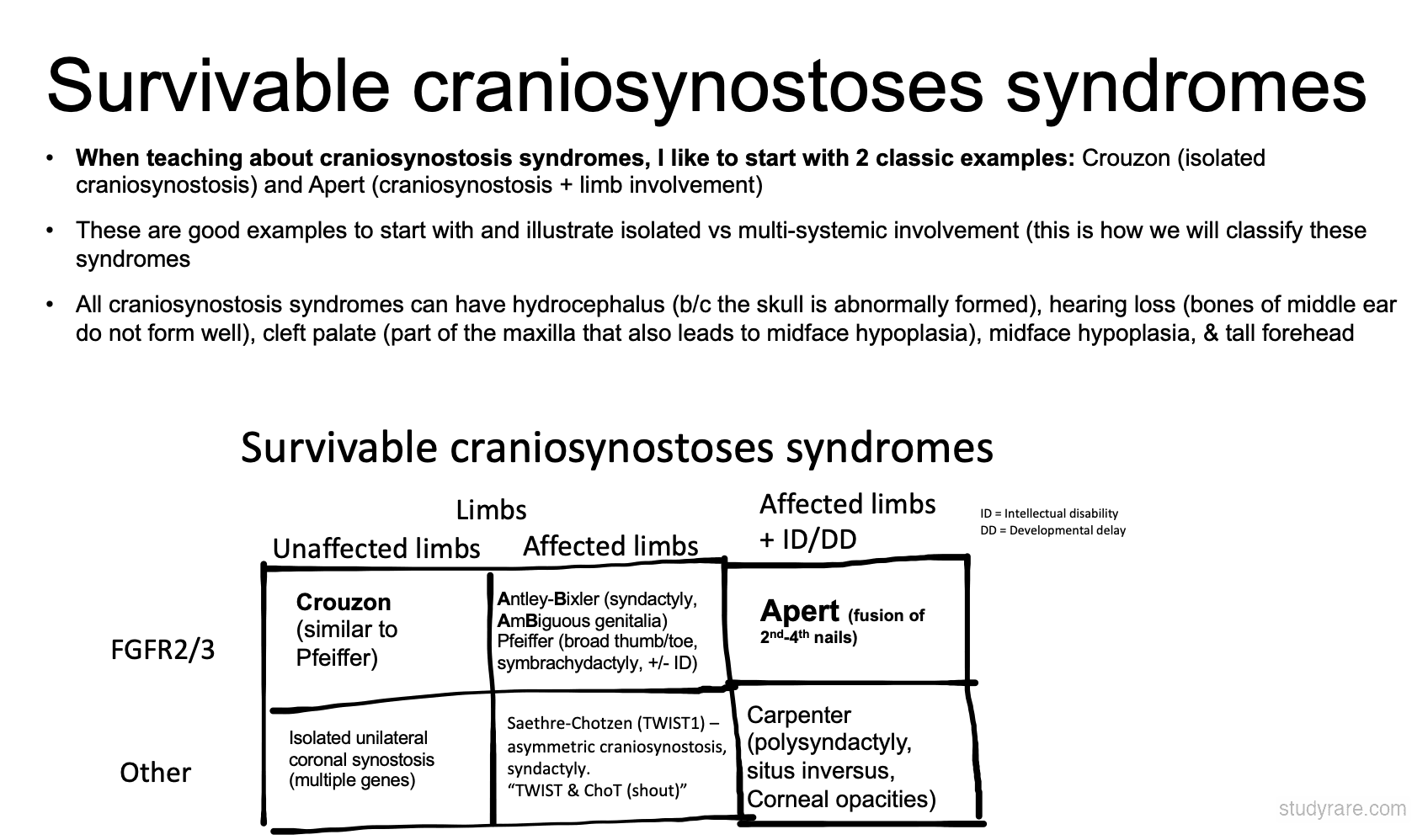
In Apert syndrome, fingers and nails are not "Apert" (apart) as they should be: they are fused (syndactyly, with fusion of 2nd-4th nails).
Apert vs Crouzon: Both are FGFR2, but Apert has syndactyly and intellectual disability. Crouzon affects the "cranium only": normal hands, normal intelligence.