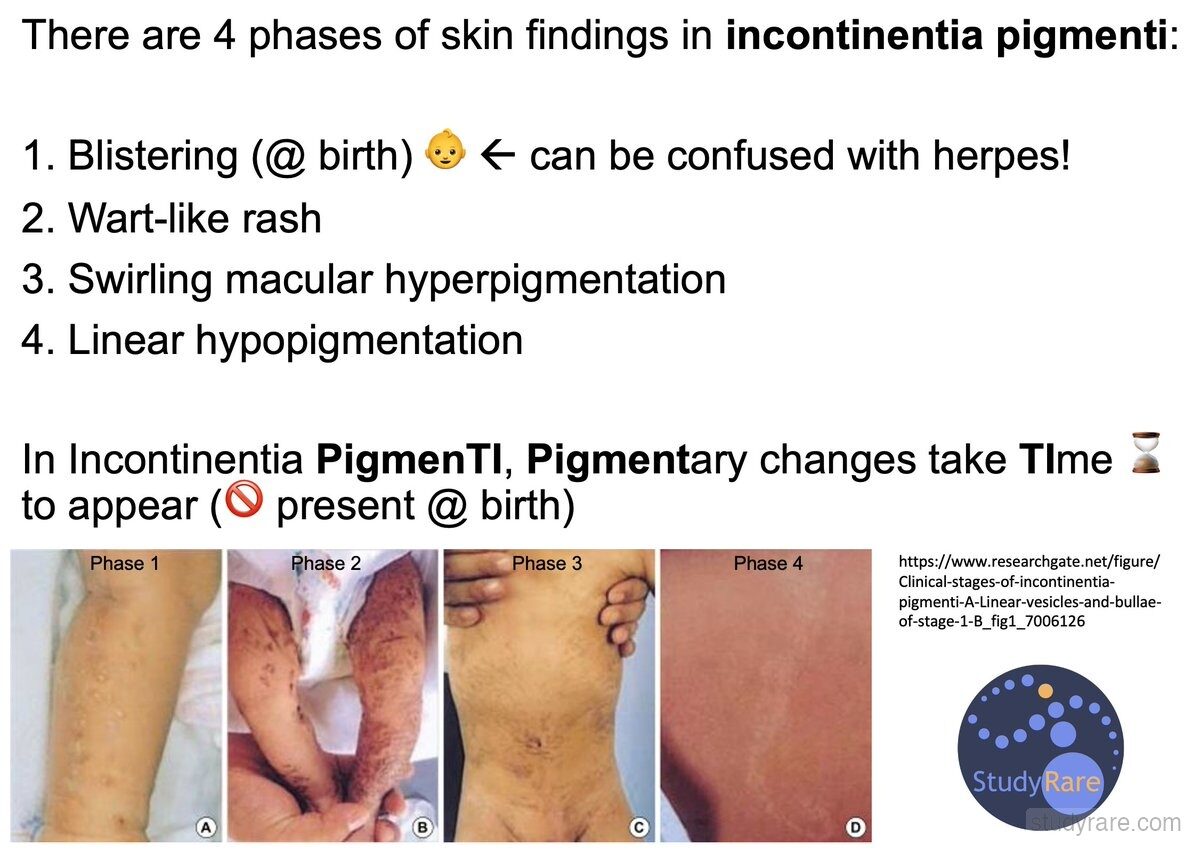
A female infant develops vesicular lesions along the lines of Blaschko on her trunk and extremities in the first weeks of life. These evolve through verrucous and hyperpigmented stages. Her brother was lost to miscarriage.
XLD; IKBKG (NEMO)
- Usually lethal in males (miscarriage)
- Females show lyonization pattern (Blaschko lines)
Skin stages:
- Vesicular (birth - weeks)
- Verrucous (weeks - months)
- Hyperpigmented (months - years) - "marble cake" pattern
- Hypopigmented/atrophic (adolescence - adult)
Other features:
- Dental anomalies (conical teeth, delayed eruption)
- Eye abnormalities (retinal vascular disease)
- CNS anomalies (seizures, ID in ~30%)
- Alopecia (vertex)
- Clinical diagnosis based on the characteristic Blaschko-linear skin stages, often with eosinophilia during the vesicular stage
- Skin biopsy showing eosinophilic spongiosis (vesicular stage) or dyskeratosis and dermal melanin (later stages)
- Molecular confirmation of the recurrent IKBKG (NEMO) deletion or other pathogenic variant
- Skin care and infection prevention during the blistering stage; later skin changes are typically self-limited
- Ophthalmologic surveillance from the neonatal period for retinal vascular disease (laser or anti-VEGF for proliferative retinopathy)
- Neurologic evaluation and seizure management; developmental monitoring
- Dental rehabilitation for hypodontia and conical teeth; genetic counseling for the X-linked dominant, male-lethal inheritance
"InKontinentia BiG-menti" is caused by variants in the gene IKBKG.
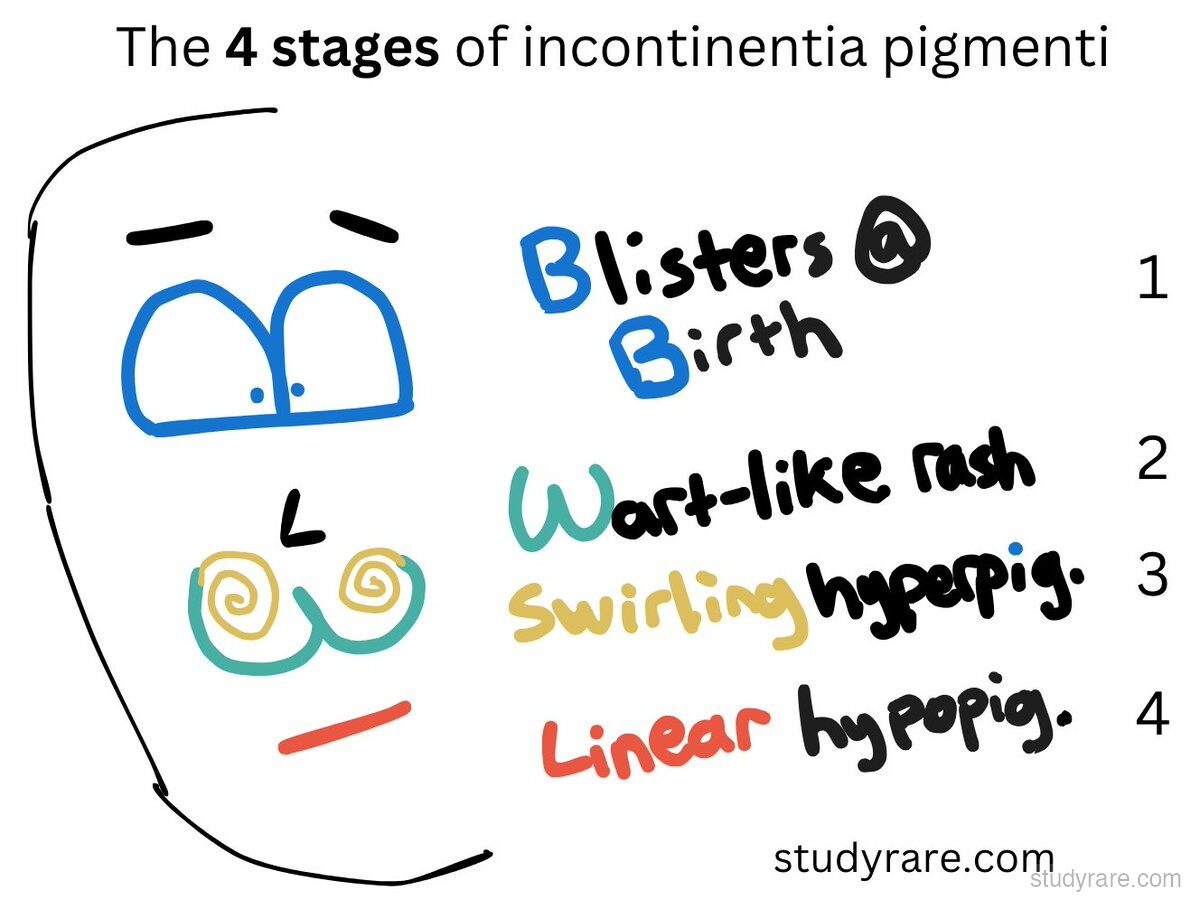
Incontinentia "Bigmenti" Begins with skin Blisters at Birth.
Pigmenti = "Pigtails": the disorder primarily affects females (X-linked dominant, male lethal).
This illustration uses a face to depict the four sequential skin stages: blisters at birth, wart-like rash, swirling hyperpigmentation, and linear hypopigmentation.
The four phases of skin findings in IP evolve over time. Pigmentary changes take time to appear and blistering at birth can be confused with herpes.