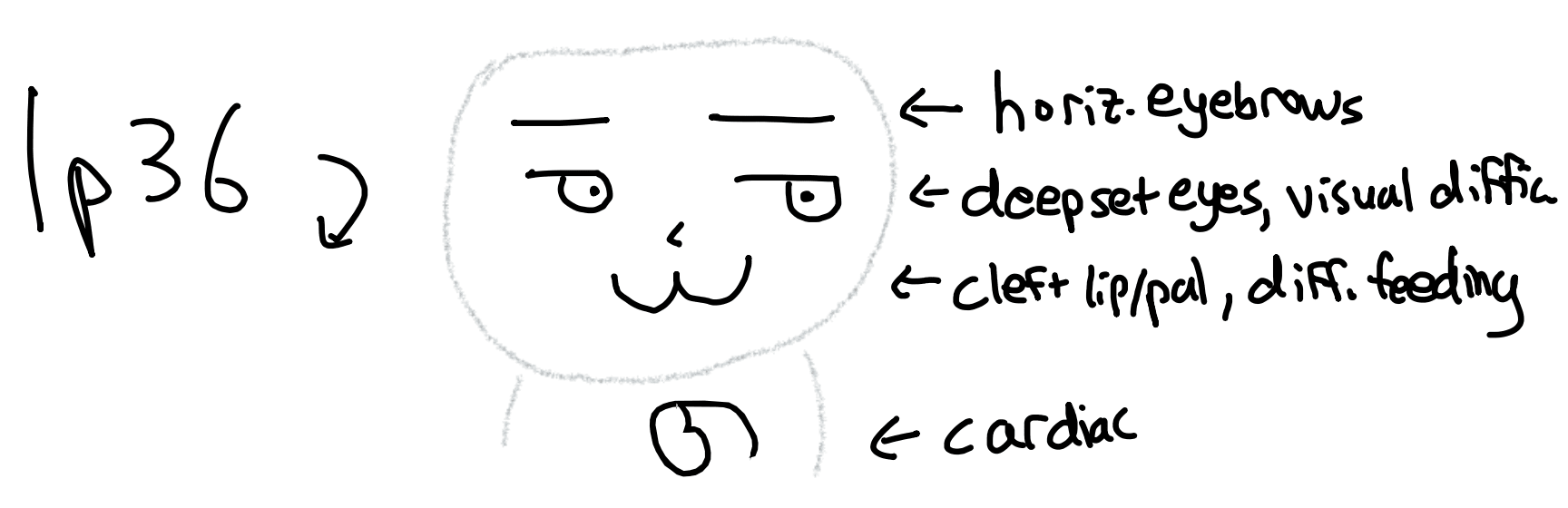
Monosomy 1p36 syndrome
Log in to starLast updated 1d ago
Log in to add personal notes on this page.
A 2-year-old has severe intellectual disability, microcephaly with pointed chin, deep-set eyes, and straight eyebrows. She has hypotonia, refractory seizures, and a structural heart defect (non-compaction cardiomyopathy was found on echo). CMA reports a 4 Mb terminal deletion of 1p36.
Terminal deletion of the short arm of chromosome 1 (1p36). The most common terminal deletion syndrome (~1 in 5,000 births). Most are de novo; ~20% from unbalanced translocations of a parent. Deletion size and breakpoints vary, which contributes to phenotypic variability.
- Severe intellectual disability with limited speech
- Hypotonia and feeding difficulties in infancy
- Microcephaly with characteristic facies: straight eyebrows, deep-set eyes, midface retrusion, pointed chin, low-set/posteriorly rotated ears
- Seizures (~50%, often refractory) and cortical visual impairment
- Cardiomyopathy: left ventricular non-compaction (LVNC) is over-represented and a major cause of mortality
- Structural CHD (~70%): PDA, ASD, VSD, valve anomalies
- Behavior: self-injury, autistic features common
- Hearing loss; ophthalmologic findings (strabismus, refractive errors)
- Chromosomal microarray (CMA) is the test of choice: detects the deletion and characterizes its size
- Karyotype may miss small deletions; FISH for 1p36 confirms when CMA isn't available
- Parental karyotype/FISH if a translocation is suggested by clinical context (recurrence implications)
- Other terminal deletion syndromes (Wolf-Hirschhorn 4p-, Cri-du-chat 5p-): different facies, different phenotype
- Angelman syndrome: seizures + ID + hypotonia, but happy demeanor and characteristic EEG; methylation analysis
- Rett syndrome: regression, hand stereotypies, female predominance; MECP2
- Cardiology: baseline echo + serial echocardiography (LVNC surveillance is life-saving)
- Neurology: seizure management
- Developmental: early intervention, augmentative communication
- GI: feeding evaluation, possible G-tube
- Family genetic counseling: most de novo, low recurrence; if parental translocation, ~25-50% recurrence