Last updated 4mo ago
Log in to add personal notes on this page.
An infant with cholestatic jaundice has a characteristic triangular face, butterfly vertebrae on X-ray, and posterior embryotoxon on eye exam. Echocardiogram reveals peripheral pulmonary stenosis.
AD; JAG1 (~95%) or NOTCH2
- ~60% de novo
- Variable expression: some family members have subtle features only
Major criteria:
- Hepatic: Bile duct paucity, cholestasis
- Cardiac: Peripheral pulmonary stenosis, TOF
- Skeletal: Butterfly vertebrae
- Ocular: Posterior embryotoxon
- Facial: Triangular face, prominent forehead, deep-set eyes
- Liver biopsy shows bile duct paucity; clinical diagnosis rests on cholestasis plus characteristic features (posterior embryotoxon, butterfly vertebrae, peripheral pulmonary stenosis, facial features)
- JAG1 (~95%) or NOTCH2 molecular testing confirms the diagnosis and clarifies the variable familial phenotype
- Echocardiography, ophthalmologic exam, and spine imaging characterize the multisystem involvement
- Supportive: ursodeoxycholic acid and ileal bile acid transport inhibitors (such as maralixibat) for cholestatic pruritus
- Aggressive nutritional support with fat-soluble vitamin (A, D, E, K) supplementation
- Liver transplantation for end-stage liver disease or intractable pruritus; cardiology management of the pulmonary stenosis
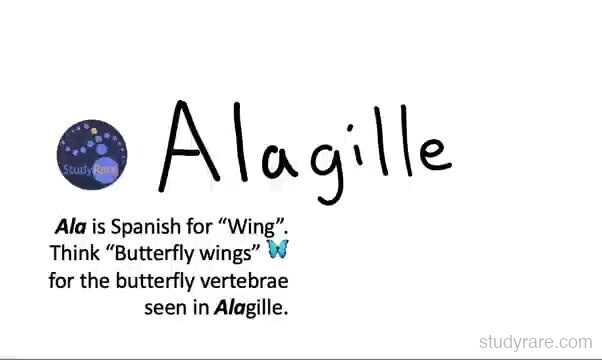
Ala-gille = Wing-Fish: "Ala" is Spanish for "wing" (think butterfly wings for the butterfly vertebrae). "Gills" are fish lungs (think pulmonary artery stenosis). The remaining features: gille = gone are the bile ducts (bile duct paucity), triangular facies, and posterior embryotoxon.