
Androgen insensitivity syndrome (AIS)
Log in to starLast updated 4mo ago
Log in to add personal notes on this page.
A 16-year-old with female external genitalia and primary amenorrhea is found to have a blind-ending vagina and absent uterus. Karyotype is 46,XY. Testes are identified in the inguinal canal.
XLR; AR (androgen receptor)
Forms:
- Complete AIS (CAIS): Female external genitalia, female gender identity, primary amenorrhea
- Partial AIS (PAIS): Ambiguous genitalia
- Mild AIS: Male phenotype with infertility, gynecomastia
CAIS:
- 46,XY with female external genitalia
- Testes (inguinal or abdominal)
- Absent uterus and fallopian tubes (AMH present)
- Normal breast development (testosterone → estrogen)
- Absent/sparse pubic and axillary hair
- Primary amenorrhea
- Karyotype 46,XY in a phenotypic female (or with ambiguous/undervirilized genitalia)
- Normal-to-elevated testosterone with normal-to-elevated LH (androgen resistance, not deficiency); AMH present
- Pelvic imaging confirms absent uterus and fallopian tubes
- Confirm with AR sequencing (X-linked)
The differential diagnosis for primary amenorrhea can be organized by the presence or absence of breast development and a uterus.
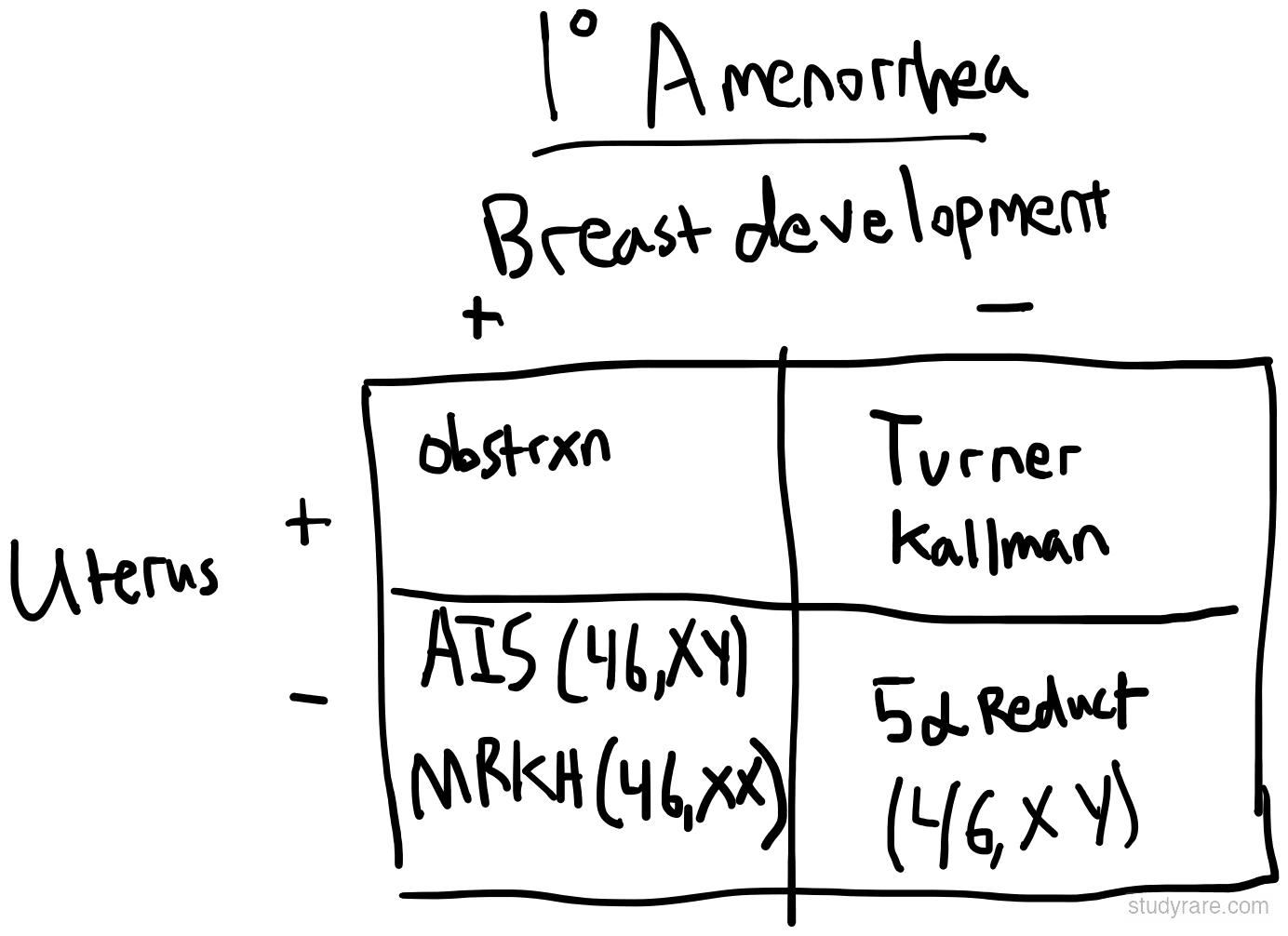
- Gonadectomy (malignancy risk)
- Estrogen replacement