Carnitine uptake defect (primary carnitine deficiency)
Log in to starLast updated 4mo ago
A child presents with cardiomyopathy and hypoglycemia. Plasma carnitine is severely reduced. The condition is completely treatable with carnitine supplementation.
AR; SLC22A5 (OCTN2 carnitine transporter)
- Cardiomyopathy (dilated)
- Hypoglycemia, hepatomegaly
- Skeletal myopathy
- Very low plasma carnitine
- On RUSP
- Newborn screening (RUSP) acylcarnitine profile: very low free carnitine (C0), the key marker (opposite of CPT1A, which has high C0)
- A low newborn C0 may reflect maternal carnitine deficiency, so the mother's plasma carnitine should also be checked
- Markedly reduced plasma total and free carnitine; reduced carnitine transport in cultured fibroblasts
- Confirmatory SLC22A5 molecular testing
- Oral carnitine (dramatic response, prevents cardiomyopathy)
NBS: Low C0 (free carnitine). On the newborn screening acylcarnitine profile, low C0 (free carnitine) is the key marker for carnitine uptake deficiency. Contrast with CPT1A, which has high C0.
"CUD is CUrable": carnitine uptake defect is one of the most treatable inborn errors of metabolism. Oral carnitine supplementation produces a dramatic response and prevents life-threatening cardiomyopathy.
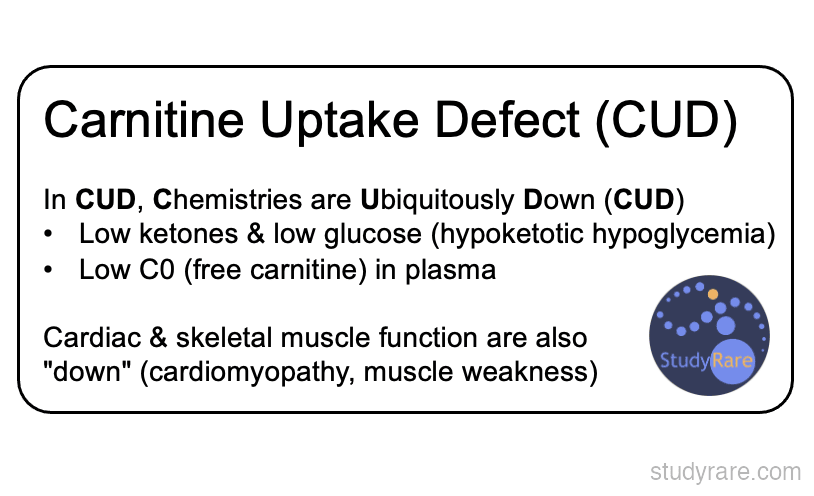
In CUD, chemistries are ubiquitously down: low ketones, low glucose, and low free carnitine (C0) in plasma, with cardiac and skeletal muscle dysfunction.