
Metabolic Disorders
Overview
Metabolic disorders encompass inborn errors of metabolism affecting amino acids, organic acids, fatty acids, carbohydrates, lysosomes, peroxisomes, and mitochondria. Key concepts include newborn screening, acute metabolic crises, and substrate reduction/enzyme replacement therapies.
Amino acid disorders
Amino acid disorders disrupt the breakdown of amino acids, causing toxic accumulation. Most are on newborn screening. Key presentations: PKU (untreated → ID, musty odor; maternal PKU is critical), MSUD (maple syrup odor, encephalopathy), homocystinuria (downward lens dislocation - opposite of Marfan, thrombosis), and tyrosinemia type 1 (liver failure, succinylacetone is pathognomonic). NKH presents with severe neonatal seizures and elevated CSF glycine.
Urea cycle disorders
Urea cycle disorders cause hyperammonemia - a metabolic emergency. OTC deficiency is X-linked (most common UCD) and distinguished by elevated urinary orotic acid. Neonatal males present with severe hyperammonemic coma; carrier females have variable symptoms. Arginase deficiency is unique - it presents later with spastic paraparesis and MILD hyperammonemia, unlike the severe hyperammonemia of proximal UCDs.
Organic acidemias
Organic acidemias present with metabolic acidosis, hyperammonemia, and ketosis - often in the neonatal period. MMA and propionic acidemia are clinically similar (both from branched-chain amino acid metabolism), but MMA can be B12-responsive. Isovaleric acidemia has the classic "sweaty feet" odor. Glutaric aciduria type 1 causes macrocephaly and acute dystonia after illness - the MRI shows "bat wings."
Carnitine cycle disorders
The carnitine cycle is the four-step entry system that gets long-chain fatty acids from the cytosol into the mitochondrial matrix: OCTN2 imports carnitine into the cell (carnitine uptake defect), CPT1 conjugates a long-chain fatty acid to carnitine on the outer mitochondrial membrane, CACT translocates the acylcarnitine across the inner membrane, and CPT2 regenerates acyl-CoA on the matrix side. Defects at any step block long-chain FAO. Acylcarnitine signatures: low C0 in CUD, high C0 in CPT1A, elevated C16/C18 species in CACT and CPT2 (indistinguishable on NBS). Phenotype severity scales with where in the cycle the block sits: CUD is the most treatable (oral carnitine), CACT is the most lethal, and CPT2 has a recognizable adult-onset myopathic form with exercise-, cold-, and fasting-induced rhabdomyolysis.
Beta-oxidation enzyme defects
Beta-oxidation is the spiral of four reactions that shortens fatty acyl-CoAs by two carbons per cycle. Chain-length-specific dehydrogenases handle each segment: SCAD (C4-C6), MCAD (C6-C12), VLCAD (C14-C20), and the trifunctional protein/LCHAD (long-chain hydroxy-step). All present with hypoketotic hypoglycemia (the body cannot use fat for energy during fasting). MCAD is the most common and clinically central; it is on newborn screening and presents with hypoketotic hypoglycemia during fasting or illness. VLCAD and LCHAD/TFP are more severe with cardiac involvement; LCHAD/TFP are distinctive for peripheral neuropathy, retinopathy, and maternal HELLP/AFLP. SCAD is largely an NBS incidentaloma with uncertain clinical significance. MADD (glutaric aciduria type II) is a special case that blocks every acyl-CoA dehydrogenase at once through an upstream electron-transfer defect (ETF/ETFDH); the late-onset form is often riboflavin-responsive.
Cholesterol metabolism
These disorders affect cholesterol synthesis or processing. Smith-Lemli-Opitz (DHCR7) is the classic one - 2-3 toe syndactyly is highly characteristic. Cerebrotendinous xanthomatosis is treatable if caught early: look for juvenile cataracts + progressive neurological decline. Familial hypercholesterolemia is common and underdiagnosed: homozygotes have cardiovascular disease in childhood. Tangier disease sits at the opposite end of the lipid panel: a broken cholesterol efflux pump (ABCA1) leaves HDL near zero and gives the tonsils their characteristic yellow-orange color.
Carbohydrate metabolism
Galactosemia presents in the first week of life with E. coli sepsis, cataracts, and liver failure after starting milk feeds - it's on newborn screening but symptoms may appear before results. Hereditary fructose intolerance presents when fructose is introduced. Glycogen storage diseases vary by which organ is affected: GSD1 (liver - severe hypoglycemia), GSD2/Pompe (muscle/heart - ERT available), GSD5/McArdle (muscle only - "second wind" phenomenon).
Lysosomal storage - Sphingolipidoses
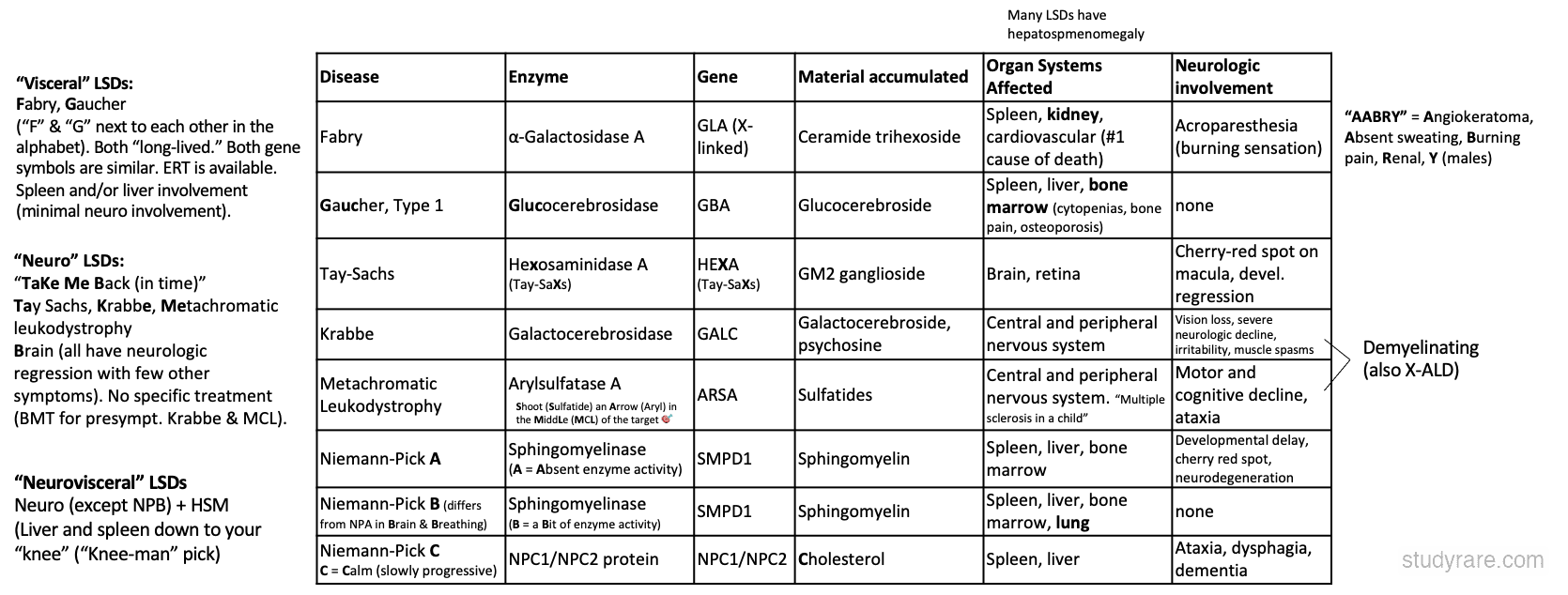
Sphingolipidoses accumulate complex membrane lipids. Distinguishing features cluster by ethnicity and physical signs: Gaucher (Ashkenazi Jewish, bone crises, GBA1-related Parkinson risk), Fabry (X-linked, acroparesthesias, angiokeratomas, renal/cardiac involvement), Tay-Sachs and the GM2 gangliosidoses (cherry-red macula, neurodegeneration; Ashkenazi founder in Tay-Sachs), Niemann-Pick (A = infantile + cherry-red; B = HSM + lung; C = vertical gaze palsy), Krabbe and MLD (leukodystrophy + peripheral neuropathy; Krabbe on RUSP). Enzyme replacement therapy is available for many.
Lysosomal storage - Mucopolysaccharidoses
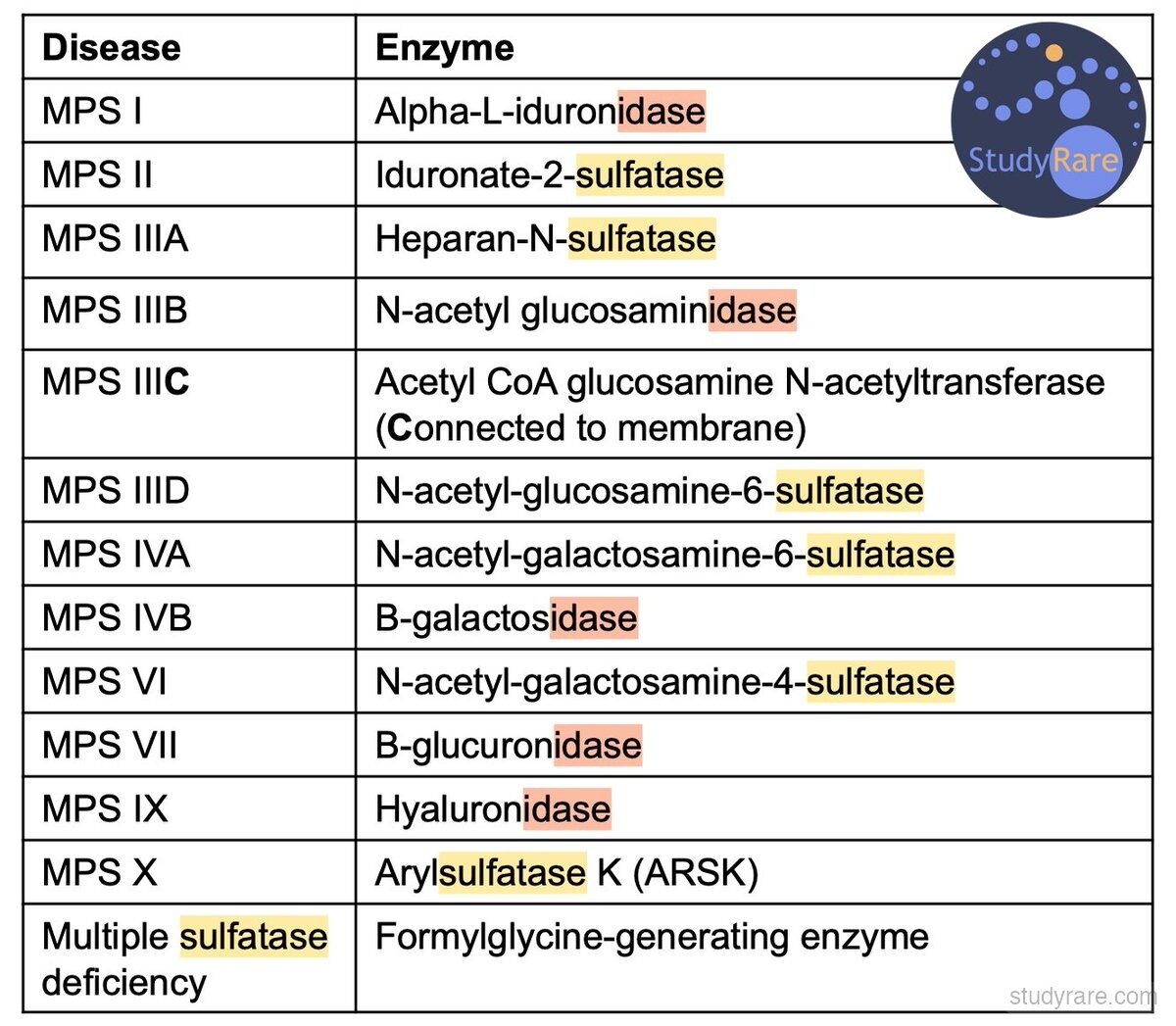
The four MPSs store glycosaminoglycans and are easiest to remember by sound: MPS I = "Hur1er", MPS II = "Hun-Two-er" (Hunter), MPS III = "SanfIIIppo", MPS IV = "MorQUio" (QUad = 4). Hunter (MPS II) is the only X-linked MPS and the only one without corneal clouding (vs. MPS I Hurler, which has it). Morquio (MPS IV) spares cognition but causes severe skeletal dysplasia and odontoid hypoplasia. Sanfilippo (MPS III) is the CNS-predominant form. Each MPS enzyme either removes sulfur ("-sulfatase") or removes a saccharide ("-idase", e.g., iduronidase, glucosaminidase). ERT is available for several.
Lysosomal storage - Lipid storage
Lipid-storage LSDs outside the classic sphingolipidoses. Wolman disease (LIPA, lysosomal acid lipase deficiency) presents in infancy with hepatosplenomegaly, failure to thrive, and bilateral adrenal calcifications on imaging.
Lysosomal storage - Other
Conditions that do not fit the sphingolipid or MPS categories. I-cell disease (mucolipidosis II, GNPTAB) presents with Hurler-like coarse features, gingival hyperplasia, and severe joint restriction. Neuronal ceroid lipofuscinosis (Batten disease, CLN3 and others) presents with progressive vision loss, refractory seizures, and cognitive decline in childhood.
Peroxisomal disorders
Peroxisomal disorders affect fatty acid metabolism and plasmalogen synthesis. X-ALD (ABCD1) is on newborn screening - the childhood cerebral form is devastating but HSCT can help if caught early. The Zellweger spectrum represents peroxisome biogenesis defects (PEX genes) - severe forms present with hypotonia, seizures, and characteristic facies. Elevated VLCFA is the screening test for most. Refsum disease is treatable with dietary phytanic acid restriction.
Mitochondrial disorders
Mitochondrial disorders affect energy production and can be caused by mtDNA or nuclear genes. Key features: maternal inheritance (mtDNA), heteroplasmy, and multi-organ involvement (especially brain, muscle, heart). MELAS (stroke-like episodes + lactic acidosis), MERRF (myoclonic epilepsy + lipomas), and Leigh syndrome (basal ganglia lesions on MRI) are classic presentations. POLG variants + valproate = fatal hepatotoxicity.
Purine and pyrimidine disorders
These disorders affect nucleotide metabolism. Lesch-Nyhan (HPRT1, X-linked) is characterized by self-injurious behavior (compulsive lip and finger biting) plus hyperuricemia. ADA deficiency causes SCID (T-B-NK- phenotype) and is on newborn screening via TREC - it's one of the few SCIDs with skeletal abnormalities.
Other metabolic
This section covers conditions that don't fit neatly elsewhere. Cobalamin C deficiency (cblC, MMACHC) sits at the intersection of organic-acid and remethylation pathways: combined methylmalonic acidemia + homocystinuria, retinopathy, and megaloblastic anemia. PMM2-CDG (a congenital disorder of glycosylation) has the characteristic inverted nipples and abnormal fat pads. Alkaptonuria is benign until adulthood when ochronosis (dark cartilage) and arthritis develop - dark urine is the clue. Acute intermittent porphyria presents with acute attacks of abdominal pain, neuropsychiatric symptoms, and NO photosensitivity (distinguishing it from other porphyrias).
Summary Table
| Disorder | Gene | Inheritance | Cardinal Features |
|---|---|---|---|
| PKU | PAH | AR | ID if untreated, maternal PKU syndrome, on RUSP |
| MSUD | BCKD genes | AR | Maple syrup odor, encephalopathy, on RUSP |
| Homocystinuria | CBS | AR | Downward ectopia lentis, thrombosis, marfanoid |
| Tyrosinemia I | FAH | AR | Liver failure, succinylacetone, HCC risk, on RUSP |
| NKH | GLDC, AMT | AR | Neonatal encephalopathy, intractable seizures, elevated CSF glycine |
| Hyperprolinemia I | PRODH | AR | Usually benign; elevated proline; 22q11.2 region |
| Pyridoxine-dependent epilepsy | ALDH7A1 | AR | Refractory neonatal seizures, dramatic response to B6 |
| OTC deficiency | OTC | XLR | Hyperammonemia, orotic aciduria, males severe |
| Arginase deficiency | ARG1 | AR | Spastic paraparesis, mild hyperammonemia, high arginine |
| ASL deficiency | ASL | AR | Hyperammonemia, trichorrhexis nodosa, argininosuccinic acid |
| MMA | MUT, MMAA | AR | Metabolic acidosis, hyperammonemia, B12-responsive forms, on RUSP |
| Propionic acidemia | PCCA, PCCB | AR | Acidosis, hyperammonemia, cardiomyopathy, on RUSP |
| Cobalamin C (cblC) | MMACHC | AR | MMA + homocystinuria, retinopathy, megaloblastic anemia |
| Isovaleric acidemia | IVD | AR | "Sweaty feet" odor, acute crises, on RUSP |
| Glutaric aciduria 1 | GCDH | AR | Macrocephaly, acute dystonia, "bat-wing" MRI, on RUSP |
| Canavan | ASPA | AR | Leukodystrophy, macrocephaly, elevated NAA, AJ founder |
| Carnitine uptake defect | SLC22A5 | AR | DCM, hypoglycemia, very low plasma carnitine (low C0), on RUSP |
| CPT1A | CPT1A | AR | Hepatic-only phenotype, high C0 (free carnitine), Inuit founder variant |
| CACT | SLC25A20 | AR | Neonatal cardiomyopathy, arrhythmia, often lethal |
| CPT2 | CPT2 | AR | Adult myopathic form: rhabdo with exercise/cold/fasting; severe neonatal form resembles CACT |
| MCADD | ACADM | AR | Hypoketotic hypoglycemia, avoid fasting, C8 on NBS, on RUSP |
| VLCADD | ACADVL | AR | Hypoketotic hypoglycemia, cardiomyopathy, C14:1, on RUSP |
| LCHADD / TFP | HADHA, HADHB | AR | Cardiomyopathy, peripheral neuropathy, retinopathy, maternal HELLP/AFLP, C16-OH, on RUSP |
| SCADD | ACADS | AR | Uncertain phenotype; elevated C4, EMA on urine; removed from many state NBS panels |
| MADD / GA-II | ETFA, ETFB, ETFDH | AR | Pan-elevation of acylcarnitines; late-onset form is riboflavin-responsive |
| Galactosemia | GALT | AR | E. coli sepsis, cataracts, ovarian failure, on RUSP |
| Hereditary fructose intolerance | ALDOB | AR | Hypoglycemia after fructose; aversion to sweets |
| GSD1 | G6PC | AR | Severe hypoglycemia, hepatomegaly, lactic acidosis |
| Pompe (GSD II) | GAA | AR | Cardiomegaly, hypotonia, ERT available, on RUSP |
| GSD III (Cori) | AGL | AR | Hepatomegaly, milder hypoglycemia, myopathy, elevated CK |
| GSD V (McArdle) | PYGM | AR | Exercise intolerance, "second wind", myoglobinuria |
| SLOS | DHCR7 | AR | 2-3 toe syndactyly, ID, genital anomalies; elevated 7-DHC |
| CTX | CYP27A1 | AR | Juvenile cataracts, tendon xanthomas, neurodegeneration; treatable |
| Familial hypercholesterolemia | LDLR, APOB, PCSK9 | AD | Elevated LDL from birth, tendon xanthomas, premature ASCVD |
| Gaucher | GBA1 | AR | Hepatosplenomegaly, bone disease, Ashkenazi Jewish |
| Fabry | GLA | XLR | Acroparesthesias, angiokeratomas, renal/cardiac |
| Tay-Sachs | HEXA | AR | Cherry-red spot, neurodegeneration, Ashkenazi Jewish |
| GM2 (Sandhoff) | HEXB, GM2A | AR | Tay-Sachs-like + visceromegaly (Sandhoff); startle, cherry-red spot |
| Niemann-Pick | SMPD1, NPC1/2 | AR | A: infantile + cherry-red; B: HSM/lung; C: vertical gaze palsy |
| Krabbe | GALC | AR | Infantile leukodystrophy, peripheral neuropathy, on RUSP |
| MLD | ARSA | AR | Leukodystrophy + peripheral neuropathy; late infantile to adult |
| MPS I (Hurler) | IDUA | AR | Coarse features, corneal clouding, dysostosis |
| MPS II (Hunter) | IDS | XLR | Like MPS I but NO corneal clouding, pebbled skin |
| MPS III (Sanfilippo) | SGSH, others | AR | Predominantly CNS, behavioral problems; mild somatic |
| MPS IV (Morquio) | GALNS, GLB1 | AR | Skeletal dysplasia, normal IQ, odontoid hypoplasia |
| NCL (Batten) | CLN3, others | AR | Progressive vision loss, seizures, cognitive decline |
| I-cell disease | GNPTAB | AR | Hurler-like, gingival hyperplasia, restricted joints |
| Wolman | LIPA | AR | Hepatosplenomegaly, adrenal calcifications, FTT |
| X-ALD | ABCD1 | XLR | Cerebral ALD in boys, elevated VLCFA, on RUSP |
| Zellweger spectrum | PEX genes | AR | Hypotonia, seizures, dysmorphism, elevated VLCFA |
| Refsum | PHYH, PEX7 | AR | Phytanic acid, RP, neuropathy, ataxia; diet-treatable |
| RCDP | PEX7, GNPAT, AGPS | AR | Rhizomelic shortening, stippled epiphyses, cataracts |
| FAR1-related | FAR1 | AR/AD | Cataracts, ID, seizures; plasmalogen deficiency |
| MELAS | mtDNA | Maternal | Stroke-like episodes, lactic acidosis |
| MERRF | MT-TK | Maternal | Myoclonic epilepsy, ragged red fibers, lipomas |
| NARP | MT-ATP6 | Maternal | Neuropathy, ataxia, RP; Leigh at high heteroplasmy |
| Leigh syndrome | mtDNA/nuclear | Variable | Subacute necrotizing encephalomyelopathy, BG lesions |
| mtDNA Deletions | mtDNA | Sporadic | Pearson, Kearns-Sayre, CPEO spectrum |
| POLG-related | POLG | AR | Alpers, PEO; VALPROATE contraindicated (hepatotoxic) |
| MNGIE | TYMP | AR | GI dysmotility, cachexia, PEO, leukoencephalopathy |
| PDH deficiency | PDHA1, others | XLD/AR | Lactic acidosis, normal L:P ratio, brain malformations |
| Barth syndrome | TAFAZZIN | XLR | DCM, neutropenia, skeletal myopathy |
| Lesch-Nyhan | HPRT1 | XLR | Self-injurious behavior, choreoathetosis, hyperuricemia |
| ADA-SCID | ADA | AR | SCID (T-B-NK-), costochondral abnormalities, on RUSP |
| AIP | HMBS | AD | Abdominal pain, neuropsychiatric, no photosensitivity |
| Alkaptonuria | HGD | AR | Dark urine, ochronosis, arthritis |
| PMM2-CDG | PMM2 | AR | Inverted nipples, abnormal fat pads, cerebellar hypoplasia |
| MTHFR | MTHFR | Common variant | Mild hyperhomocysteinemia with low folate; testing rarely indicated |