Hereditary fructose intolerance
Log in to starLast updated Nov 4, 2026
An infant develops vomiting, hypoglycemia, and liver dysfunction after introduction of fruit/juice. Symptoms resolve when fructose is removed.
AR; ALDOB (aldolase B, which splits fructose-1-phosphate). Biallelic loss-of-function variants; p.Ala150Pro is the most common.
Aldolase B works with fructokinase and triokinase to clear dietary fructose, mostly in the liver, kidney cortex, and intestinal mucosa. Fructokinase first makes fructose-1-phosphate; aldolase B then splits it into dihydroxyacetone phosphate and glyceraldehyde, which feed glucose and glycogen production. With aldolase B lost, fructose-1-phosphate accumulates every time fructose, sucrose, or sorbitol is eaten, and the trapped sugar phosphate does three things:
- Inhibits gluconeogenesis and glycogenolysis, so glucose falls, and the hypoglycemia does not respond to glucagon.
- Uses up ATP faster than it can be regenerated.
- Impairs protein glycosylation, seen as an abnormal transferrin pattern.
An acute exposure also brings hypophosphatemia, hyperuricemia, and lactic acidosis. Repeated exposure injures the liver and the proximal renal tubule; the tubular defect usually resolves soon after fructose is removed. Fructose aversion with pristine teeth is a clue in older patients. No genotype-phenotype correlation is known: severity depends on how much fructose a person eats. The same reasoning bans fructose and sorbitol in intravenous fluids, and the fructose tolerance test, which can be fatal.
Part of galactose and fructose metabolism. See also N-linked protein glycosylation.
Fructose metabolism (fructolysis), mainly in the liver.
sucrose, sorbitol → fructose → fructokinase → fructose-1-phosphate → aldolase B (the block) → dihydroxyacetone phosphate + glyceraldehyde → glycolysis and gluconeogenesis, glycogen
- Accumulates: fructose-1-phosphate in liver, kidney, and gut; the lab sees its effects: low glucose and phosphate, high uric acid, lactate, and magnesium.
- Missing: glucose output from the liver during the exposure, because gluconeogenesis and glycogenolysis are inhibited.
- Workbook: 6.G. Hereditary fructose intolerance
- Symptoms after fructose/sucrose/sorbitol exposure
- Hypoglycemia, vomiting, hepatomegaly
- Aversion to sweets (protective)
- Avoid IV solutions containing fructose
- Not on newborn screening; suspect from symptoms (vomiting, hypoglycemia, hepatomegaly) triggered by fructose/sucrose/sorbitol exposure
- Acute exposure causes hypoglycemia, hypophosphatemia, hyperuricemia, lactic acidosis, and abnormal liver/renal function
- Confirmatory ALDOB molecular testing (preferred); the fructose tolerance test is diagnostic but hazardous and largely replaced by genetic testing
- Reduced aldolase B activity on liver biopsy if molecular testing is inconclusive
- Fructose/sucrose/sorbitol-free diet
"ALdo B = A Liver enzyme": aldolase B works mostly in the liver (also the kidney cortex and intestinal mucosa), which is why hepatomegaly and liver damage dominate. Fructose-1-phosphate accumulates and traps phosphate.
"He-Re-di-tary" = Hepatic, Renal function is Fruct'd up: liver and kidney are both affected.
Low "FuSS" diet: avoid Fructose, Sucrose (glucose + fructose), and Sorbitol (converted to fructose). "Fruit-toSS": toss out foods with fructose, sucrose, and sorbitol.
"Kinase = kinder": fructokinase (KHK) deficiency is essential fructosuria, a benign condition with isolated fructosuria. HFI (aldolase B) causes liver and kidney damage. Same pattern in the galactose pathway: galactokinase (GALK1) deficiency = cataracts only vs classic GALT galactosemia = severe. The first kinase step is the kinder deficiency in both sugar pathways.
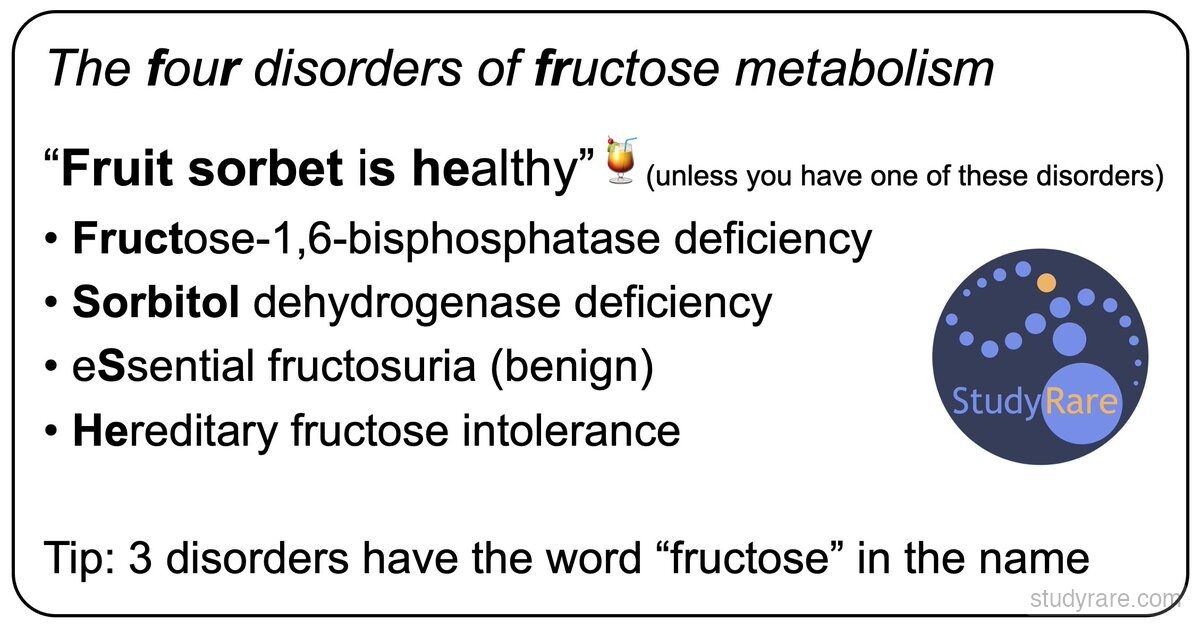
This table lists the four disorders of fructose metabolism: "Fruit Sorbet Is Healthy". Fructose-1,6-bisphosphatase deficiency, Sorbitol dehydrogenase deficiency, Essential fructosuria (benign), and Hereditary fructose intolerance.