X-linked adrenoleukodystrophy (X-ALD)
On ABGC's listListed on the ABGC Self-Study GuideLog in to starLast updated Nov 4, 2026
A 7-year-old boy with behavior changes and declining school performance develops vision and hearing loss. MRI shows posterior white matter changes. He has adrenal insufficiency.
X-linked; ABCD1 (ALDP, the peroxisomal membrane transporter that imports very long-chain fatty acids). Loss-of-function variants; most heterozygous females develop symptoms, so the disorder is not purely recessive.
ABCD1 encodes adrenoleukodystrophy protein (ALDP), an ATP-binding cassette transporter that carries very long-chain fatty acids (VLCFAs) into the peroxisome for beta-oxidation. Without it the fatty acids are not broken down and keep being elongated, so saturated VLCFAs, especially hexacosanoic acid (C26:0), accumulate in every tissue. The nervous system, adrenal cortex, and testicular Leydig cells are hit hardest, which matches the three main pictures: cerebral demyelination, myelopathy with neuropathy (AMN), and primary adrenal insufficiency. How VLCFA accumulation injures myelin or adrenal cells is not well understood.
Neither the VLCFA level nor the variant type predicts the phenotype. The same variant can produce every phenotype, and large deletions that remove the protein give the same range as missense variants with abundant protein. Boys found by newborn screening (C26:0-lysophosphatidylcholine on dried blood spots) therefore need scheduled adrenal testing, neurologic examinations, and brain MRI, because genotype cannot say who will develop cerebral disease. Hematopoietic stem cell transplantation works best in a boy with minimal but characteristic MRI changes and no symptoms; ex vivo gene therapy is an option for some. About 95% of probands inherit the variant, and at least 4% are de novo.
Part of the peroxisomal pathways.
Peroxisomal very long-chain fatty acid oxidation.
very long-chain fatty acids in the cytosol → ALDP transporter in the peroxisomal membrane (the block; ABCD1) → very long-chain fatty acids inside the peroxisome → peroxisomal beta-oxidation → shortened fatty acids
- Accumulates: saturated VLCFAs, especially C26:0, in plasma, and C26:0-lysophosphatidylcholine on newborn screening; elevated VLCFAs also occur in other peroxisomal beta-oxidation disorders, so ABCD1 testing is paired with them.
- Missing: peroxisomal breakdown of VLCFAs, which are instead elongated further.
- Workbook: 8.C. X-linked adrenoleukodystrophy (X-ALD)
- Childhood cerebral ALD: 4-10 years, rapid neurological decline, death in ~2 years
- Adrenomyeloneuropathy (AMN): Adult males, spastic paraparesis, peripheral neuropathy
- Adrenal insufficiency only: May precede neurological symptoms
- Female heterozygotes: Most develop myelopathy in adulthood, so they are not silent carriers
- On RUSP
| Feature | Hemizygous males | Heterozygous females |
|---|---|---|
| Adrenal insufficiency | About 80% over a lifetime, often the first sign in childhood | Under 1%; adrenal surveillance not indicated |
| Cerebral disease | 35 to 40% as boys, with additional adolescent and adult onset forms | Very rare |
| Myelopathy (AMN) | Nearly all by age 60, onset usually in the 20s to 30s | About 80% by age 60, onset usually after age 40 |
| Usual first symptom | Adrenal crisis or hyperpigmentation | Spastic gait, bladder urgency, sensory ataxia |
| Asymptomatic | Essentially none by later adulthood | Most before age 40, a minority after age 60 |
| Plasma VLCFA | Elevated in essentially all; diagnostic | Normal in 15 to 20%, so sequence ABCD1 to confirm |
Neither sex has a genotype-phenotype correlation: brothers with the same ABCD1 variant can have childhood cerebral disease and isolated adult myelopathy.
- Elevated VLCFA (very long-chain fatty acids), ABCD1 testing
- HSCT (early cerebral disease)
- Lorenzo's oil (prevention questionable)
- Adrenal replacement
- Gene therapy
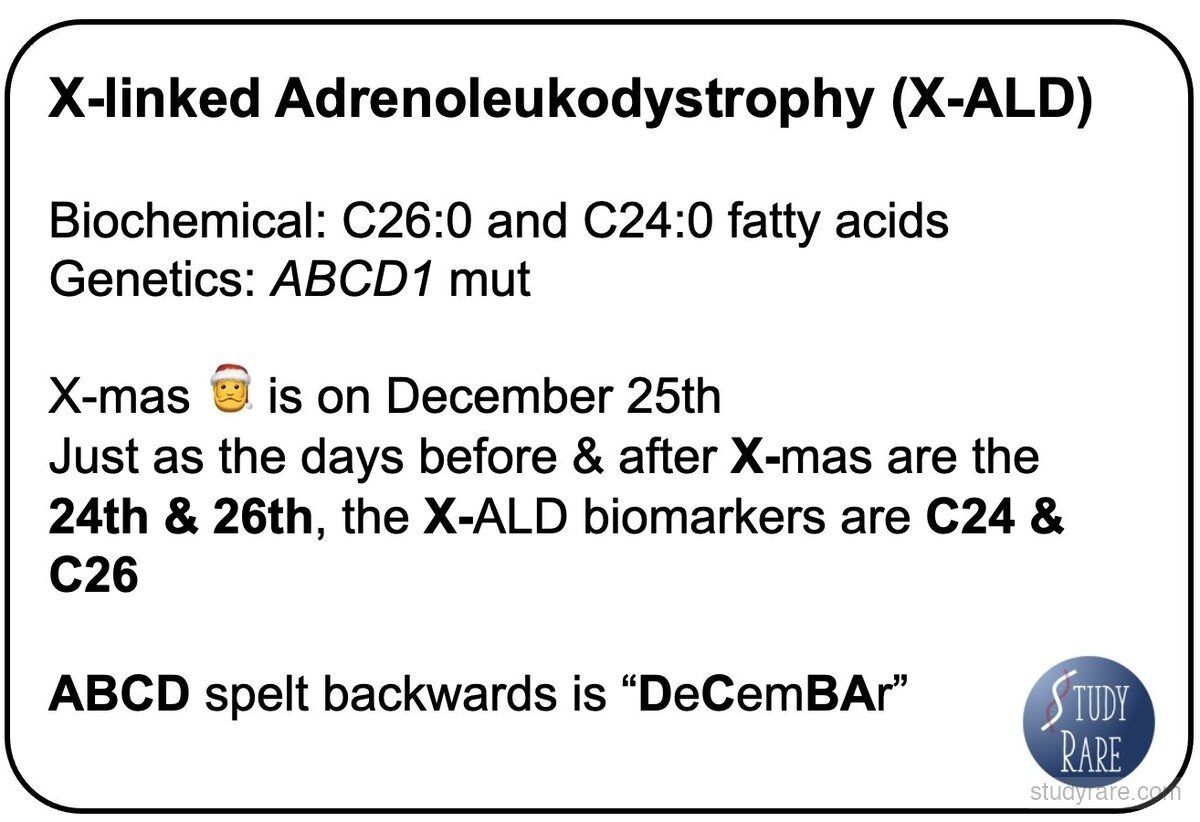
ABCD1, "DeCemBAr 25th": ABCD spelled backwards is "DeCemBAr." Think about the day before and after Christmas: C24 and C26 are the VLCFA biomarkers for X-ALD. Also: "The Almighty was Born on Christmas Day."
"Veri long beta oxi in the peroxi": VLCFA cannot be transported across the peroxisome membrane for beta-oxidation, so they build up in adrenal glands (adrenal crisis), white matter of brain (leukodystrophy), and testes.
Part of HALO-M, the X-linked disorders: Hunter, Adrenoleukodystrophy, Lesch-Nyhan, OTC deficiency, Menkes.
This visual summarizes the X-ALD biomarkers (C26:0 and C24:0 fatty acids) and the "Christmas" mnemonic: ABCD spelled backwards is "DeCemBAr," and the days before and after Christmas (24th and 26th) give you the biomarker carbon chain lengths.