Last updated 4mo ago
A newborn presents at 1 week of age with jaundice, hepatomegaly, and E. coli sepsis after starting breast milk or formula. Cataracts are noted on exam.
AR; GALT (galactose-1-phosphate uridyltransferase)
- Toxic accumulation of galactose-1-phosphate
- Acute: Hepatomegaly, jaundice, coagulopathy, E. coli sepsis, cataracts
- Long-term (even with treatment): Developmental delay, ovarian failure, speech problems
- On RUSP
- On RUSP: flagged by elevated total galactose and elevated galactose-1-phosphate
- Confirmation: deficient GALT erythrocyte enzyme activity (do before transfusion) plus biallelic GALT variants
- Urine reducing substances positive, glucose-negative dipstick; genotype distinguishes classic (G/G) from benign Duarte (D/G)
- Galactose-free diet (avoid lactose)
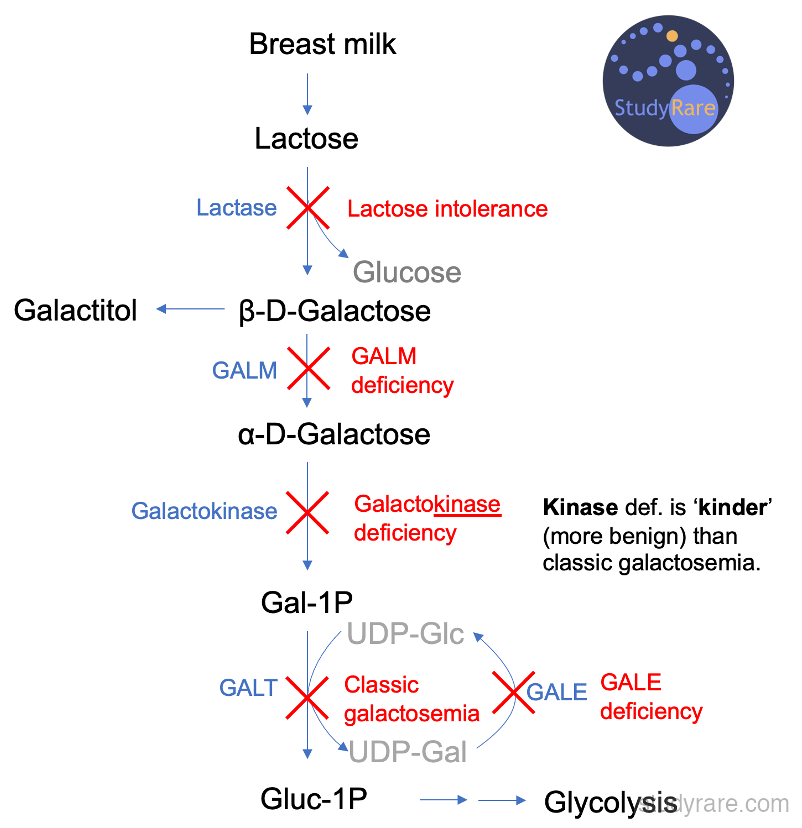
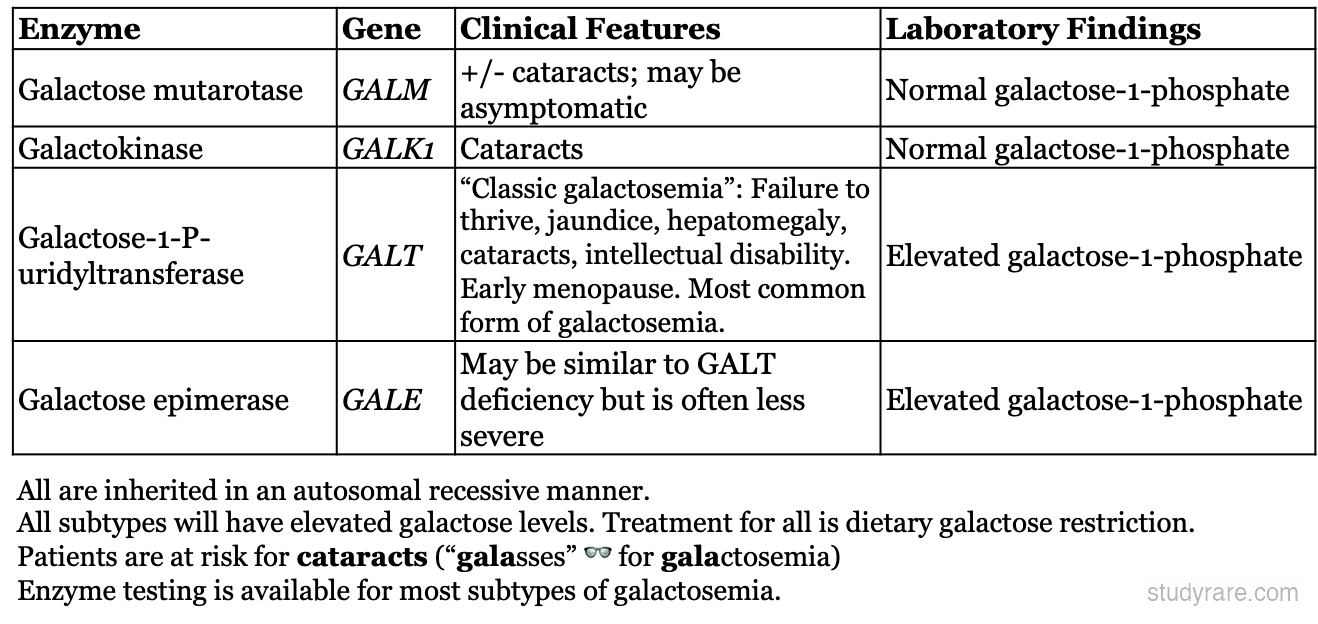
"Galactosemia" colloquially refers to classic GALT-deficient galactosemia, but the term covers four enzymes in the Leloir pathway plus a mild GALT allelic variant:
| Subtype | Gene / Enzyme | Clinical phenotype | Newborn screening |
|---|---|---|---|
| Classic galactosemia (Type I) | GALT (galactose-1-P uridyltransferase) | Severe: sepsis, hepatic failure, cataracts, long-term ID/POI even with diet | ✅ on RUSP |
| Galactokinase deficiency (Type II) | GALK1 (galactokinase) | Cataracts only (galactitol accumulation in lens), no liver, no ID | Not on RUSP; detected by elevated galactose without elevated Gal-1-P |
| Epimerase deficiency (Type III) | GALE (UDP-galactose-4-epimerase) | Spectrum: peripheral (benign, RBC-only) → intermediate → generalized (resembles classic) | Variable detection |
| GALM deficiency (Type IV) | GALM (galactose mutarotase) | Cataracts; recently described | Variable |
| Duarte (D2) variant galactosemia | GALT p.N314D in cis with a 4-bp 5'UTR deletion (D2 haplotype) | Compound heterozygote with a classic GALT pathogenic variant gives ~25% residual GALT activity ("D/G" genotype). Generally clinically benign; most US centers do not restrict diet | Often flagged on NBS; confirmatory enzyme + genotype distinguishes D/G from G/G classic |
Key teaching points:
- Galactokinase deficiency presents with isolated cataracts: same lens-galactitol mechanism, but no upstream Gal-1-P toxicity, so the liver and brain are spared
- GALE deficiency can mimic classic galactosemia (generalized form) or be a benign incidental finding (peripheral form, RBC-restricted)
- Duarte (D/G) babies are frequently identified by NBS and historically were placed on lactose restriction; current evidence (e.g., the TIDE study) does not support routine diet restriction in D/G
"Galac-see-mia needs Galasses": bilateral cataracts from galactitol accumulation in the lens. Also applies to galactokinase deficiency.
GALT: the enzyme name (galactose-1-phosphate uridyltransferase) sounds like a liver enzyme, and the liver is prominently affected (hepatomegaly, jaundice, coagulopathy).
"HGTV": HIV/Herpes, Galactosemia, TB are absolute contraindications to breastfeeding. Galactosemia is the only inborn error of metabolism that is a contraindication to breastfeeding.
"Kinase = kinder": galactokinase (GALK1) deficiency causes cataracts only, much milder than classic GALT galactosemia. Same pattern in the fructose pathway: fructokinase (KHK) deficiency = essential fructosuria (benign) vs aldolase B = hereditary fructose intolerance (severe). The first kinase step is the kinder deficiency in both sugar pathways.