Cleidocranial dysplasia
Log in to starLast updated 4mo ago
Log in to add personal notes on this page.
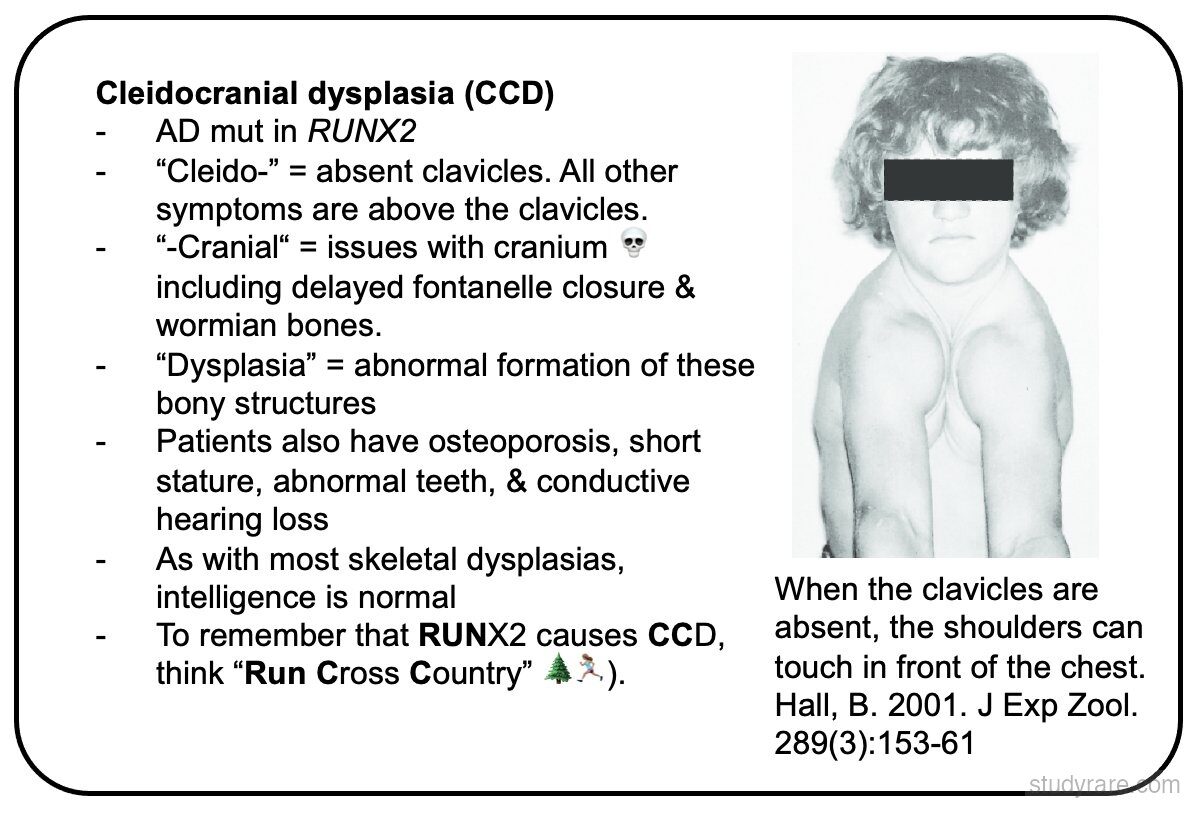
A child can bring his shoulders together in front of his chest ("opposing shoulders"). He has a large head with frontal bossing, delayed closure of fontanelles, and multiple dental abnormalities.
AD; RUNX2 (transcription factor for osteoblast differentiation)
- Absent or hypoplastic clavicles (hypermobile shoulders)
- Delayed closure of fontanelles and sutures
- Supernumerary teeth, delayed eruption of permanent teeth
- Short stature (mild)
- Wormian bones
- Clinical recognition: hypermobile shoulders (clavicular hypoplasia/aplasia), large head with open fontanelles, dental anomalies
- Radiographs: absent or hypoplastic clavicles, wide pubic symphysis, wormian bones, delayed ossification of skull sutures
- Panoramic dental imaging: supernumerary and unerupted teeth
- RUNX2 sequencing and deletion/duplication analysis confirms
- Dental: orthodontic and oral-surgical care for retained deciduous teeth, supernumerary teeth, and delayed eruption; staged extraction and exposure of impacted permanent teeth
- Skull: monitor delayed fontanelle/suture closure; helmet protection in infancy when fontanelles remain widely open
- Orthopedic: surveillance for scoliosis, genu valgum, and recurrent dislocations; treat fractures as they arise
- Audiology and ENT follow-up for recurrent otitis media and hearing loss
RUNX2 causes Cleidocranial Dysplasia: think "Run Cross Country" for RUNX2 + CCD.
"Your Clavicles are Missing!" Cleidocranial dysplasia shares this finding with Yunis-Varon syndrome and Mandibuloacral dysplasia.
This overview shows the AD RUNX2 mutation, absent clavicles allowing opposing shoulders, delayed fontanelle closure, wormian bones, and the "Run Cross Country" gene mnemonic.