Last updated 1d ago
Log in to add personal notes on this page.
A newborn has a high-pitched, mewing cry that sounds like a cat. The infant has microcephaly, hypertelorism, and low birth weight. The cry normalizes by age 2.
- Terminal deletion of the distal short arm of chromosome 5 (telomeric end of 5p), hence the old shorthand "5p-"
- Deletion spans 5p15.2-p15.3, with two distinct critical regions: 5p15.3 for the high-pitched cat-like cry and 5p15.2 for the intellectual disability and dysmorphic features
- ~80% de novo terminal deletions; ~10–15% arise from unbalanced segregation of a parental balanced translocation (parental karyotypes therefore indicated)
- High-pitched "cat-like" cry (laryngeal hypoplasia) - fades with age
- Microcephaly
- Round face in infancy → long face in adulthood
- Intellectual disability (moderate to severe)
- Hypotonia
- Chromosomal microarray
- Parental karyotypes are indicated to detect a balanced translocation when the deletion is not a simple terminal de novo event
- Supportive and multidisciplinary; no targeted therapy
- Early intervention: physical, occupational, and speech therapy; developmental and educational support
- Feeding support for poor suck and reflux in infancy; monitor growth
- Surveillance and management of associated cardiac, orthopedic (scoliosis), and behavioral issues
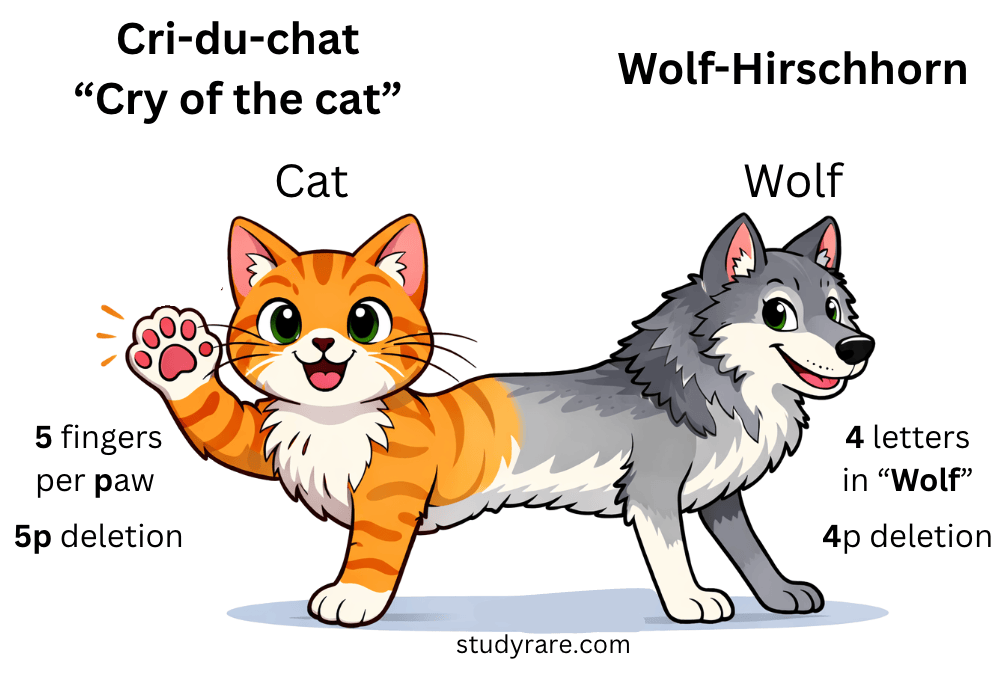
Cat = 5p, Wolf = 4p. Two terminal short-arm deletion syndromes paired by mnemonic. A cat has 5 fingers per paw (Cri du chat = 5p deletion). "Wolf" has 4 letters (Wolf-Hirschhorn = 4p deletion).