Last updated 1d ago
Log in to add personal notes on this page.
A newborn presents with a prominent glabella, hypertelorism, microcephaly, and hypotonia. She has seizures in the first week of life. A microarray reveals a deletion at 4p16.3.
- Deletion: 4p16.3 (variable size)
- Critical genes: NSD2 (formerly WHSC1), NELFCD (formerly WHSC2), LETM1 (seizure phenotype)
- ~85-90% de novo; ~10-15% inherited (parental translocation)
- Facial features: prominent glabella (forehead ridge between eyebrows), hypertelorism (wide-set eyes), high forehead → creates "Greek warrior helmet" appearance
- Microcephaly, intellectual disability (usually severe)
- Seizures (~90%)
- Growth restriction
- Congenital heart defects, cleft lip/palate
- CMA or FISH for 4p16.3
- Parental karyotypes are indicated to detect a balanced translocation, which accounts for ~10-15% of cases
- Supportive and multidisciplinary; no targeted therapy
- Seizure control with anti-seizure medications; seizures often improve with age
- Feeding support (frequently gastrostomy) for poor feeding and reflux; monitor growth
- Early intervention: physical, occupational, and speech therapy; developmental support
- Surveillance and management of associated cardiac, renal, ophthalmologic, and skeletal (scoliosis) anomalies
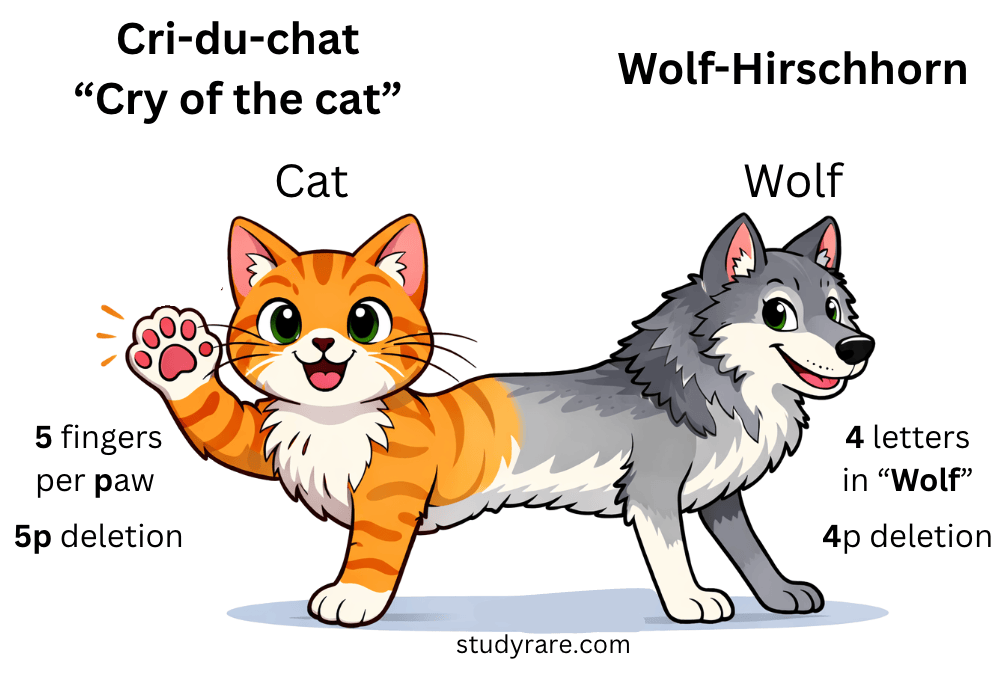
Cat = 5p, Wolf = 4p. Two terminal short-arm deletion syndromes paired by mnemonic. "Wolf" has 4 letters (Wolf-Hirschhorn = 4p deletion). A cat has 5 fingers per paw (Cri du chat = 5p deletion).