Last updated Nov 3, 2026
A 5-year-old with mild intellectual disability has an unusually friendly, outgoing personality and is notably talkative. His verbal abilities are relatively stronger than his visuospatial skills, though both are below age expectations. He has a history of infantile hypercalcemia and supravalvular aortic stenosis.
- Contiguous gene deletion at 7q11.23: 1.55 Mb (25 genes) in 90% to 95%, 1.84 Mb (27 genes) in 5% to 10%
- Haploinsufficiency of ELN (elastin) causes the arteriopathy
- Usually de novo; in about 25% of families, the parent in whom the deletion arose carries a 7q11.23 inversion
The deletion arises by nonallelic homologous recombination between the blocks of low copy repeats that flank the region, which is why most deletions are the same size. It removes one copy of about 25 genes, and the features that have been traced map to a few of them:
- ELN encodes elastin, the main structural protein of elastic fibers. Half the normal amount causes the elastin arteriopathy (supravalvular aortic stenosis, peripheral pulmonary stenosis, other arterial narrowing) and the connective tissue findings. ELN point variants alone cause autosomal dominant supravalvular aortic stenosis without the rest of the syndrome.
- GTF2I and GTF2IRD1, transcription factors at the telomeric end, go with the intellectual disability and the facial features: partial deletions that include ELN but spare GTF2I give the cognitive profile without intellectual disability.
- LIMK1, a kinase in neuronal migration, is implicated in the weak visuospatial construction.
- NCF1 is deleted in about 40%, and those individuals have a lower risk of hypertension.
Deletions larger than 2 to 4 Mb give lower cognitive ability. The cause of infantile hypercalcemia is not established; BAZ1B, which binds the vitamin D receptor, is a proposed candidate.
- Facies: periorbital fullness, stellate iris, wide mouth, full lips
- Cardiovascular: supravalvular aortic stenosis (SVAS), peripheral pulmonary stenosis
- Infantile hypercalcemia
- Intellectual disability with relative strength in language and facial recognition
- Hypersocial personality
- Connective tissue laxity (due to elastin deletion)
- Chromosomal microarray
- Cardiology surveillance for SVAS and arterial stenoses; serial echocardiography and blood pressure monitoring in all four limbs
- Caution with anesthesia given risk of sudden cardiac events with severe SVAS or coronary involvement
- Monitor serum and urine calcium; restrict vitamin D and excess calcium during infantile hypercalcemia
- Periodic blood pressure checks for renal artery stenosis and hypertension
- Endocrine surveillance (thyroid function, glucose tolerance, early puberty)
- Early intervention and educational support; behavioral support for anxiety and attention
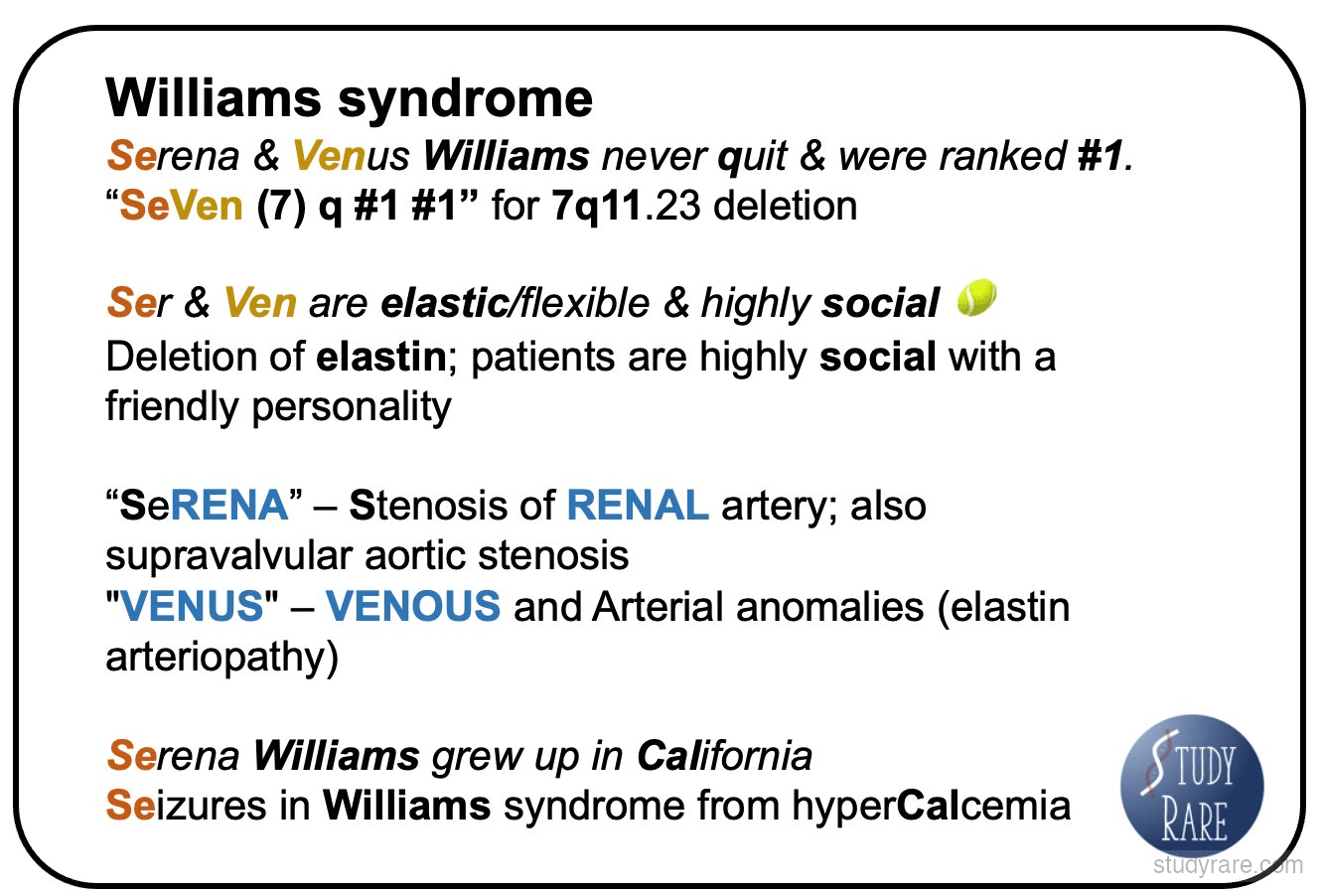
"Serena and Venus Williams" 🎾
- Del of chromosome "SeVen" q11.23
- "SeRENA" = Stenosis of RENAL artery; also supravalvular aortic stenosis
- "VENUS" = VENOUS and arterial anomalies
- WilliAMS = "Arteries Might Stenose" (elastin arteriopathy)
- Rotate the "W" 90 degrees to get an "E" for Elastin