Last updated 4mo ago
A 2-year-old boy is evaluated for absent speech and severe developmental delay. He has frequent episodes of laughter, an ataxic gait with arm-flapping, and refractory seizures. EEG shows characteristic large-amplitude slow spike-wave discharges.
- Loss of maternally expressed UBE3A at 15q11.2-q13
- Mechanisms:
- ~70% maternal deletion
- ~10% UBE3A variant
- ~3-5% paternal UPD
- ~3% imprinting center defect
- ~10% unknown/clinical diagnosis
- Severe developmental delay with absent/minimal speech
- Happy demeanor: frequent laughing/smiling
- Ataxia, arm-flapping gait
- Seizures (>80%)
- Microcephaly (postnatal onset)
- Sleep disturbance
- Methylation analysis → if abnormal: CMA/FISH
- If methylation normal: UBE3A sequencing
- Supportive and multidisciplinary; no disease-modifying therapy
- Seizure control with anti-seizure medications (valproate, clonazepam, levetiracetam); avoid carbamazepine, which may worsen seizures
- Management of sleep disturbance (behavioral measures, melatonin)
- Communication-focused therapy (augmentative/alternative communication), physical and occupational therapy for gait and motor delay
- Surveillance for scoliosis, constipation, and gastroesophageal reflux
"Angels have fluorescent tubes (halos)": the gene is UBE3A ("tube-3-A"). Maternal deletion of UBE3A is the #1 cause (~70%).
To remember the two most common causes, break the word "Angel-man" in half:
- 1st half ("Angel") = maternal deletion of UBE3A (the "girl" allele is eliminated), the #1 cause
- 2nd half ("man") = extra copy of the "man's" (paternal) chromosome (paternal UPD), the #2 cause
Pedigree tip ("Right-hand MAN"): For familial cases of AngelMAN or Beckwith-WiedeMANN, look to the right on the pedigree (where the mother is typically drawn), as familial cases are transmitted through the mother.
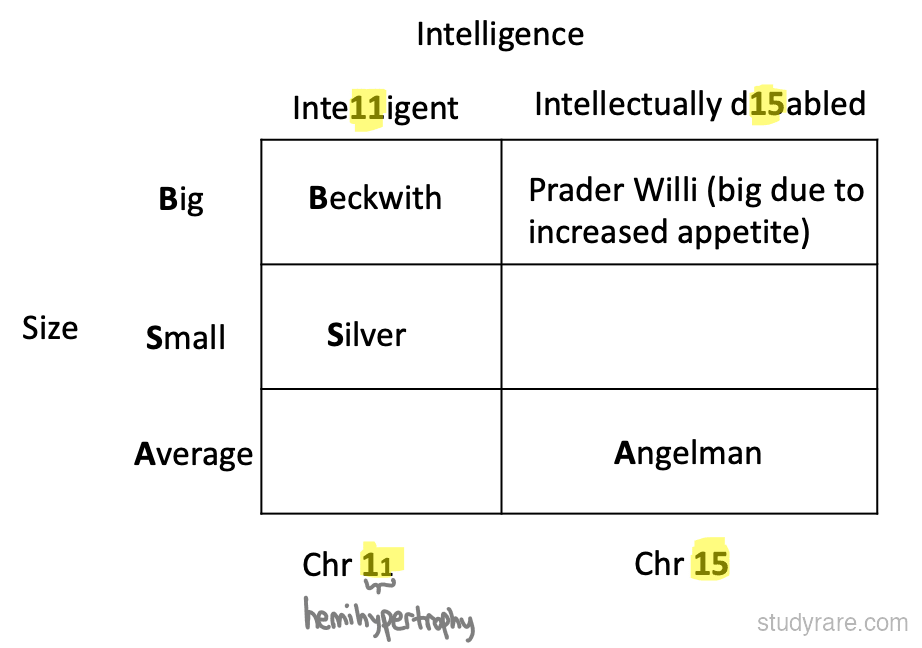
This chart compares the imprinting disorders by body size and intelligence, mapped to their chromosomal loci.