
Beckwith-Wiedemann syndrome
Log in to starLast updated 4mo ago
A newborn presents with macrosomia, macroglossia, and an omphalocele. The baby has ear creases and indentations. The geneticist recommends tumor surveillance.
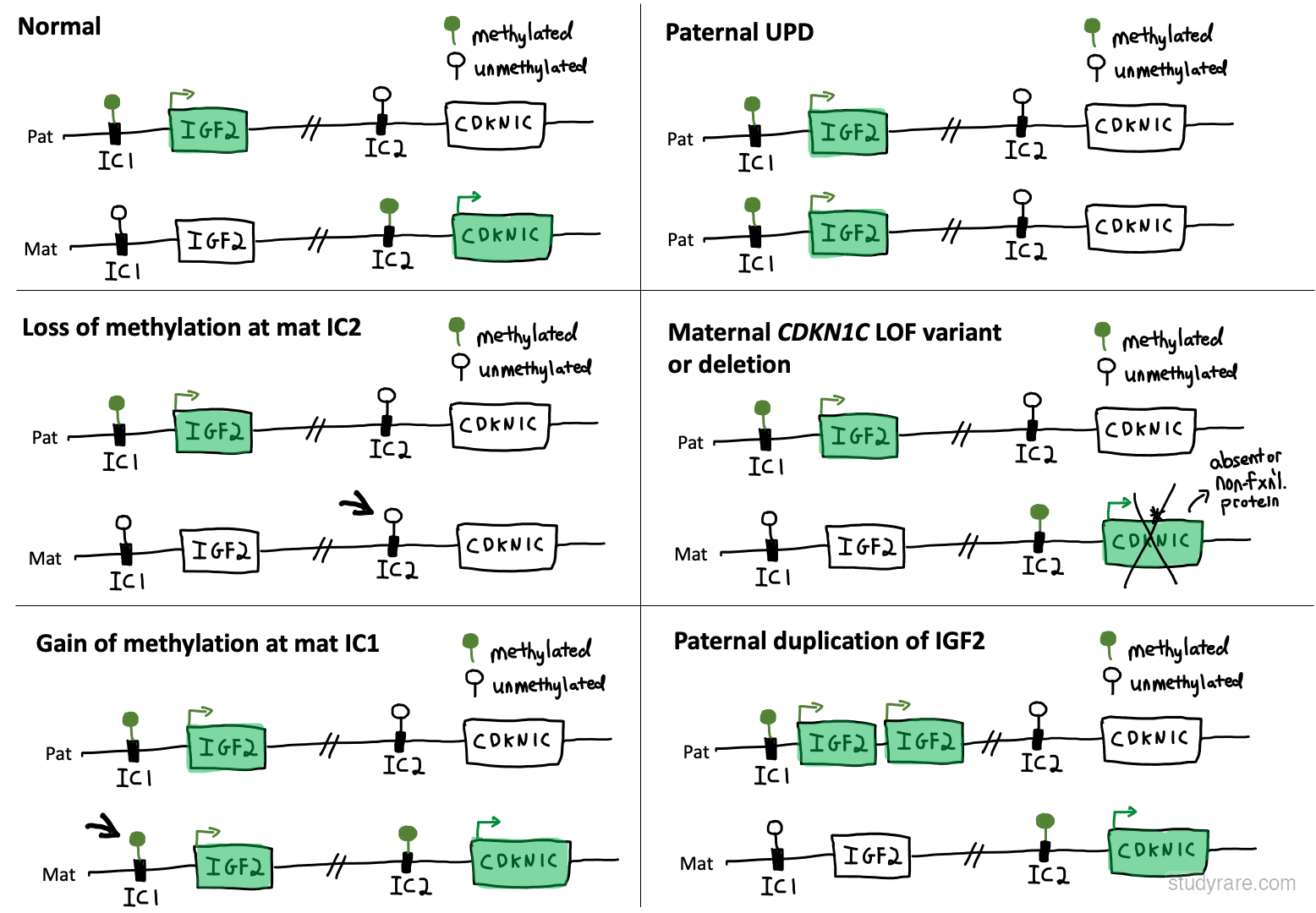
All four mechanisms below converge on the same imbalance at 11p15.5: IGF2 (paternally expressed, growth-promoting) > CDKN1C (maternally expressed, growth-suppressing) → overgrowth and tumor predisposition. IC1 gain of methylation amplifies IGF2; IC2 loss of methylation silences CDKN1C; paternal UPD does both; CDKN1C loss-of-function variants drop CDKN1C directly.
- IC2 loss of methylation (low CDKN1C): most common (~50%)
- Paternal UPD 11p15: mosaicism common (~20%)
- IC1 gain of methylation (high IGF2): highest tumor risk (~5%)
- CDKN1C variants: can be inherited (AD-maternal) (~5%)
- Macrosomia, macroglossia
- Abdominal wall defects (omphalocele, umbilical hernia, diastasis recti)
- External ear anomalies (creases, pits)
- Hemihyperplasia
- Neonatal hypoglycemia
- Embryonal tumor risk: Wilms tumor, hepatoblastoma
- First-line molecular test is methylation analysis of the 11p15.5 imprinting centers (MS-MLPA), which detects IC1 gain and IC2 loss of methylation plus copy-number changes in one assay
- MS-MLPA also flags paternal UPD 11p15 (both centers shifted); sequence CDKN1C if methylation is normal and clinical suspicion remains
- Mosaicism is common, so a normal blood result does not exclude the diagnosis; consider testing affected tissue (skin fibroblasts, or tumor) when blood is uninformative
- AFP and abdominal ultrasound every 3 months until age 4 (hepatoblastoma)
- Renal ultrasound every 3 months until age 8 (Wilms)
- Risk stratified by molecular subtype
"Biggie Smalls": Beckwith is Big (overgrowth), Silver-Russell is Small (undergrowth). Both map to chromosome 11p15. Intelligence is typically normal: "Inte11igent on Chr 11; intellectually d15abled on Chr 15."
Pedigree tip, "Right-hand MAN": For familial cases of Beckwith-WiedeMANN or AngelMAN, look to the right on the pedigree (where the mother is typically drawn), as familial cases are transmitted through the mother.