Last updated 2mo ago
A male infant is noted to have severe hypotonia at birth requiring nasogastric feeding. By age 4, his tone has improved and he now has an insatiable appetite, food-seeking behaviors, rapid weight gain. He has small hands and feet and almond-shaped eyes.
- Loss of paternally expressed genes at 15q11.2-q13
- Mechanisms:
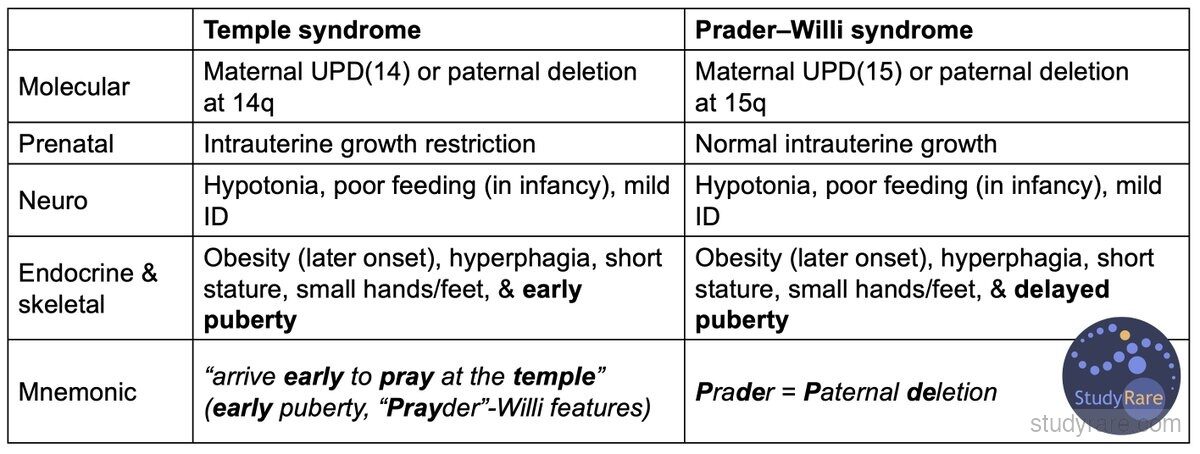
- ~70% paternal deletion (15q11.2-q13) (Pra-der = Paternal deletion)
- ~25% maternal uniparental disomy (UPD)
- ~2-5% imprinting center defect
- Neonatal hypotonia and feeding difficulties
- Hyperphagia and obesity (begins age 2-4)
- Hypogonadism
- Small hands and feet
- Characteristic facies: almond-shaped eyes, thin upper lip
- Mild intellectual disability
- Behavioral: temper outbursts, OCD features, skin picking
- Methylation analysis (detects all mechanisms)
- If abnormal: FISH/CMA (deletion) and UPD studies to determine mechanism
- Growth hormone therapy improves growth, body composition, and tone (sleep study before and during treatment)
- Strict caloric restriction and supervised, locked food access to manage hyperphagia and prevent obesity
- Sex hormone replacement for hypogonadism; monitor for scoliosis and osteoporosis
- Early intervention: physical, occupational, and speech therapy; developmental and educational support
- Behavioral and psychiatric management; structured environment for food security and outbursts
- Compare with Angelman syndrome, the maternally derived counterpart at the same locus
- P = Paternal allele deletion is the Primary (#1) cause (~70%). (Pra-der = Paternal deletion.)
- W = tWo Maternal alleles (uniparental disomy): #2 cause (~25%).
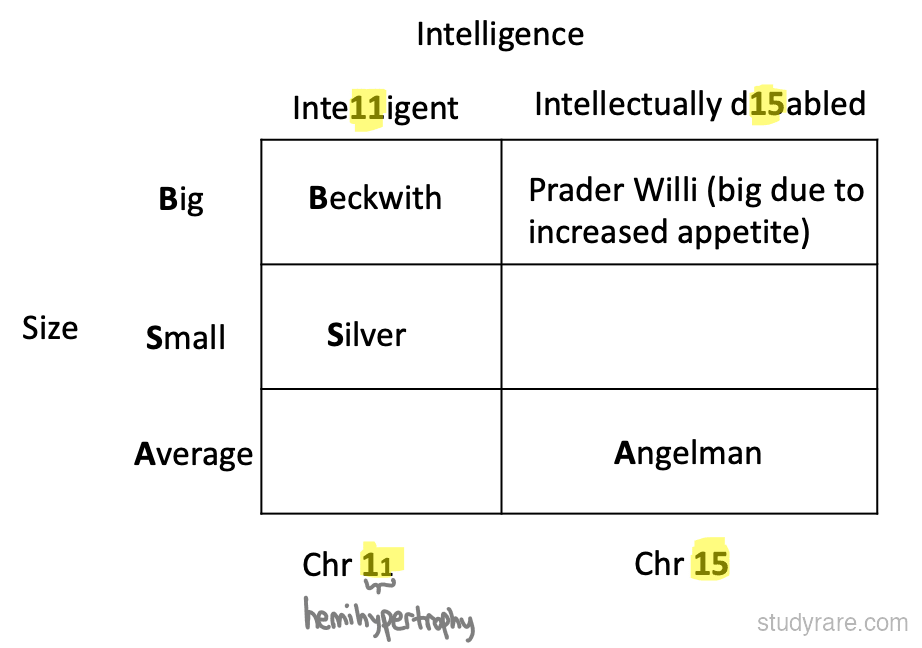
11p15 vs 15q11: The letter p or q "points" toward the 5 in each locus. BWS/Silver-Russell = 11p15; PWS/Angelman = 15q11.
Chr 11 vs Chr 15: "Inte11igent on Chr 11; intellectually d15abled on Chr 15." Patients with chromosome 11 imprinting disorders (BWS, Silver-Russell) have normal intelligence, while those with chromosome 15 imprinting disorders (PWS, Angelman) have intellectual disability.
This comparison table highlights the overlap between Temple syndrome (maternal UPD 14/paternal deletion at 14q) and Prader-Willi syndrome (maternal UPD 15/paternal deletion at 15q), including the key differentiator of early puberty in Temple vs delayed puberty in PWS.