Russell-Silver syndrome
Log in to starLast updated 4mo ago
A 3-year-old is evaluated for severe growth restriction since birth. He has a triangular face with a prominent forehead, body asymmetry (one leg shorter than the other), and clinodactyly of the 5th fingers.
- Heterogeneous:
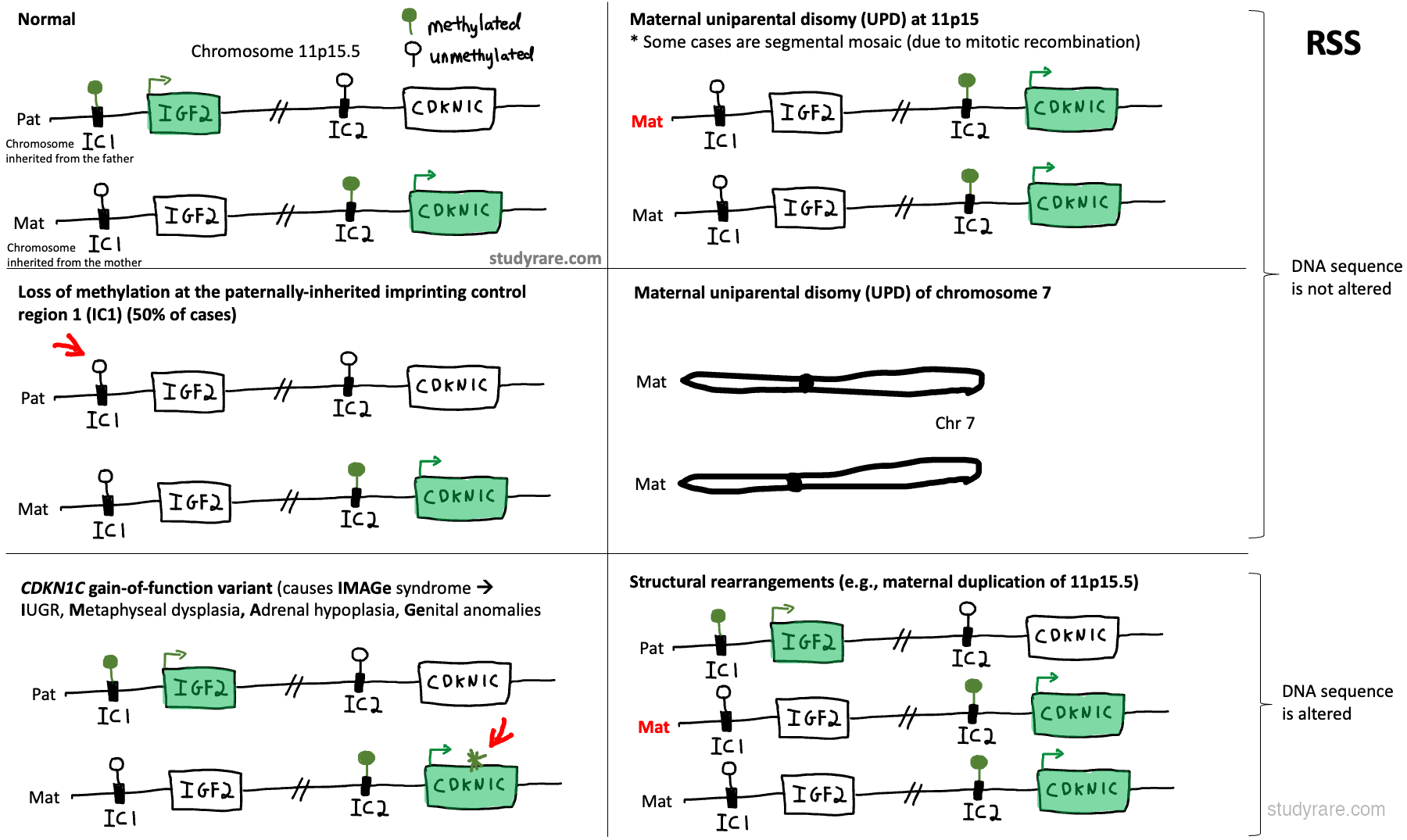
- ~40% IC1 hypomethylation at 11p15 (loss of paternal methylation)
- ~10% maternal UPD chromosome 7
- Other: 14q32 abnormalities, rare gene variants
- Severe intrauterine and postnatal growth restriction
- Relative macrocephaly (head sparing)
- Triangular face, prominent forehead
- Body asymmetry/hemihypoplasia
- Clinodactyly of 5th finger
- Feeding difficulties
- Normal intelligence (typically)
- Clinical diagnosis supported by the Netchine-Harbison clinical scoring system; molecular confirmation in a substantial fraction
- First-line molecular testing is methylation analysis of 11p15 (MS-MLPA) to detect IC1 hypomethylation, followed by UPD7 testing if 11p15 is normal
- A negative molecular result does not exclude the diagnosis when clinical criteria are met; consider broader testing (e.g., 14q32 imprinting, gene panels)
- Growth: dietary and feeding support for early failure to thrive; growth hormone therapy is established for short stature
- Endocrinology follow-up, including monitoring for hypoglycemia in infancy and managing the pace/timing of puberty
- Orthopedics for leg-length discrepancy from body asymmetry
- Developmental and educational support as needed
- RuS-SE-11 → 7-11: Russell-Silver involves chromosomes 7 (maternal UPD7) and 11 (11p15 hypomethylation), like the convenience store "7-Eleven"
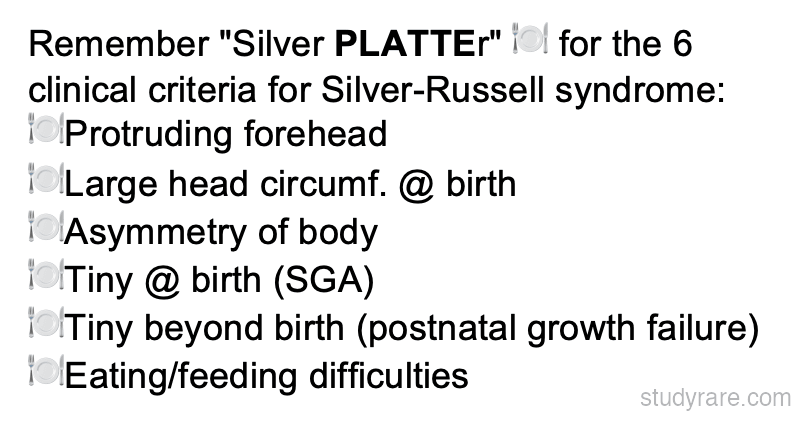
"Silver PLATTER": a memory aid for the Netchine-Harbison clinical criteria for Silver-Russell syndrome: Protruding forehead, Large head circumference at birth, Asymmetry of body, Tiny at birth (SGA), Tiny beyond birth (postnatal growth failure), Eating/feeding difficulties, Relative macrocephaly. Note that the Netchine-Harbison system has 6 formal criteria; the L and R letters both encode the single criterion of relative macrocephaly / large head at birth.
The molecular mechanisms of Russell-Silver syndrome involve dysregulation at the 11p15.5 imprinted region (IGF2/CDKN1C) and maternal UPD of chromosome 7.