
Cat eye syndrome
Log in to starLast updated Nov 3, 2026
A child is evaluated for iris colobomas and preauricular tags. CMA reveals a small supernumerary marker chromosome derived from chromosome 22.
- Supernumerary marker chromosome: inv dup(22)(q11.2) in more than 90%, usually dicentric
- Tetrasomy (two extra copies) or, less often, trisomy of 22pter→22q11.2, including the 1.5- to 2-Mb cat eye critical region
- Variable phenotype (due to mosaicism)
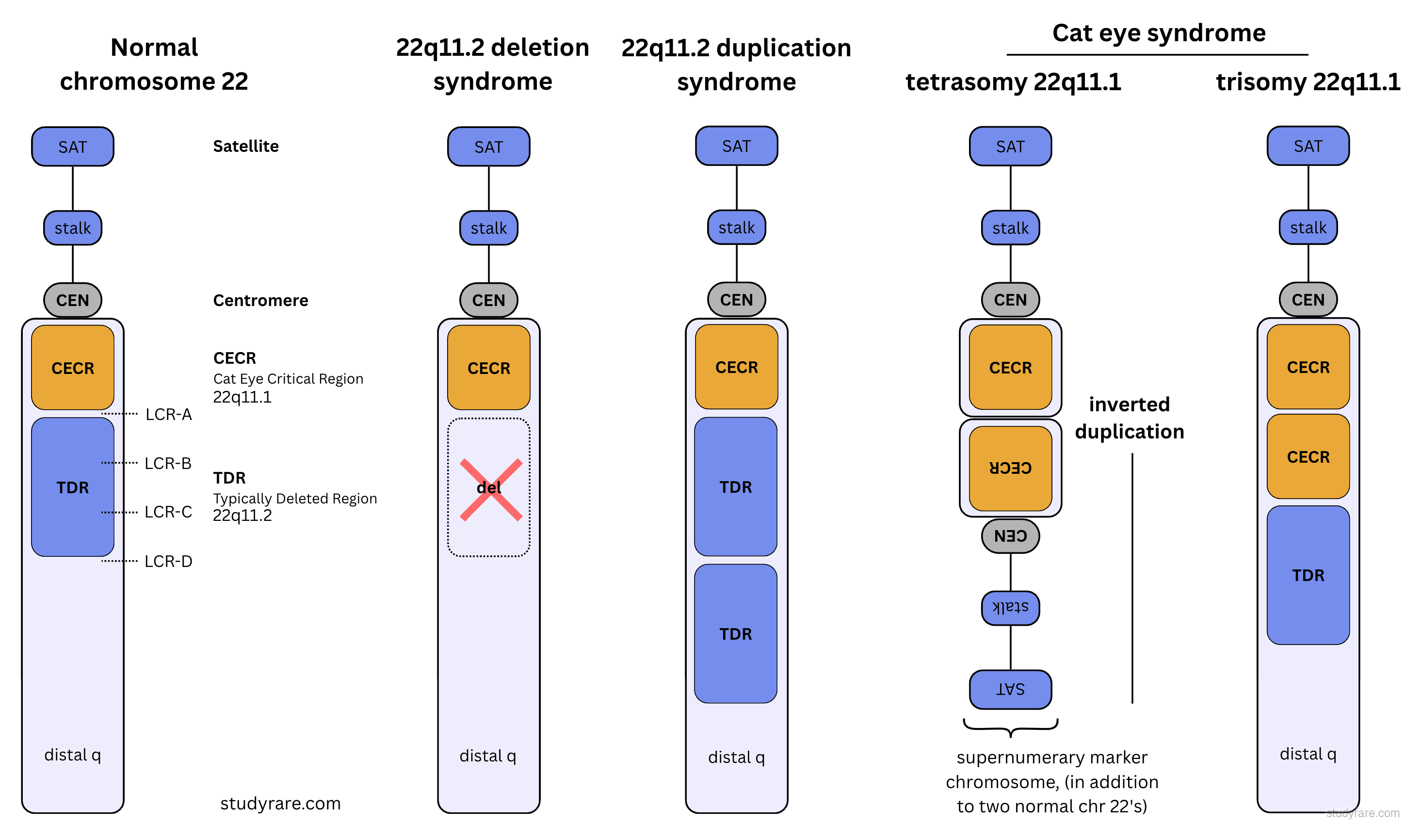
Cat eye syndrome is a dosage disorder: extra copies of the cat eye critical region at 22q11.1-q11.21, most often on a small marker that carries two extra copies, so the region is present four times. The marker usually arises de novo, when recombination between the low copy repeats that flank 22q11 produces a small extra chromosome during gametogenesis or early embryogenesis. Type 1 markers carry the critical region only; type 2 markers also carry the DiGeorge critical region, the same region whose loss causes 22q11.2 deletion syndrome.
- Dosage-sensitive candidates: overexpression of CECR2, a chromatin remodeling factor, may disrupt the development of neural crest-derived tissues. ADA2 (formerly CECR1), SLC7A4, and TXNRD2 are other candidates; none is proven.
- Mosaicism: when only some cells carry the marker, the dose effect is smaller and the picture milder and more variable. Low-level mosaicism can be missed on a blood karyotype.
- Marker size: there is no strict correlation, but larger markers tend to give more pronounced malformations.
Most cases are sporadic. A parent can carry the marker, often in mosaic form, and the recurrence risk is then up to 50%, so parental testing is indicated.
- Ocular coloboma (iris, retina)
- Preauricular tags/pits
- Anal atresia (some patients)
- Cardiac defects (TAPVR)
- Renal malformations
- Normal to mild intellectual disability
- Chromosomal microarray (CMA) detects the gain at 22pter→q11.2 and is the first-line test when a marker is suspected
- Karyotype with FISH (chromosome 22 probes) confirms the small supernumerary marker chromosome as inv dup(22) and characterizes its structure
- Mosaicism is common, so report the proportion of cells carrying the marker; a low-level marker on blood may be missed
- Echocardiogram for cardiac defects (TAPVR) and renal ultrasound for urinary tract malformations
- Ophthalmology evaluation for coloboma and vision monitoring
- Assessment for anal atresia and other anorectal anomalies in the newborn period
- Developmental monitoring with early intervention as needed
Remember "CCAATT": Cardiac anomalies, Coloboma, Anal Atresia, Tags (preauricular), Twenty-two (tetrasomy 22).