
Log in to add personal notes on this page.
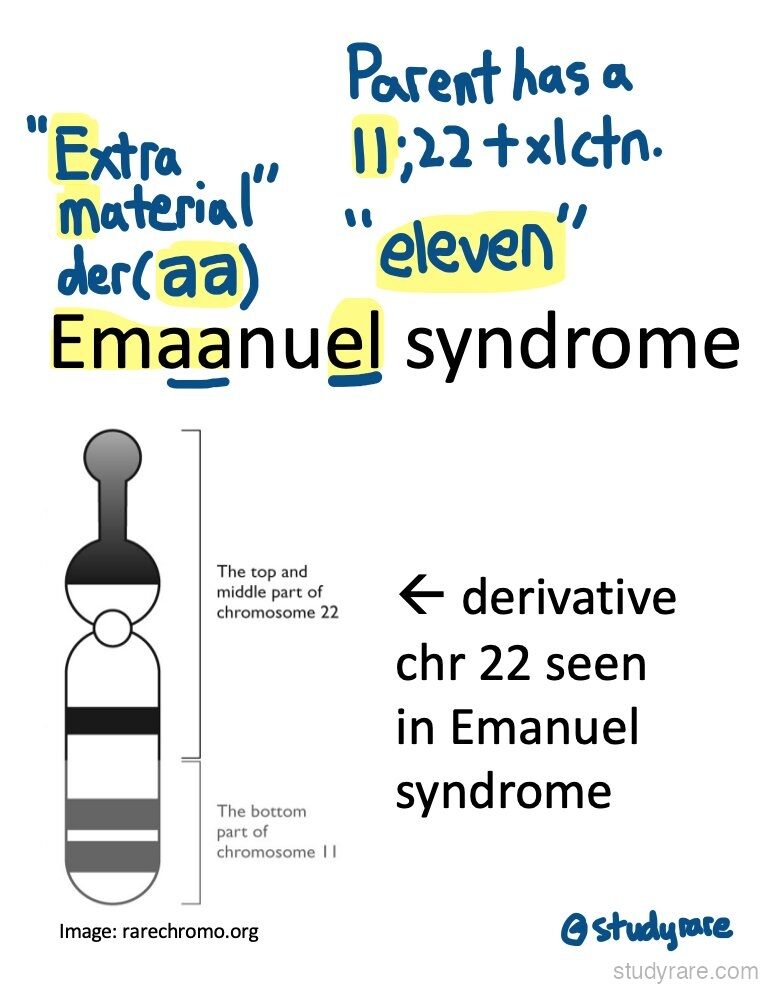
A newborn with micrognathia, ear anomalies, and a congenital heart defect is found to have 47 chromosomes. The extra chromosome is a derivative chromosome 22 containing material from chromosomes 11 and 22. The mother carries a balanced t(11;22) translocation.
Supernumerary der(22)t(11;22); patients have 47 chromosomes
- Results from 3:1 meiotic segregation in a parent carrying a balanced t(11;22)(q23;q11.2) translocation
- The extra derivative chromosome 22 contains the top/middle of chr 22 + bottom of chr 11
- The t(11;22) is the most common recurrent non-Robertsonian translocation in humans
- Intellectual disability (severe)
- Characteristic facial features: micrognathia, ear anomalies (preauricular tags/pits), cleft/high-arched palate
- Congenital heart defects
- Renal anomalies
- Genital anomalies in males
- Karyotype: 47,XX or XY,+der(22)t(11;22)
- CMA shows gains of 11q23→qter and 22pter→q11.2
- Always test parents for balanced t(11;22) translocation
- Multidisciplinary supportive care: echocardiogram for cardiac defects and renal ultrasound for urinary tract anomalies
- Feeding support for early failure to thrive; many infants need gastrostomy
- Early intervention, developmental therapies, and audiology evaluation for hearing loss
- Genetic counseling for the family, with carrier testing and reproductive options (prenatal diagnosis, preimplantation genetic testing) for the balanced t(11;22) carrier parent
"EManuEL = Extra Material from ELeven & 22": the name contains the key cytogenetic features: Extra Material from chromosomes ELeven and 22.
47 chromosomes: patients have a supernumerary (extra) derivative chromosome, giving them 47 total (vs normal 46).
Always check the parents: a parent carries the balanced t(11;22) translocation. Recurrence risk depends on the sex of the carrier parent (~5% if mother is carrier).