
Last updated 4mo ago
Log in to add personal notes on this page.
A 25-year-old woman on oral contraceptives develops a deep vein thrombosis. Her mother also had a DVT in her 30s.
AD; F5 c.1691G>A (Arg506Gln)
- Most common inherited thrombophilia in Caucasians (~5% carrier frequency)
- Activated protein C resistance
- Increased risk of venous thromboembolism (DVT, PE)
- Heterozygotes: 3-8x increased risk
- Homozygotes: 80x increased risk
- Risk enhanced by OCPs, pregnancy, other risk factors
- Activated protein C resistance assay is the functional screen; a low ratio prompts confirmatory genetic testing
- Targeted F5 genotyping for the c.1691G>A (Arg506Gln) variant confirms the diagnosis and distinguishes heterozygotes from homozygotes
- Testing is indicated after an unprovoked venous thromboembolism or VTE at a young age; routine population screening is not recommended
- Acute VTE: standard anticoagulation; duration guided by whether the event was provoked, recurrent, and zygosity
- Asymptomatic carriers do not need prophylactic anticoagulation but should weigh estrogen-containing contraceptives and receive thromboprophylaxis during high-risk periods (surgery, prolonged immobility, pregnancy/postpartum)
- Counsel on modifiable risk factors and signs of DVT/PE
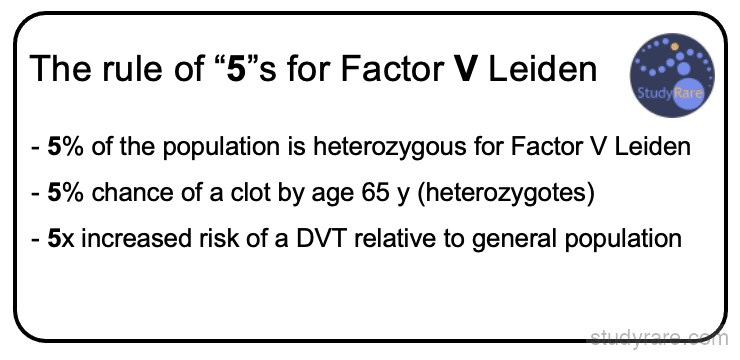
The rule of "5"s for Factor V Leiden: 5% of the population is heterozygous; heterozygotes have a 5% chance of a clot by age 65; if no prior history of a clot, 0.5% chance of DVT in pregnancy (5x increased risk of DVT in pregnancy).
Factor V Leiden = deep Vein thrombosis in the Leg: The "V" in the name reminds you of the clinical presentation. Turn the "V" 90 degrees to the right to get a "<" that looks like a "C" for resistance to protein C cleavage.