Last updated 4mo ago
A 4-year-old boy with autism and developmental delays has a long face and prominent ears. His maternal grandfather has tremor and balance problems.
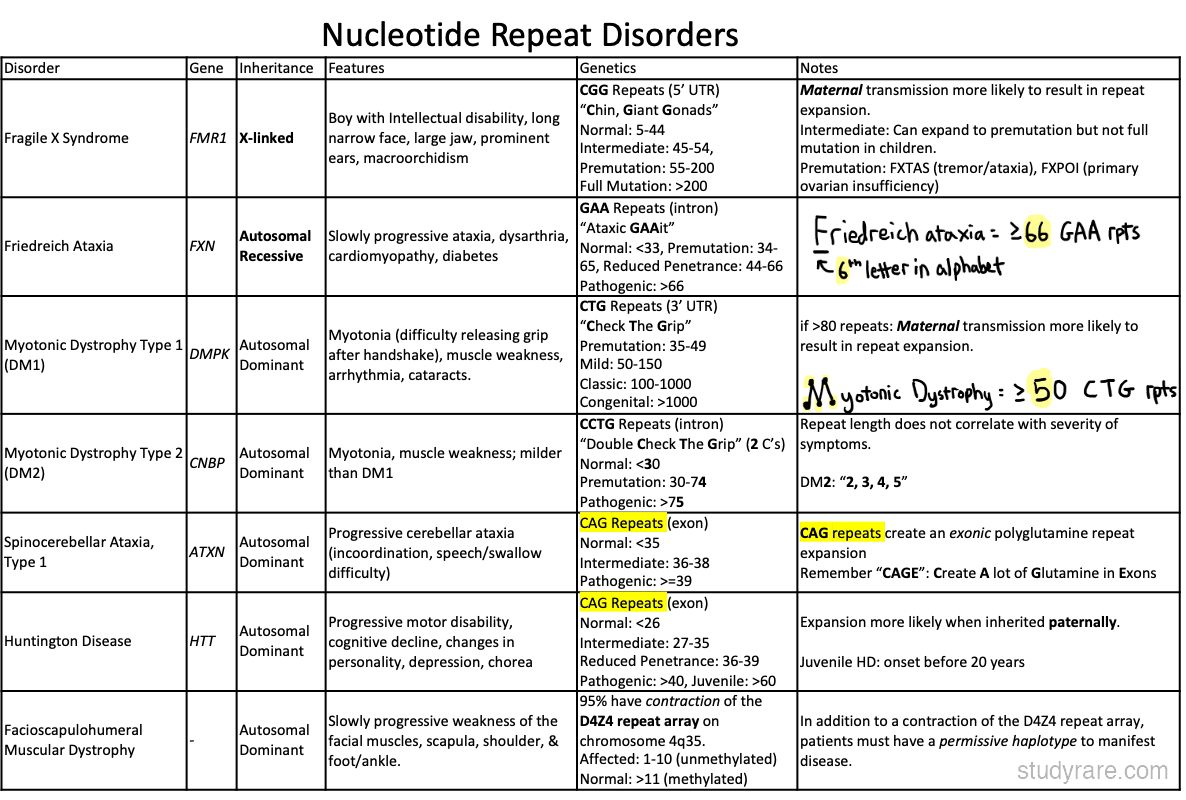
XLD; CGG repeat expansion in 5'UTR of FMR1
- Normal: 5-44 repeats
- Intermediate: 45-54
- Prevariant: 55-200 (risk for FXTAS, FXPOI)
- Full variant: >200 (hypermethylation of CpG island in promoter region → gene silencing)
- Exhibits [genetic anticipation] through maternal transmission (prevariant → full variant)
Males:
- Intellectual disability (moderate)
- Long face, prominent ears, prominent jaw
- Macroorchidism (postpubertal)
- Behavioral: autism, ADHD, anxiety, hand-flapping
Prevariant carriers (55-200 repeats):
- Females: Fragile X-associated primary ovarian insufficiency (FXPOI)
- Males (and some females): Fragile X-associated tremor/ataxia syndrome (FXTAS) - late onset
A late-onset neurodegenerative disorder of prevariant carriers (55-200 CGG repeats), distinct from Fragile X syndrome (full variant), which is caused by loss of FMRP. FXTAS is instead an RNA gain-of-function toxicity from elevated FMR1 mRNA containing the expanded CGG tract, which sequesters RNA-binding proteins and produces ubiquitin-positive intranuclear inclusions.
Who develops FXTAS:
- Predominantly males (~40% of male carriers >50 yrs); penetrance rises sharply with age
- A minority of female carriers (~8-16%); milder due to X-inactivation
- Risk increases with longer prevariant size (within the 55-200 window)
Clinical features:
- Progressive intention tremor and cerebellar ataxia (gait and limb)
- Parkinsonism, autonomic dysfunction (impotence, orthostasis), peripheral neuropathy
- Cognitive decline → executive dysfunction, eventual frontal-subcortical dementia
- Mood symptoms (anxiety, depression, irritability) often precede motor signs
Imaging:
- MCP sign: hyperintensity of the middle cerebellar peduncles on T2/FLAIR (highly characteristic)
- Generalized cerebral and cerebellar atrophy, splenium of corpus callosum hyperintensity
Counseling implications:
- Older male relatives of a Fragile X proband presenting with "atypical Parkinson disease," "cerebellar tremor," or "Lewy body dementia" should be tested for an FMR1 prevariant
- A maternal grandfather with tremor/ataxia is a classic family-history clue
FMR1 CGG repeat sizing and DNA methylation analysis
| Test | Method | Purpose |
|---|---|---|
| Repeat sizing | PCR + capillary electrophoresis | Normal (≤44) and prevariant (55-200) |
| Repeat sizing | Southern blot | Full variant (>200); detects mosaicism |
| Methylation analysis | Southern blot (methylation-sensitive restriction enzymes) | Confirms promoter hypermethylation |
| Methylation analysis | Methylation-sensitive PCR | Alternative methylation detection |
- The most severe symptoms happens in the presence of a full variant with complete promoter methylation. Patients with a full variant but "incomplete" DNA methylation have milder symptoms.
- No cure; supportive care with early developmental, behavioral, speech, and educational intervention
- Treat comorbid ADHD, anxiety, aggression, and autism features pharmacologically and behaviorally as indicated
- Surveillance for associated issues: recurrent otitis media, strabismus, seizures, connective-tissue features (joint laxity, mitral valve prolapse)
- Counsel female prevariant carriers about FXPOI (fertility, early menopause) and carriers about FXTAS risk; offer cascade testing and reproductive options including prenatal/preimplantation testing
Fragile X is all about 4's and 5's:
- 45-54 = intermediate range
- 55 or more = prevariant/variant
- 5' UTR location
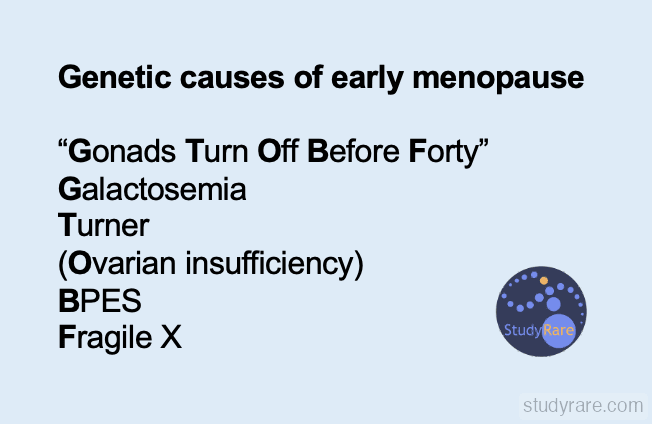
- Menopause before 40 = FXPOI
This table summarizes the major nucleotide repeat disorders including Fragile X, Friedreich ataxia, myotonic dystrophy, Huntington disease, and spinocerebellar ataxias.
Fragile X premutation carriers are at risk for primary ovarian insufficiency (FXPOI), one of several genetic causes of early menopause remembered with "Gonads Turn Off Before Forty."