
Neurological Disorders
Overview
This chapter covers the largest category of genetic disorders: conditions affecting the brain, spinal cord, peripheral nerves, and muscles. Key themes include:
Structural brain anomalies often present prenatally on ultrasound or MRI. Many are associated with syndromes and have specific gene associations (e.g., SHH in holoprosencephaly, ZIC2, SIX3).
Trinucleotide repeat disorders are a core concept. Key principles are anticipation (expansion across generations), parent-of-origin effects, and the difference between CAG (polyglutamine) repeats vs. non-coding repeats.
Neuromuscular disorders require understanding of dystrophin (DMD/BMD), repeat expansions (myotonic dystrophy), and SMN1 copy number (SMA).
Neurocutaneous syndromes (NF1, NF2, TSC) are tumor suppressor disorders with increased cancer risk.
Trinucleotide Repeat Disorders
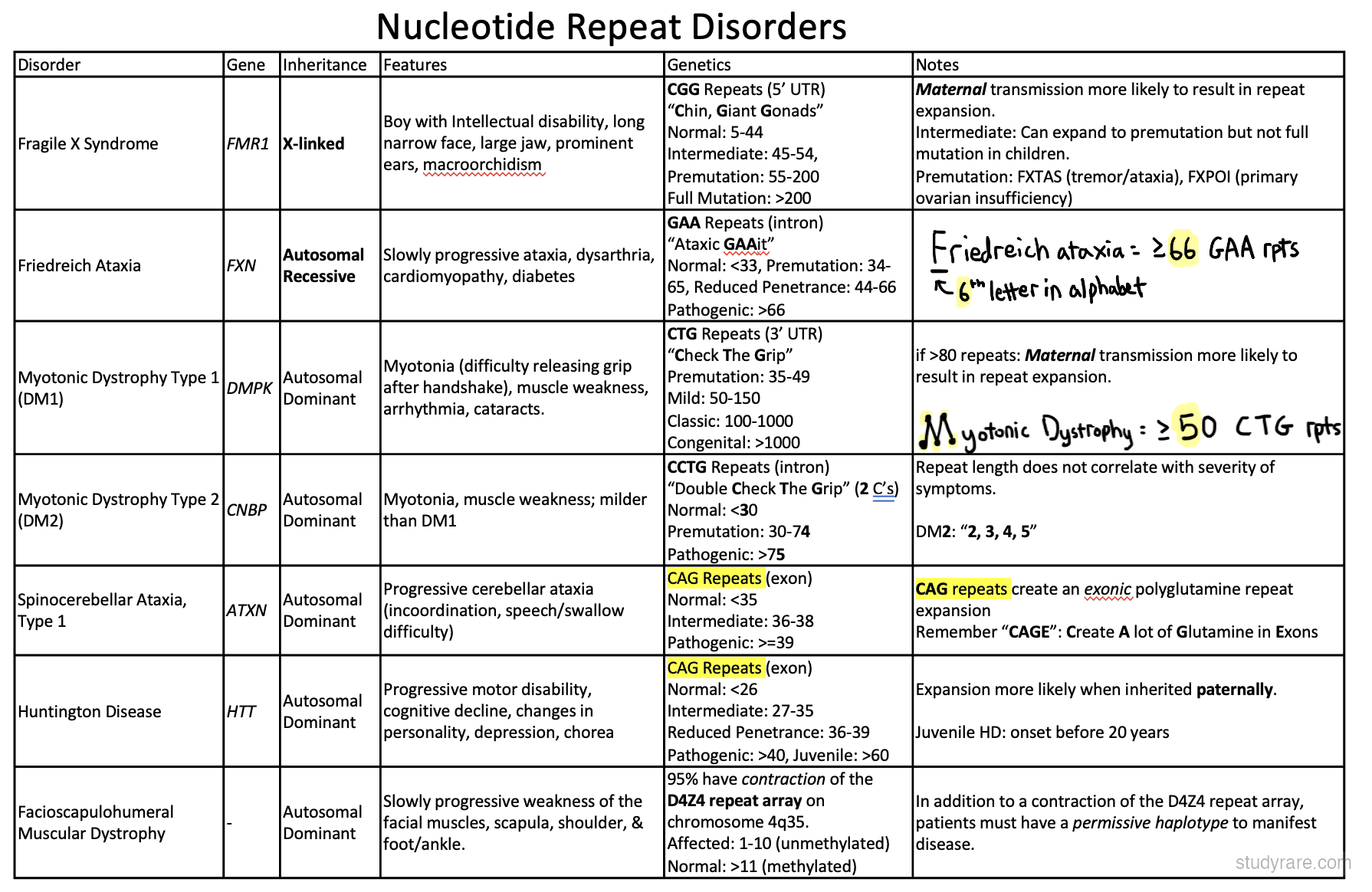
Anticipation: earlier onset and/or more severe phenotype in successive generations, driven by repeat expansion during gametogenesis.
Parent-of-origin: CAG repeats (Huntington, most SCAs) typically expand on paternal transmission. CGG (Fragile X) and CTG (DM1) expand on maternal transmission.
Inheritance: autosomal dominant for most (Huntington, the SCAs, DM1, DM2). Friedreich ataxia is the AR exception. Fragile X (FMR1) and SBMA / Kennedy disease (AR) are X-linked.
Coding vs non-coding: CAG sits in coding regions, producing toxic polyglutamine proteins (gain-of-function). Because they have to fit inside an open reading frame, pathogenic CAG expansions stay relatively short, typically ~36-100 repeats. CGG, CTG, CCTG, and GAA sit in untranslated or intronic regions and act through gene silencing or RNA toxicity; freed from that constraint, these expansions can balloon into the thousands (DM2 CCTG up to ~11,000; FXN GAA into the high hundreds; FMR1 CGG full mutations >200 and often >1,000). The size disparity is itself a teaching point: when you see a "thousands-of-repeats" expansion, the mechanism is almost never polyQ.
| Repeat | Location | Disorder |
|---|---|---|
| CAG | Exon (polyQ) | Huntington disease, SCAs 1/2/3/6/7, SBMA / Kennedy disease |
| CGG | 5′ UTR | Fragile X syndrome |
| CTG | 3′ UTR | Myotonic dystrophy type 1 |
| CCTG | Intron | Myotonic dystrophy type 2 |
| GAA | Intron | Friedreich ataxia |
Structural brain anomalies
These conditions involve abnormal brain development detectable on prenatal ultrasound or MRI. The key imaging findings (lissencephaly, holoprosencephaly, cobblestone cortex) link to specific genes. Many are associated with facial dysmorphisms; "the face predicts the brain" applies to midline defects like holoprosencephaly.
X-linked neurodevelopmental
These X-linked conditions predominantly affect males, with carrier females often showing milder features. Fragile X is a key trinucleotide repeat disorder with unique inheritance (anticipation through maternal transmission only). Rett syndrome is essentially exclusive to females because it's lethal in males. The characteristic physical and behavioral features help distinguish these conditions clinically.
Other X-linked neurodevelopmental conditions live elsewhere in the library, filed under the organ system their vignette centers on: Lesch-Nyhan syndrome under purine and pyrimidine disorders, oral-facial-digital syndrome type 1 under craniofacial disorders, and Lowe syndrome under genetic kidney disease. Craniofrontonasal syndrome is the inheritance-pattern exception worth flagging here: it's X-linked, but heterozygous females are affected more severely than hemizygous males, the opposite of every other condition on this page.
Autosomal recessive neurodevelopmental
These AR conditions often involve ciliopathy genes, meaning they share overlapping features and genetic heterogeneity. Joubert's "molar tooth sign" on MRI is pathognomonic. Many of these conditions have significant genetic heterogeneity, so the clinical features are more useful than any single gene.
Autosomal dominant neurodevelopmental
These AD conditions are usually de novo, so recurrence risk is low (but consider germline mosaicism). Many involve recognizable facial features or physical findings. CHARGE and Cornelia de Lange have clinical diagnostic criteria built on major and minor features.
Neurodegenerative - Ataxias
Hereditary ataxias cause progressive cerebellar dysfunction with gait instability, limb incoordination, and dysarthria. Friedreich ataxia (FXN, GAA repeat, AR) is the most common hereditary ataxia; it presents before age 25 with progressive gait ataxia, cardiomyopathy, and diabetes. Unlike the dominant SCAs, Friedreich does NOT show anticipation. The spinocerebellar ataxias (SCAs) are AD trinucleotide repeat disorders distinguished by their associated features: SCA1 (pyramidal signs), SCA2 (slow saccades), SCA3/Machado-Joseph (bulging eyes), SCA7 (retinal degeneration).
Neurodegenerative - Movement disorders
Inherited movement disorders that cause abnormal involuntary movements without prominent ataxia or dementia. Dopa-responsive dystonia (Segawa syndrome, GCH1) is the classic example: childhood-onset dystonia with diurnal worsening that responds dramatically to low-dose levodopa. Always trial L-DOPA in early-onset dystonia before assuming a non-treatable cause.
Neurodegenerative - Dementias
Dementia is a clinical symptom of progressive cognitive decline severe enough to interfere with daily functioning. It affects memory, thinking, language, judgment, and behavior (deMEMtia = MEMory loss). Dementia is a symptom, not a diagnosis - it can be caused by many conditions (Alzheimer's, FTD, vascular disease, Lewy body disease, etc.). Alzheimer's disease is the most common cause of dementia.
Also note that dementia represents a decline from a previously healthy baseline, while intellectual disability is present from early development.
| Feature | Dementia | Parkinsonism |
|---|---|---|
| What is it? | Clinical syndrome of progressive cognitive decline | Clinical syndrome of movement disorder |
| Core symptoms | Memory loss, language problems, impaired judgment, behavioral changes | Resting tremor, bradykinesia, rigidity, postural instability |
| Affects | Cognition (thinking, memory) | Movement (motor function) |
| Common causes | Alzheimer's, FTD, vascular, Lewy body, Huntington | Parkinson disease, Lewy body, MSA, PSP, drug-induced |
| Key point | Both are clinical symptoms, not diagnoses - must find underlying cause |
Note: Some conditions cause BOTH (e.g., Lewy body dementia, Huntington disease, some FTD subtypes)
Neurodegenerative - Motor neuron
Motor neuron diseases affect the neurons that control voluntary movements (e.g. arms, legs, and diaphragm). ALS involves both upper and lower motor neurons; SMA affects only lower motor neurons. SMA is on RUSP and is one of the few conditions with disease-modifying treatment (nusinersen, onasemnogene). SMN2 copy number influences the severity of SMA, and C9orf72 underlies the FTD-ALS spectrum overlap.
Neurodegenerative - Other
This section covers other neurodegenerative conditions that do not fit neatly into the above categories. These include DNA repair disorders (ataxia-telangiectasia, Cockayne) which have overlapping features like neurodegeneration, photosensitivity, and cancer predisposition.
Neurovascular
These conditions cause stroke-like episodes due to vascular abnormalities. CADASIL is the most common hereditary cause of stroke in adults - think of it when you see recurrent strokes in a young patient with migraine and white matter changes on MRI. MELAS (covered in metabolic chapter) also presents with stroke-like episodes but is a mitochondrial disorder.
Neuromuscular - Muscular dystrophies
Muscular dystrophies feature progressive muscle weakness and degeneration. DMD and BMD are allelic (same gene, different severity); the reading frame rule predicts phenotype. Look for Gowers sign (using arms to stand from floor) and highly elevated CK. DMD is the most common severe childhood form; BMD has later onset and slower progression.
Neuromuscular - Myotonic dystrophies
Myotonic dystrophies feature myotonia (delayed muscle relaxation) plus multi-system involvement. DM1 is another key trinucleotide repeat disorder with anticipation - unique features include maternal anticipation for congenital form, cataracts, and cardiac conduction defects. The "can't let go of handshake" is classic myotonia. DM2 is milder and lacks severe congenital form.
Peripheral neuropathies
Peripheral neuropathies affect the nerves outside the brain and spinal cord. CMT is the most common inherited neuropathy, with a notable duplication/deletion relationship (CMT1A = PMP22 duplication, HNPP = PMP22 deletion). Look for distal weakness, foot deformities (pes cavus), and "stork legs" appearance.
The peripheral nervous system is divided into somatic (movements what you can feel and control) and autonomic (involuntary actions like your heart rate and sweating) systems. Think of the autonomic nervous system as the 'automatic' nervous system (works without you having to think about it). As you are learning about this class of disorders, think about which branch of the peripheral nervous system is affected in each disorder.
Neuromuscular - Other
This section covers neuromuscular conditions that don't fit the above categories. Malignant hyperthermia is clinically critical because of its anesthetic implications: always ask about family history before surgery. Central core disease is allelic and associated with MH susceptibility.
Neurocutaneous syndromes
These conditions affect both nervous system ("neuro") and the skin ("cutaneous") due to abnormal cell growth/migration during development. NF1, NF2, and TSC are disorders due to loss of function of a tumor suppressor. Therefore, the risk of cancer in all 3 conditions is increased. Each has defined clinical diagnostic criteria, distinguishing features, associated tumor types, and surveillance recommendations.
Epilepsy syndromes
Genetic epilepsies often involve ion channel genes (channelopathies). These conditions often present in infancy/childhood with refractory seizures. The genetic diagnosis has direct treatment implications, as in the case of Dravet syndrome and avoiding sodium channel blockers.
BAFopathies (SWI/SNF complex disorders)
The BAF (mammalian SWI/SNF) chromatin-remodeling complex uses ATP hydrolysis to reposition nucleosomes and regulate transcription. Pathogenic variants in any of its many subunit genes produce overlapping neurodevelopmental phenotypes: intellectual disability, characteristic coarse facial features, and limb/digit hypoplasia (especially the 5th fingers and toes). Coffin-Siris syndrome (most often ARID1B) is the prototype; Nicolaides-Baraitser syndrome (SMARCA2) is the closely related sibling. Almost all cases are de novo. Recognize the BAFopathy gestalt (coarse facies + 5th-digit nail hypoplasia + corpus callosum abnormalities) and order a SWI/SNF gene panel.
Summary Table
| Disorder | Gene | Inheritance | Cardinal Features |
|---|---|---|---|
| Fragile X | FMR1 CGG repeat | XLD | ID, long face, macroorchidism, autism |
| Rett | MECP2 | XLD | Regression, hand stereotypies, females |
| MECP2 duplication | Xq28 dup | XLR | Severe ID, hypotonia → spasticity, recurrent infections (males) |
| Coffin-Lowry | RPS6KA3 | XLD | ID, coarse facies, tapered fingers, kyphoscoliosis |
| Menkes | ATP7A | XLR | Kinky hair, neurodegeneration, low copper/ceruloplasmin |
| Huntington | HTT CAG repeat | AD | Chorea, psychiatric, dementia, anticipation |
| SCAs | ATXN1/2/3/6/7 | AD | Cerebellar ataxia, anticipation (paternal CAG) |
| Friedreich ataxia | FXN GAA repeat | AR | Ataxia, cardiomyopathy, pes cavus |
| Ataxia w/ OMA (AOA1/2) | APTX, SETX | AR | Cerebellar ataxia + oculomotor apraxia; elevated AFP (AOA2) |
| Familial Alzheimer | APP, PSEN1/2 | AD | Early-onset dementia; APOE ε4 is risk factor |
| Familial Parkinson | LRRK2, SNCA, PARK2 | AD/AR | Parkinsonism, often younger onset |
| FTD | MAPT, GRN, C9orf72 | AD | Behavioral/language onset, ALS-FTD spectrum |
| ALS | SOD1, C9orf72 | AD | UMN + LMN degeneration, fasciculations, dysarthria |
| SMA | SMN1 deletion | AR | Hypotonia, fasciculations, preserved intellect |
| SBMA (Kennedy) | AR CAG repeat | XLR | Adult LMN-only, bulbar, gynecomastia, androgen insensitivity |
| Dopa-responsive dystonia | GCH1 | AD | Childhood dystonia, diurnal variation, levodopa response |
| DMD | DMD (out-of-frame) | XLR | Gowers sign, high CK, no dystrophin |
| BMD | DMD (in-frame) | XLR | Milder, ambulatory into adulthood, cardiomyopathy |
| LGMD | Sarcoglycans, calpain-3, others | AD/AR | Proximal weakness, elevated CK; some w/ cardiac |
| FSHD | D4Z4 contraction, SMCHD1 | AD | Facial weakness, scapular winging, asymmetric |
| Emery-Dreifuss | EMD, LMNA | XLR/AD/AR | Early contractures, conduction defects |
| OPMD | PABPN1 GCN repeat | AD | Late-onset ptosis, dysphagia |
| α-dystroglycanopathy CMD | POMT1, FKRP, others | AR | CMD + brain/eye anomalies (severe: Walker-Warburg) |
| Walker-Warburg | POMT1, others | AR | Cobblestone lissencephaly, CMD, eye anomalies (lethal) |
| Nemaline myopathy | NEB, ACTA1, others | AD/AR | Hypotonia, bulbar/respiratory weakness, nemaline rods on biopsy |
| Malignant hyperthermia | RYR1, CACNA1S | AD | Volatile anesthetic-triggered hyperthermia, rigidity |
| DM1 | DMPK CTG repeat | AD | Myotonia, cataracts, anticipation (maternal) |
| DM2 | CNBP CCTG repeat | AD | Proximal weakness, no congenital form, milder than DM1 |
| CMT1A | PMP22 dup | AD | Distal weakness, pes cavus, demyelinating NCS |
| HNPP | PMP22 del | AD | Pressure-induced focal neuropathies, recurrent |
| Familial dysautonomia | ELP1 | AR | Alacrima, autonomic crises, AJ founder |
| Holoprosencephaly | SHH, ZIC2, SIX3 | AD/sporadic | Midline brain/face defects; trisomy 13 association |
| Miller-Dieker | del 17p13.3 (LIS1) | Sporadic | Lissencephaly, severe ID, facial dysmorphism |
| DCX lissencephaly | DCX | XLD | Males: lissencephaly; females: SBH ("double cortex") |
| Periventricular nodular heterotopia | FLNA | XLD | Bilateral periventricular nodules, epilepsy; male-lethal |
| L1 syndrome | L1CAM | XLR | X-linked hydrocephalus, adducted thumbs, spasticity, ID |
| Bardet-Biedl | BBS genes | AR (ciliopathy) | RP, polydactyly, obesity, renal anomalies, ID |
| Joubert | AHI1, CEP290, others | AR (ciliopathy) | Molar tooth sign, hypotonia, abnormal breathing |
| Meckel-Gruber | MKS1, TMEM67, others | AR | Encephalocele + polycystic kidneys + polydactyly (lethal) |
| CHARGE | CHD7 | AD (de novo) | Coloboma, heart, choanal atresia, growth/dev, GU, ear |
| Cornelia de Lange | NIPBL, others (cohesin) | AD | Growth restriction, limb defects, synophrys, thin lips |
| Coffin-Siris | ARID1B, SMARCA4, BAF complex | AD | ID, 5th-digit nail/phalanx hypoplasia, coarse facies |
| Kabuki | KMT2D, KDM6A | AD/XLD | Arched eyebrows, long palpebral fissures, fingertip pads |
| Rubinstein-Taybi | CREBBP, EP300 | AD (de novo) | Broad thumbs/halluces, beaked nose, ID |
| Mowat-Wilson | ZEB2 | AD (de novo) | Hirschsprung, severe ID, uplifted earlobes |
| Pitt-Hopkins | TCF4 | AD (de novo) | Severe ID, hyperventilation/apnea, wide mouth |
| Phelan-McDermid | 22q13.3 del / SHANK3 | AD (de novo) | Autism, severe speech delay, hypotonia |
| Pallister-Hall | GLI3 | AD | Hypothalamic hamartoma, central polydactyly, bifid epiglottis |
| Cockayne | ERCC6, ERCC8 | AR | Cachectic growth failure, photosensitivity, neurodegeneration, NO cancer |
| CADASIL | NOTCH3 | AD | Recurrent strokes, migraine w/ aura, anterior temporal WMH |
| Familial CCM | KRIT1, CCM2, CCM3 | AD | Cavernous malformations, "popcorn" MRI, seizures |
| Sturge-Weber | GNAQ | Somatic mosaic | V1 port-wine stain, leptomeningeal angioma, glaucoma |
| NF1 | NF1 | AD | CAL spots, neurofibromas, Lisch nodules |
| NF2 | NF2 | AD | Bilateral vestibular schwannomas |
| TSC | TSC1/TSC2 | AD | Ash-leaf spots, tubers, rhabdomyomas |
| Dravet (SCN1A) | SCN1A | AD (de novo) | Prolonged febrile sz, refractory, avoid Na blockers |
| KCNQ2-related | KCNQ2 | AD | Benign familial neonatal seizures or encephalopathy |
| DEPDC5 epilepsy | DEPDC5 | AD | Familial focal epilepsy, focal cortical dysplasia (mTOR) |
| AHC | ATP1A3 | AD (de novo) | Alternating hemiplegia, episodes resolve with sleep |