Lowe syndrome (oculocerebrorenal syndrome)
Log in to starLast updated 1mo ago
A newborn boy has dense bilateral congenital cataracts and severe hypotonia with absent deep tendon reflexes. By 1 year of age, he develops glucosuria, generalized aminoaciduria, and a non-anion-gap metabolic acidosis. On slit-lamp exam, his mother has fine punctate lens opacities but is otherwise unaffected.
XLR; OCRL (encodes an inositol polyphosphate 5-phosphatase that regulates membrane trafficking); affects males almost exclusively
- Carrier females typically show punctate lens opacities on slit-lamp exam without other features, useful for confirming carrier status in an at-risk relative
- Allelic to Dent disease 2, a milder OCRL-related phenotype with isolated proximal tubulopathy and no cataracts or intellectual disability
Classic triad ("oculocerebrorenal"):
-
Eye: Dense bilateral congenital cataracts (essentially universal); infantile glaucoma (about 50%)
-
Brain: Congenital hypotonia with absent deep tendon reflexes; intellectual disability in nearly all, ranging from borderline to profound; behavioral problems, seizures
-
Kidney: Proximal renal tubular (Fanconi) dysfunction: low-molecular-weight proteinuria, generalized aminoaciduria, bicarbonate wasting/renal tubular acidosis, progressing toward chronic kidney disease
-
Cryptorchidism, joint hypermobility with later contractures, short stature, rickets from renal phosphate wasting
- Clinical triad in a male infant: dense congenital cataracts plus hypotonia plus proximal (Fanconi) tubulopathy
- Low-molecular-weight proteinuria is often the earliest detectable renal finding, sometimes present before overt Fanconi syndrome
- Molecular confirmation via OCRL sequencing
- Slit-lamp exam of the mother for punctate lens opacities supports carrier status and can help when the family history is unclear
- Dent disease (OCRL or CLCN5, X-linked): proximal tubulopathy and low-molecular-weight proteinuria without cataracts or intellectual disability. The milder allelic condition when caused by OCRL.
- Early cataract surgery; lifelong glaucoma surveillance
- Alkali and phosphate replacement, vitamin D for renal Fanconi syndrome and rickets
- Physical and occupational therapy for hypotonia; developmental and educational support
- Serial monitoring of renal function; progression to end-stage renal disease is common by adulthood
- Behavioral and psychiatric support as needed
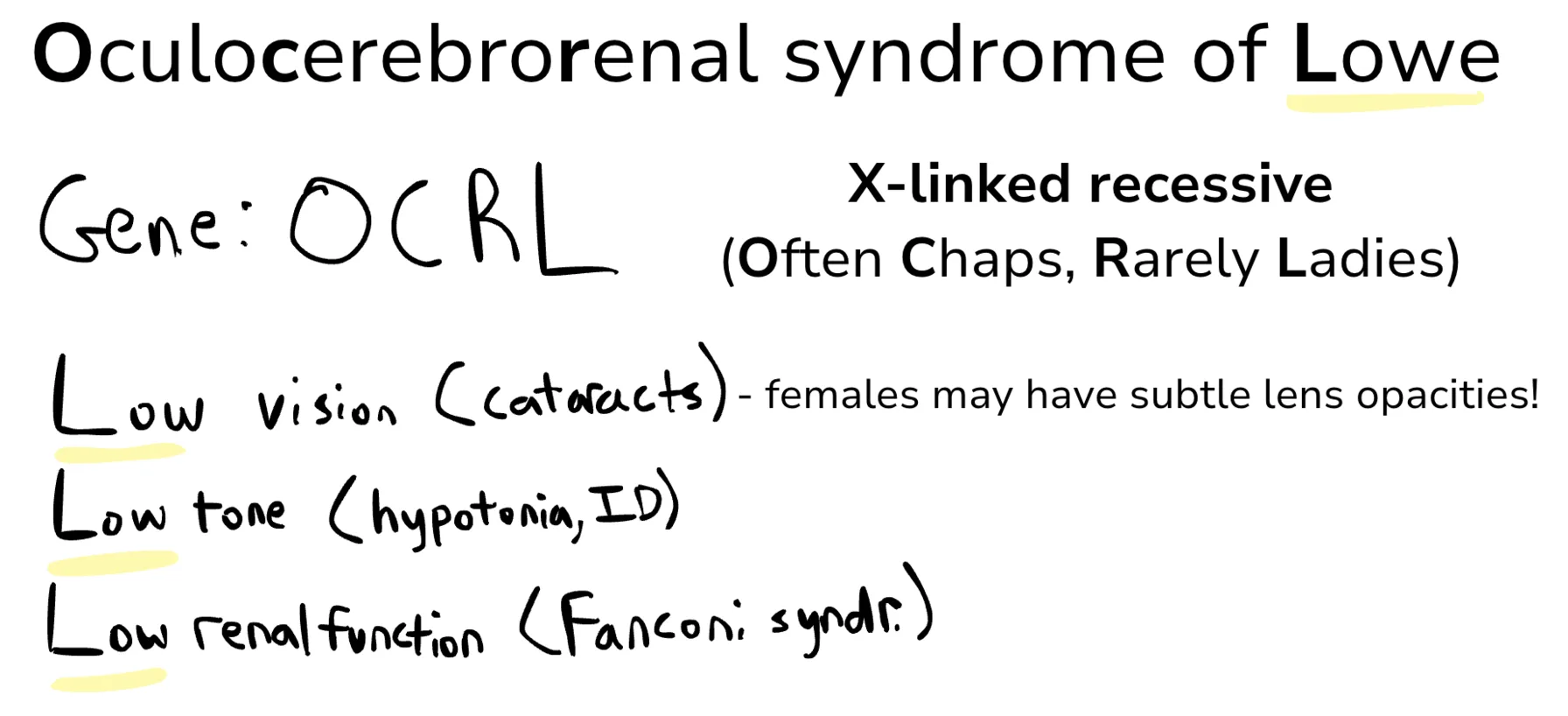
"LOWE" = three LOWs: Low vision (dense congenital cataracts), low tone (hypotonia, absent reflexes, intellectual disability), low renal function (Fanconi syndrome).
Gene OCRL = "Often Chaps, Rarely Ladies": X-linked recessive, so the disease is seen almost entirely in males; carrier females are usually unaffected (or only mildly, per the lens-opacity clue below).
Carrier clue: mom has "Lowe-grade" cataracts too. Punctate lens opacities on slit lamp mark OCRL carrier females even though they are otherwise unaffected.