
Kabuki syndrome
Log in to starLast updated 4mo ago
Log in to add personal notes on this page.
A child with intellectual disability has distinctive facial features including arched eyebrows with lateral flaring, long palpebral fissures, and eversion of the lower eyelids. He also has fingertip pads.
AD; KMT2D (>70%), KDM6A (XLD, ~5%)
- Distinctive facies: arched eyebrows with lateral sparseness, long palpebral fissures, eversion of lateral lower eyelids
- Persistent fingertip pads
- Short stature
- Intellectual disability (mild to moderate)
- Congenital heart defects, skeletal anomalies
- Clinical recognition of the distinctive facies plus supportive features
- Molecular confirmation by sequencing/deletion analysis of KMT2D and KDM6A (gene panel or single-gene testing)
- Echocardiogram, renal ultrasound, and audiology to define associated anomalies
- Multidisciplinary care: cardiology, nephrology/urology, audiology, ophthalmology, immunology
- Developmental and educational support; speech, occupational, and physical therapy
- Monitor for and treat recurrent otitis media and hearing loss; immune evaluation for recurrent infection
- Surveillance for feeding difficulties, growth, and endocrine issues (including premature thelarche)
"The K in Kabuki stands for Lysine": KMT2D (Lysine MethylTransferase) and KDM6A (Lysine DeMethylase) both involve lysine (single-letter amino acid code = K) modifications.
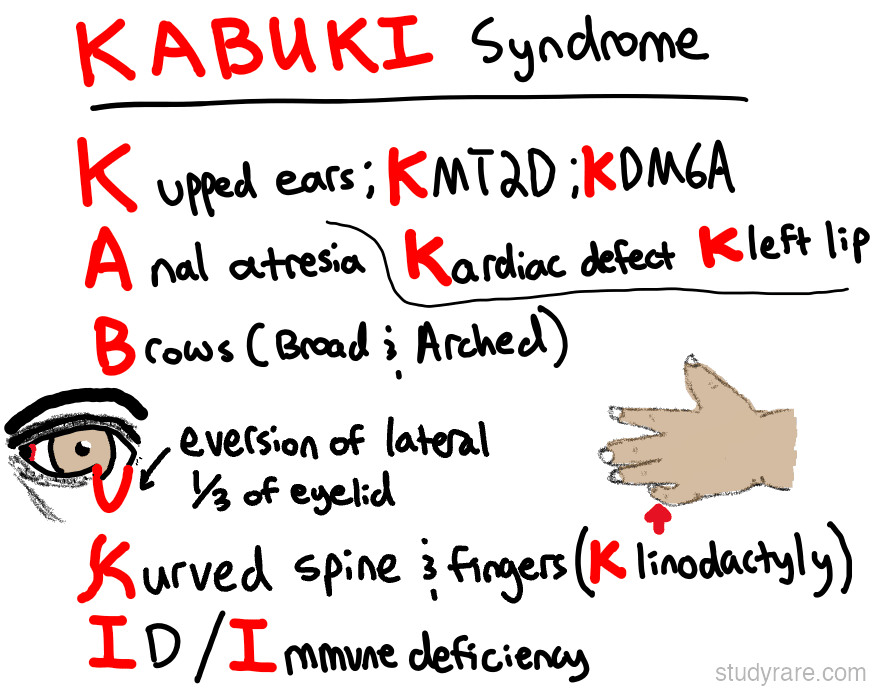
"KABUKI":
- K: Kupped ears with hearing loss / KMT2D / KDM6A / Kardiac anomalies / Kleft lip
- A: Anal atresia & GU anomalies
- B: Brows that are broad and arched / Brachydactyly with persistence of fetal fingertip pads
- U: Urogenital anomalies
- K: Kurved spine / Klinodactyly
- I: Intellectual disability / Immunologic deficits