Mowat-Wilson syndrome
Log in to starLast updated 4mo ago
Log in to add personal notes on this page.
A child with Hirschsprung disease, severe intellectual disability, and absent speech has distinctive facies with widely spaced eyes, broad nasal bridge, and uplifted earlobes.
AD (de novo); ZEB2 gene
- Distinctive facies: hypertelorism, broad nasal bridge, uplifted earlobes, pointed chin
- Hirschsprung disease (~50%)
- Intellectual disability (severe), absent/limited speech
- Seizures, microcephaly
- Congenital heart defects, genitourinary anomalies
- Clinical recognition of the distinctive facies with severe intellectual disability, often with Hirschsprung disease
- Molecular confirmation by ZEB2 sequencing and deletion/duplication analysis (most variants are de novo)
- Suction rectal biopsy to confirm Hirschsprung disease; echocardiogram, renal ultrasound, and brain MRI (corpus callosum)
- Surgical management of Hirschsprung disease; ongoing bowel and constipation management
- Antiseizure medication for epilepsy; developmental, speech, and physical therapy
- Cardiology, nephrology/urology, and ophthalmology surveillance for associated anomalies
- Genetic counseling: typically de novo with low recurrence risk (germline mosaicism reported)
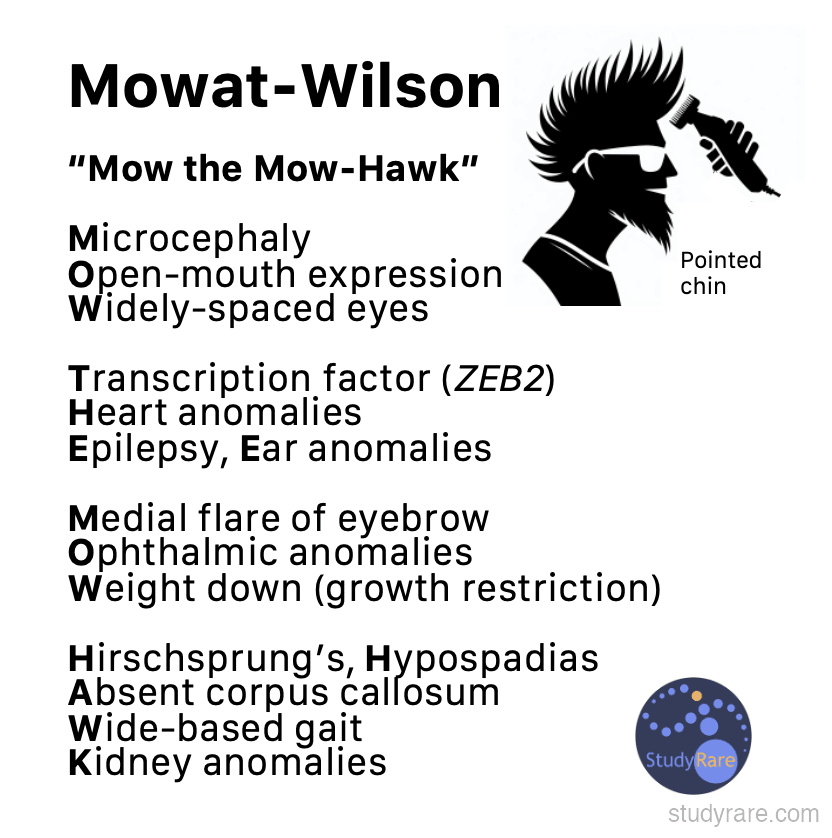
"Mow the Mohawk": Microcephaly, Open-mouth expression, Widely-spaced eyes, absent corpus callosum, Transcription factor mutation (ZEB2), weight down (growth restriction), Hirschsprung's & hypospadias, epilepsy, heart defects, kidney defects
"Zero Exit from Bowels in ZEB2": Hirschsprung disease (absent ganglion cells in colon) occurs in ~50% of patients.