Cornelia de Lange syndrome
Log in to starLast updated 4mo ago
Log in to add personal notes on this page.
A newborn has severe growth restriction, limb anomalies (absent forearm on one side), and distinctive facies with synophrys, a long philtrum, and thin lips.
AD (mostly de novo); NIPBL (~60%), SMC1A (XL), SMC3, RAD21, HDAC8. All are part of the cohesin complex, which holds sister chromatids together during cell division. Abnormal cell division → slower growth.
- Growth restriction (prenatal and postnatal)
- Limb abnormalities: oligodactyly to phocomelia (severe), small hands (mild)
- Characteristic facies: synophrys, long philtrum, thin downturned lips
- Hirsutism
- Intellectual disability (variable)
- GI issues (GERD common)
- Clinical diagnosis based on consensus criteria (cardinal facial features plus growth, limb, and developmental findings)
- Confirm with molecular testing, ideally a multigene panel covering NIPBL, SMC1A, SMC3, RAD21, HDAC8, and BRD4; mosaicism may require testing of a second tissue (buccal/fibroblast) when blood is negative
- Baseline evaluation: echocardiogram, hearing and ophthalmology assessment, and renal ultrasound
- Multidisciplinary developmental, speech, feeding, and behavioral support
- Aggressive treatment of gastroesophageal reflux (a major source of morbidity); monitor growth and consider gastrostomy for feeding difficulties
- Periodic cardiac, hearing, and vision surveillance; orthopedic care for limb and spine anomalies
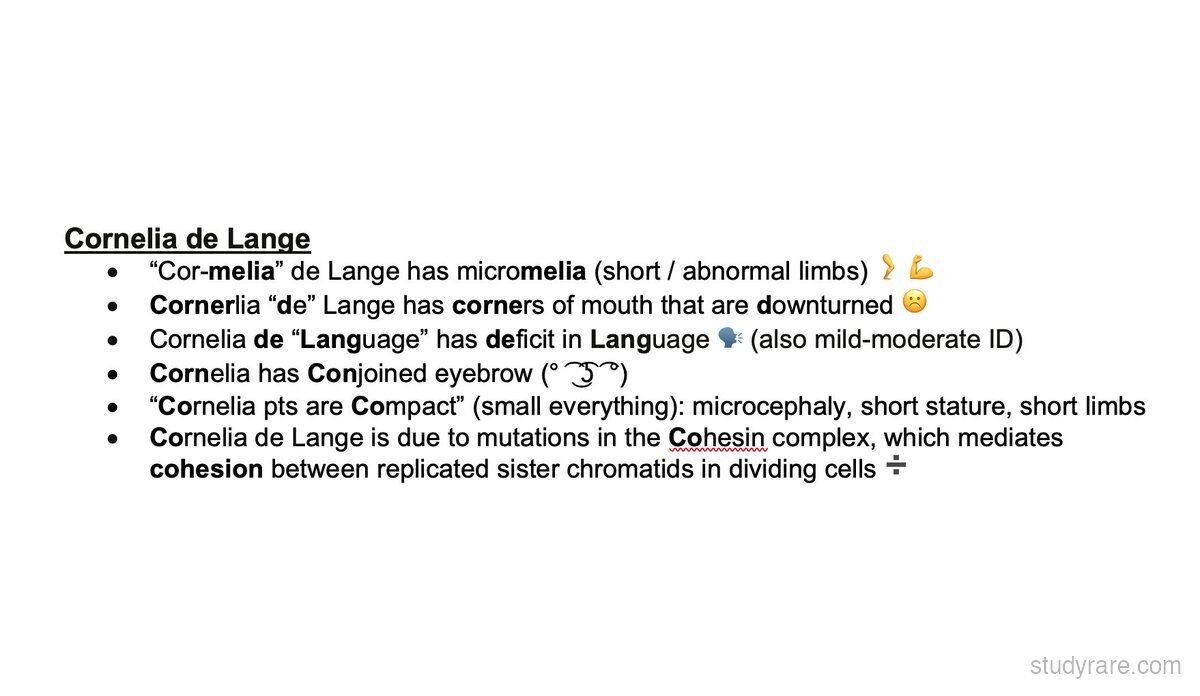
- "Cor-melia" de Lang has micromelia (short/abnormal limbs) and delayed Language (+ ID)
- Cornelia has Connected eyebrows (synophrys)
- "Cornelia patients are Compact" (small): microcephaly, short stature, short limbs
- Cornelia de Lange is due to variants in the Cohesin complex
- "Corner-li-a de Lange" has corners of lip that are downturned
This visual summarizes all CdLS mnemonics: micromelia, downturned mouth corners, language deficit, conjoined eyebrows, compact body habitus, and cohesin complex mutations.