
Last updated Nov 3, 2026
A second trimester ultrasound shows enlarged echogenic kidneys, occipital encephalocele, and postaxial polydactyly. Oligohydramnios is noted.
AR; ciliary transition zone genes (TMEM67, also called MKS3, about 16%; MKS1 about 7%, but about 70% in Finland; CEP290, RPGRIP1L, CC2D2A, and others); biallelic, usually null, variants. Known genes explain only 50% to 60% of cases.
The primary cilium is a microtubule-based projection from the cell surface that receives chemical and mechanical signals, and it is thought to be a hub for developmental pathways such as sonic hedgehog and Wnt. Many Meckel-Gruber proteins sit in the transition zone at the base of the cilium, where they form the "MKS-JBTS module" that controls which proteins enter and leave. Disrupting it mislocalizes signaling proteins such as Smoothened, and Meckel-Gruber genes cause defective hedgehog signaling in mouse models. How this yields each feature is still unresolved.
Phenotype is allele-specific, which is how the same genes also cause Joubert syndrome:
- Severe versus milder alleles: CC2D2A null alleles give Meckel-Gruber while missense variants give Joubert; homozygous truncating RPGRIP1L variants give Meckel-Gruber while missense variants are prevalent in Joubert; every MKS1 variant reported in Meckel-Gruber is null.
- MKS1: more polydactyly, occipital encephalocele, and bone dysplasia; most Finnish cases share one founder variant ("Finn major").
- TMEM67: the most frequent cause; brain malformation and polydactyly are less frequent than with MKS1.
- Classic triad:
- Occipital encephalocele
- Polycystic kidneys (bilateral, enlarged)
- Postaxial polydactyly
- Oligohydramnios (due to renal failure)
- Lethal (usually in utero or neonatal)
- Allelic to Joubert syndrome (milder)
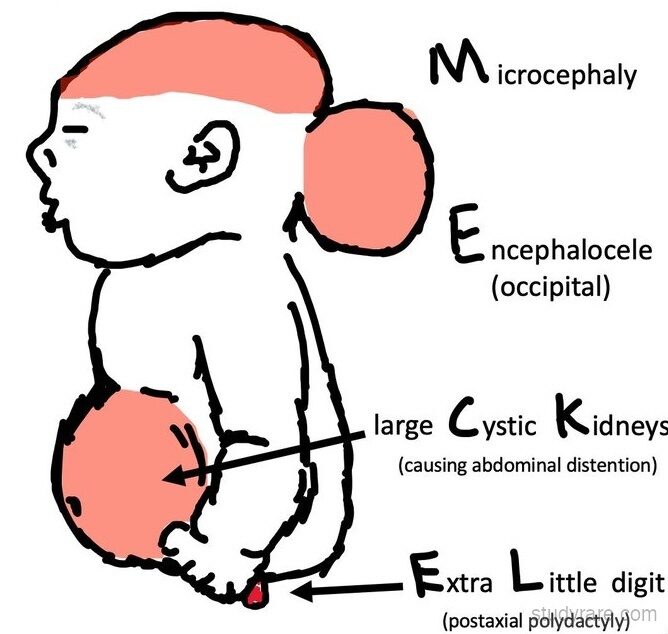
- Prenatal ultrasound: enlarged echogenic/cystic kidneys, occipital encephalocele, and postaxial polydactyly, often with oligohydramnios
- Fetal MRI can further characterize the CNS malformation
- Confirm with molecular testing of the ciliopathy genes (MKS1, TMEM67, CEP290, and others); identifying the variants enables prenatal/preimplantation testing in future pregnancies
- AR inheritance: 25% recurrence risk; offer carrier testing to the parents
- Supportive
"MECKEL": Microcephaly, occipital Encephalocele, Cystic Kidneys, Extra Little digit (postaxial polydactyly, next to the pinky, the "littlest digit")