Oculopharyngeal muscular dystrophy (OPMD)
Log in to starLast updated Nov 3, 2026
A 50-year-old French-Canadian man presents with progressive bilateral ptosis and difficulty swallowing. He tilts his head back to see and has lost weight due to dysphagia. His father had similar symptoms starting in his 40s.
AD; PABPN1 (poly(A) binding protein nuclear 1); GCN repeat expansion that lengthens a polyalanine tract (likely a toxic gain of function)
- GCN trinucleotide repeat expansion in exon 1
- Normal: 10 repeats; pathogenic: 11-18 repeats (older papers counted these as 6 and 7-14, or as pure GCG repeats)
- French-Canadian and Bukharan Jewish founder populations
- About 10% have two expanded alleles (homozygous or compound heterozygous): earlier onset, more severe
PABPN1 encodes an abundant nuclear protein that binds the poly(A) tails of mRNAs, travels with RNA polymerase II during transcription, and escorts finished transcripts through the nuclear pore. It also works in polyadenylation, splicing, and RNA decay. Every GCN codon encodes alanine, so the expansion lengthens the protein's polyalanine stretch from 10 to 11-18 residues.
- Polyalanine toxicity (likely gain of function): the expanded protein aggregates in muscle nuclei, the intranuclear tubular filaments seen in 5%-15% of muscle fiber nuclei, and is degraded inefficiently. The inclusions disturb expression of mRNA processing genes and splicing.
- Loss of function is an emerging second explanation, with normal protein pulled into the aggregates.
- Repeat size and dose: in heterozygotes, a longer repeat gives earlier onset; two expanded alleles give earlier onset still and the most severe disease.
- No anticipation: the repeat is stable in mitosis and meiosis (about 1 change per 500 meioses).
The repeat is short enough for exome or genome sequencing to detect, but high GC content can leave it poorly covered, so confirm that the laboratory sized it.
- Late onset (typically 40s-60s): one of the latest-onset muscular dystrophies
- Progressive ptosis (bilateral): often the first symptom
- Progressive dysphagia (pharyngeal muscles): risk of aspiration
- Proximal limb weakness (later, mild)
- Tongue atrophy
- No cardiac involvement (unlike DM1)
- PABPN1 GCN repeat sizing
- Muscle biopsy: intranuclear tubular filaments (characteristic)
- CK mildly elevated
- Surgical ptosis correction (frontalis sling or blepharoplasty)
- Cricopharyngeal myotomy or dilation for dysphagia
- Speech/swallow therapy
- Nutritional support
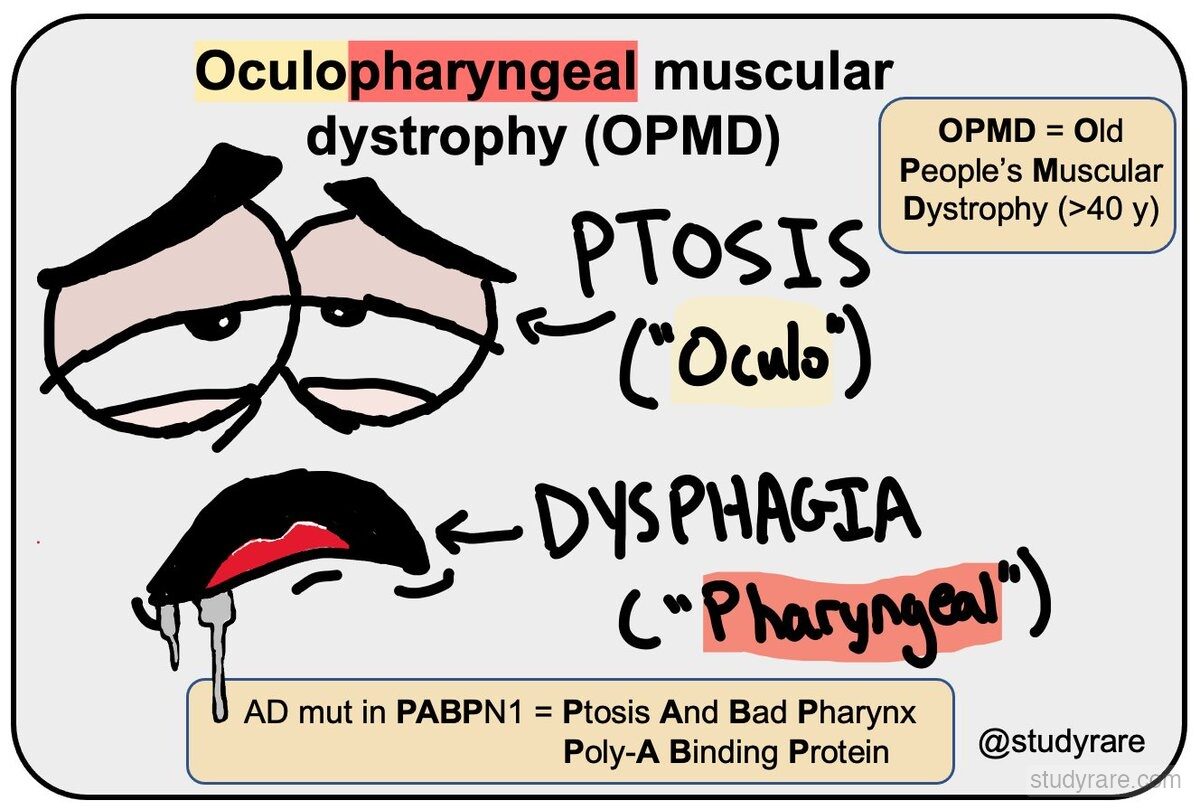
"OPMD = Old People's Muscle Disease": one of the latest-onset muscular dystrophies (40s-60s), unlike Duchenne (childhood) or FSHD (teens-20s).
"Oculo-Pharyngeal": the name tells you the two key features: eyes (ptosis) and pharynx (dysphagia).
Shortest pathogenic repeat: Only 11-18 GCN repeats needed (normal 10) (vs >200 for Fragile X, >40 for Huntington). Think "OPMD is a short repeat for an old person."
This visual highlights the two cardinal features encoded in the name (ptosis for "Oculo," dysphagia for "Pharyngeal") and the gene mnemonic: "PABPN1 = Ptosis And Bad Pharynx, Poly-A Binding Protein."