
Last updated Nov 3, 2026
An infant with infantile spasms is found to have hypopigmented macules (ash-leaf spots) and cardiac rhabdomyomas. Brain MRI shows cortical tubers and subependymal nodules.
AD; TSC1 (hamartin, about 25%) or TSC2 (tuberin, about 70%), tumor suppressors that turn down cell growth signaling; loss of function.
- ~2/3 de novo
Hamartin and tuberin bind each other and, as a pair, turn down cell growth in response to insulin signaling. When either protein is missing, growth signaling stays on, cells overgrow, and benign tumors (hamartomas) form in the brain, skin, heart, kidney, and lung. The same pathway is why mTOR inhibitors stabilize or shrink SEGAs, angiomyolipomas, and LAM.
A variant counts toward the diagnosis only when it clearly inactivates the protein (nonsense, out-of-frame indel, large deletion) or has been shown to do so in a functional assay, since variants of uncertain effect cannot be assumed to remove function.
- TSC2: more severe on average, with more angiomyolipomas and renal malignancy, intellectual disability, autism, infantile spasms, cardiac rhabdomyomas, and facial angiofibromas. It is more common in simplex cases. Some missense variants give milder disease, and a deletion that also removes the neighboring PKD1 adds polycystic kidney disease with a risk of kidney failure.
- TSC1: milder on average; familial cases split almost evenly between the two genes.
When blood testing is negative, test other tissues (tumor, skin, saliva, hair follicles), since at least 1% of affected people are mosaic.
- Skin: ash-leaf spots (hypopigmented macules), facial angiofibromas, shagreen patches, ungual fibromas
- Brain: cortical tubers, subependymal nodules → subependymal giant cell astrocytomas (SEGA), seizures
- Heart: cardiac rhabdomyomas
- Kidney: angiomyolipomas, cysts
- Lung: lymphangioleiomyomatosis (LAM) - females
- Clinical diagnosis by consensus criteria, combining major features (e.g., ≥3 hypomelanotic macules, angiofibromas, cortical tubers, subependymal nodules, SEGA, cardiac rhabdomyoma, angiomyolipomas) and minor features
- A pathogenic TSC1 or TSC2 variant is independently diagnostic, regardless of clinical findings
- Baseline workup at diagnosis: brain MRI, EEG, echocardiogram, renal imaging, dilated eye exam, and skin/dental exam
- Molecular testing of TSC1/TSC2 confirms the diagnosis and enables family and prenatal/preimplantation testing
- mTOR inhibitors (everolimus, sirolimus) for SEGA, angiomyolipomas, LAM
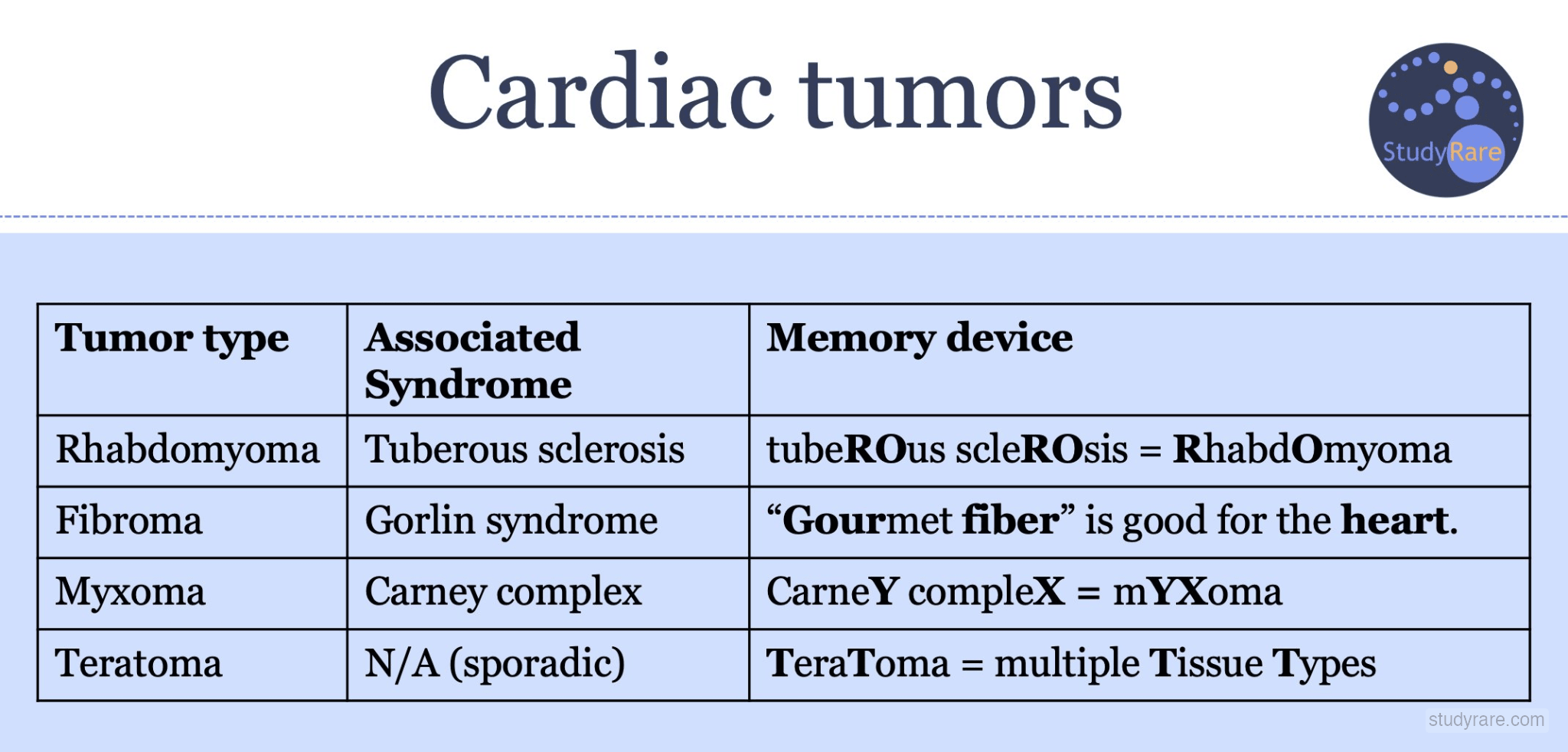
This table summarizes cardiac tumors and their associated genetic syndromes, a clinically central area to know.
"IS with TS": Infantile spasms are the most common seizure type in tuberous sclerosis. Vigabatrin is first-line treatment for infantile spasms associated with TS.
"In TS, you become a Teen Soon": CNS hamartomas can cause precocious puberty.
"Hammar Time": TSC1 encodes hamartin ("9" looks like a hammer), TSC2 encodes tuberin. Together they form the hamartoma-causing complex.
"mTOR inhibiTOR for TubORous sclerosis": Sirolimus (rapamycin) and everolimus are used to treat SEGAs, angiomyolipomas, and LAM.
"Top cause of death in TS are Tumors causing Seizures": #1 cause of death is CNS tumors leading to seizures; #2 is renal failure.