
Joubert syndrome
Log in to starLast updated 1mo ago
Log in to add personal notes on this page.
A newborn has hypotonia and abnormal eye movements. Brain MRI reveals the characteristic "molar tooth sign" at the midbrain-hindbrain junction.
AR; ciliopathy (>40 genes including AHI1, CEP290, CC2D2A, TMEM67)
- "Molar tooth sign" on axial MRI (hypoplastic cerebellar vermis, elongated superior cerebellar peduncles)
- Hypotonia, ataxia
- Abnormal breathing patterns (episodic hyperpnea)
- Abnormal eye movements (oculomotor apraxia)
- Variable: retinal dystrophy, kidney disease (nephronophthisis), liver fibrosis
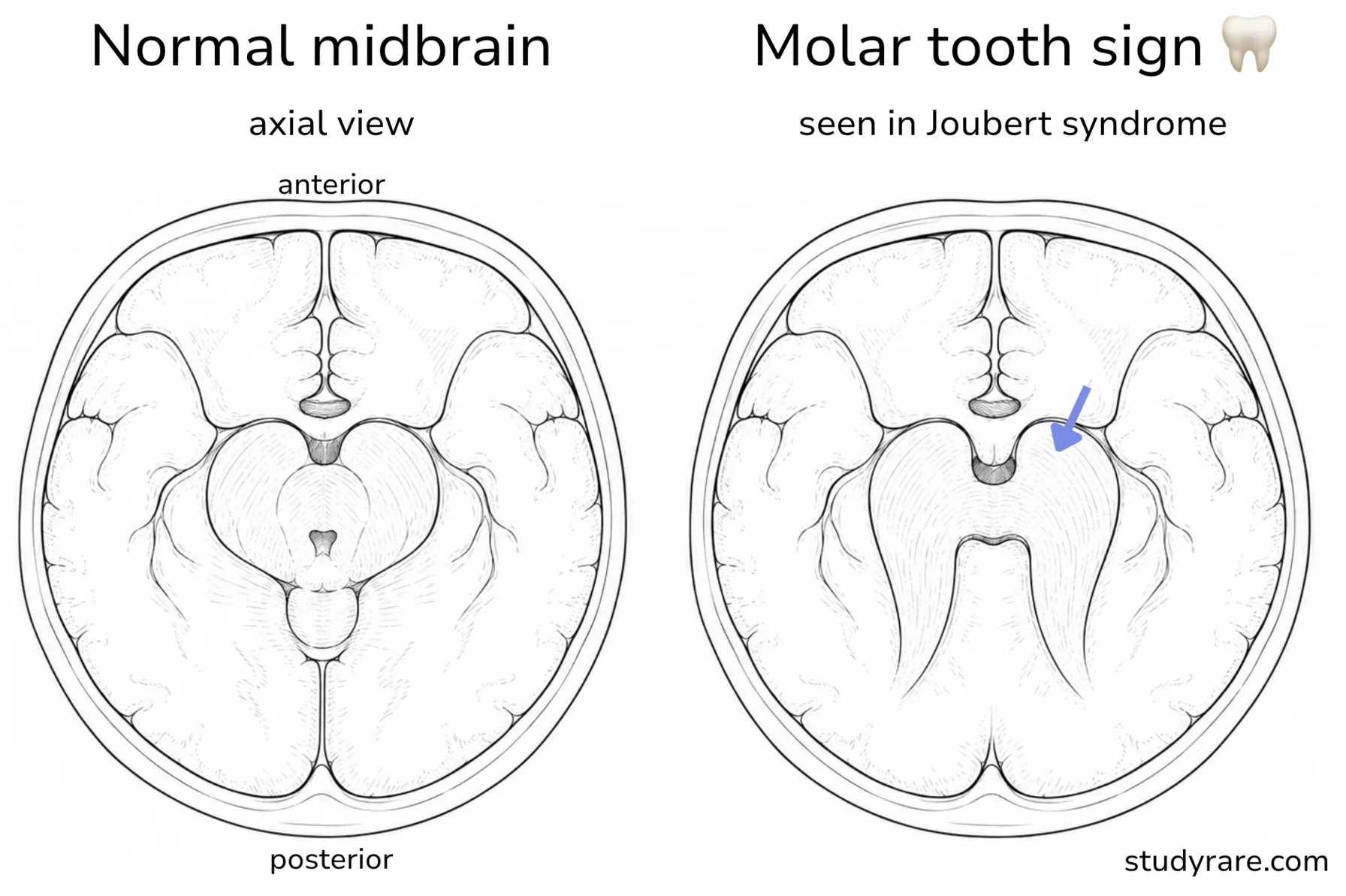
- Diagnosis requires the "molar tooth sign" on axial brain MRI plus hypotonia and developmental delay/intellectual disability
- Confirm with molecular testing via a multigene ciliopathy panel (>40 genes including AHI1, CEP290, CC2D2A, TMEM67); CEP290 correlates with retinal disease and TMEM67 with liver fibrosis
- Evaluate for organ involvement at diagnosis: dilated eye exam/electroretinogram, renal ultrasound and function, and liver function/ultrasound
- Supportive multidisciplinary care: physical, occupational, and speech therapy plus developmental and educational support
- Monitor for and manage the episodic breathing abnormalities (especially in infancy), feeding difficulties, and seizures
- Periodic surveillance for progressive retinal dystrophy, nephronophthisis/renal failure, and hepatic fibrosis; ophthalmology, nephrology, and hepatology follow-up
"JOUBERT": Tell a "Cili (silly) Joke" (ciliopathy), One extra digit (polydactyly), Under 70 IQ, Brain anomalies (molar tooth sign on axial MRI), Eye anomalies, Renal failure / Retina, Tone is low (hypotonia leading to ataxia)