Last updated 4mo ago
Log in to add personal notes on this page.
A 6-month-old previously healthy infant has a prolonged febrile seizure lasting 30 minutes. He goes on to develop multiple seizure types refractory to medications and experiences developmental regression.
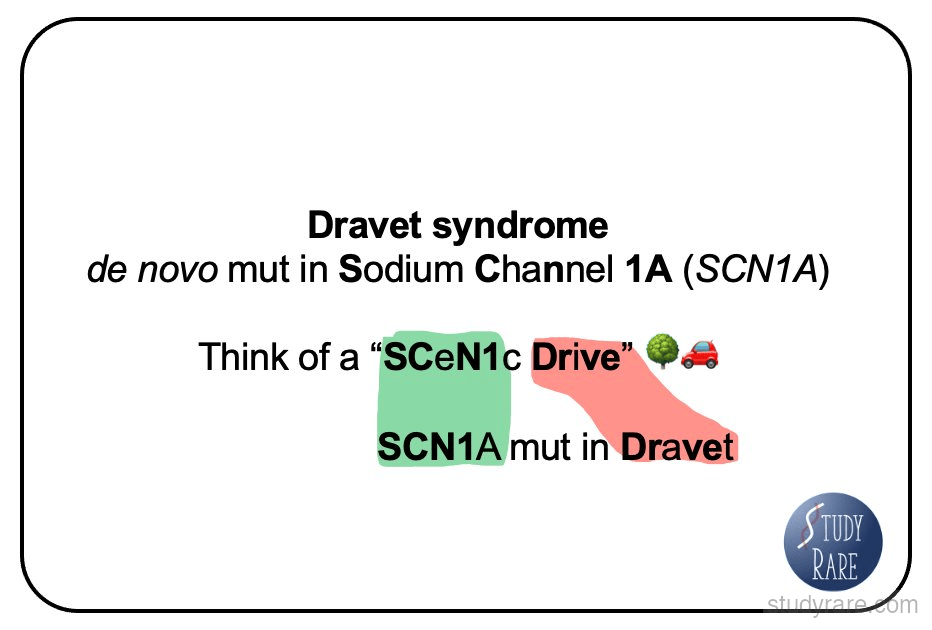
AD (de novo); SCN1A (sodium channel α subunit)
- Onset in first year with prolonged febrile or afebrile seizures
- Multiple seizure types (myoclonic, absence, focal)
- Temperature sensitivity (fever, hot baths trigger seizures)
- Developmental plateau/regression after onset
- Ataxia, crouched gait
Important: Avoid sodium channel blockers (carbamazepine, phenytoin), which can worsen seizures
- Suspect Dravet syndrome in an infant with prolonged, fever-triggered hemiclonic or generalized seizures and normal early development, later evolving to multiple drug-resistant seizure types with developmental slowing
- Confirm with molecular testing of SCN1A (sequencing plus deletion/duplication analysis), usually as part of an epilepsy gene panel
- Most cases are de novo; the milder GEFS+ phenotypes can be familial (autosomal dominant)
- EEG is often normal early; molecular testing drives both diagnosis and treatment choice
- Avoid sodium channel blockers (carbamazepine, phenytoin, lamotrigine), which worsen seizures in SCN1A-related Dravet syndrome
- First-line agents include valproate and clobazam; stiripentol, fenfluramine, and cannabidiol are approved add-on therapies
- Aggressive fever and seizure-trigger avoidance; rescue plan and counseling on status epilepticus and SUDEP risk
- Multidisciplinary developmental, physical, and behavioral support
Think of a "SCeN1c Drive" → SCN1A variants in Dravet