Last updated 4mo ago
Log in to add personal notes on this page.
A male infant has prolonged bleeding after circumcision. He later develops hemarthroses with minor trauma. PTT is prolonged, PT is normal. Factor VIII is <1%.
XLR; F8 (factor VIII)
Severity:
- Severe (<1%): Spontaneous bleeding, hemarthroses
- Moderate (1-5%): Bleeding with minor trauma
- Mild (5-40%): Bleeding with surgery/trauma
- Hemarthroses (ankles, knees, elbows)
- Muscle hematomas
- Prolonged PTT, normal PT
- Carrier females may have mild symptoms
- Prolonged aPTT with normal PT; a mixing study corrects, indicating factor deficiency rather than an inhibitor
- Reduced factor VIII activity assay confirms and grades severity (severe <1%, moderate 1-5%, mild 5-40%); normal von Willebrand factor distinguishes from von Willebrand disease
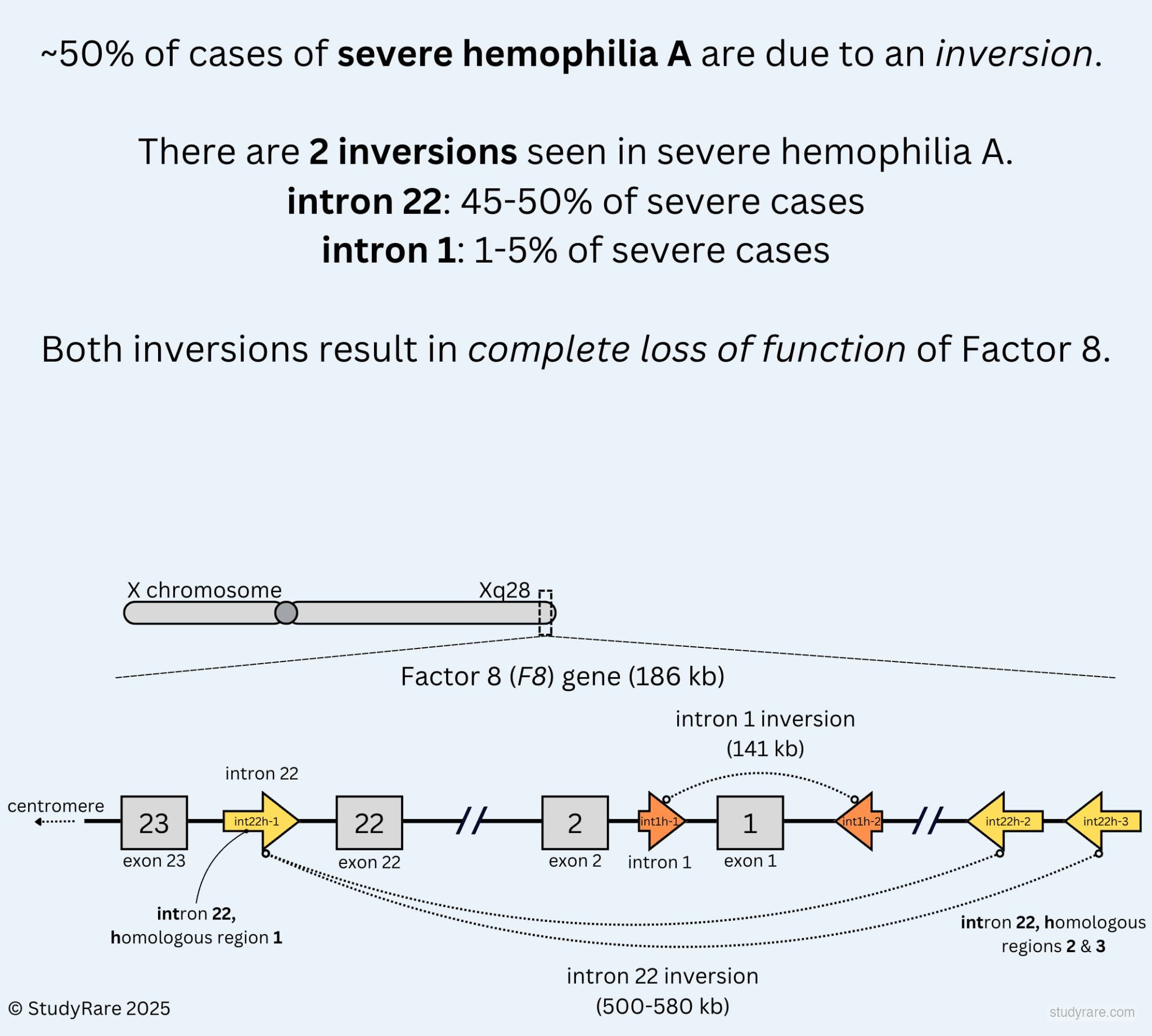
- F8 molecular testing (intron 22 inversion first, then sequencing/del-dup) confirms the diagnosis, enables carrier testing of at-risk females, and supports prenatal diagnosis
- Factor VIII replacement, emicizumab (bispecific antibody), gene therapy
ADH for Hemophilia A: Treatment includes ADH (desmopressin/DDAVP) for mild hemophilia A. Inheritance is XLR, so it primarily affects boys (same as Hemophilia B).
Hemophilia = "He" disease: Like Hemochromatosis, Hunter syndrome (MPS II), and Hirschsprung disease, hemophilia is male-predominant.
Approximately 50% of severe hemophilia A cases are caused by inversions in the F8 gene at Xq28. The intron 22 inversion accounts for 45-50% and intron 1 inversion for 1-5% of severe cases.