
Last updated 4mo ago
Log in to add personal notes on this page.
A 2-day-old newborn fails the universal newborn hearing screen (OAE) bilaterally. Follow-up ABR confirms bilateral moderate-to-severe sensorineural hearing loss. Physical exam is unremarkable with no dysmorphic features, no pigmentary anomalies, and no branchial or renal abnormalities. Family history is negative. Genetic testing with a hearing loss panel is recommended.
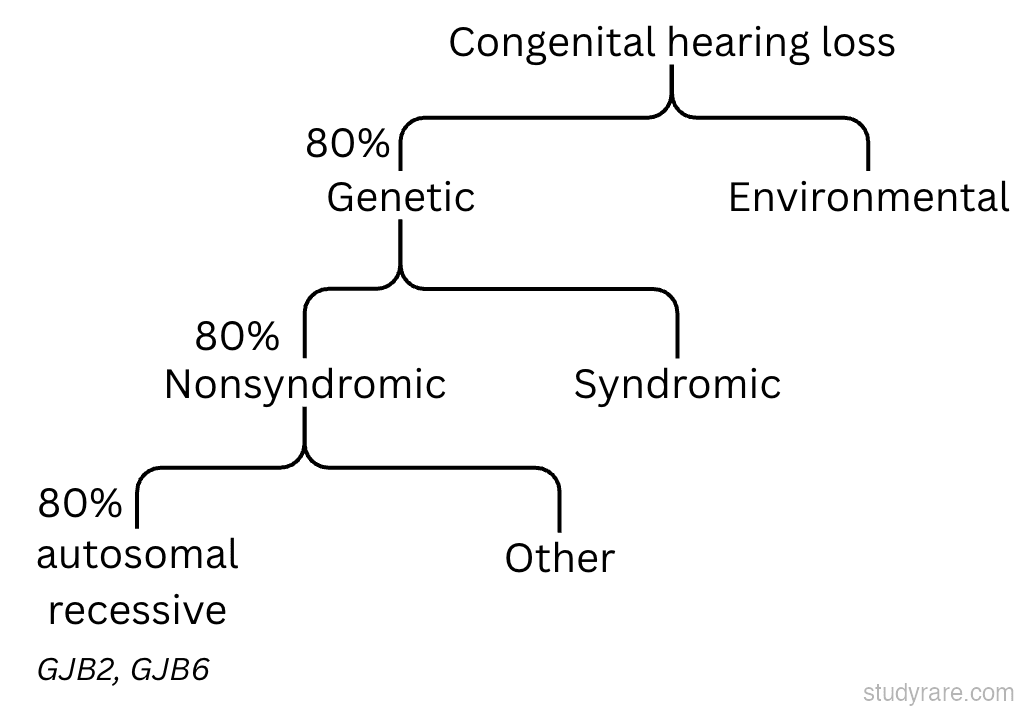
Over 100 genes identified for non-syndromic hearing loss
- ~50-60% of congenital hearing loss is genetic
- Of genetic cases: ~70% non-syndromic, ~30% syndromic
- Non-syndromic inheritance: ~75-80% AR, ~15-20% AD, 1-2% X-linked, <1% mitochondrial
- GJB2 (connexin 26) accounts for ~50% of AR non-syndromic cases
Non-syndromic hearing loss (70% of genetic hearing loss):
- Hearing loss is the only clinical feature
- Most common cause: GJB2 pathogenic variants (AR)
- Other common genes: SLC26A4, OTOF, TMC1, MYO15A
- Locus nomenclature: DFNB (AR), DFNA (AD), DFNX (X-linked)
Syndromic hearing loss (30% of genetic hearing loss):
- Usher syndrome: hearing loss + retinitis pigmentosa (AR, most common syndromic form)
- Pendred syndrome: hearing loss + thyroid goiter + EVA (AR, SLC26A4)
- Waardenburg syndrome: hearing loss + pigmentary anomalies (AD, types I-IV)
- Branchio-oto-renal syndrome: hearing loss + branchial/renal anomalies (AD, EYA1)
- Stickler syndrome: hearing loss + myopia + cleft palate + joint problems (AD, collagen genes)
- Jervell and Lange-Nielsen syndrome: hearing loss + long QT (AR, KCNQ1/KCNE1)
- Alport syndrome: hearing loss + nephritis + ocular anomalies (X-linked or AR, collagen IV)
- Universal newborn hearing screening (OAE or ABR); mandated in all 50 US states
- Audiologic evaluation to characterize type, degree, and configuration
- Genetic testing: GJB2 sequencing first-line, then multi-gene panel or exome
- CMV testing (most common non-genetic cause of congenital hearing loss)
- Temporal bone imaging (CT or MRI) to evaluate for EVA or cochlear malformations
- Ophthalmology, renal ultrasound, ECG, and thyroid studies as indicated to evaluate for syndromic forms
- Early intervention (ideally by 6 months of age; EHDI 1-3-6 guidelines)
- Hearing aids or cochlear implantation depending on degree of loss
- Speech-language therapy
- Genetic counseling for recurrence risk (most non-syndromic is AR → 25% recurrence)
- Screening for associated features in syndromic forms (e.g., ECG for Jervell and Lange-Nielsen, ophthalmology for Usher)
- Avoid aminoglycoside antibiotics in patients with mitochondrial hearing loss (m.1555A>G)