
Hearing Disorders
7 conditions|5 on ABGC's list
Overview
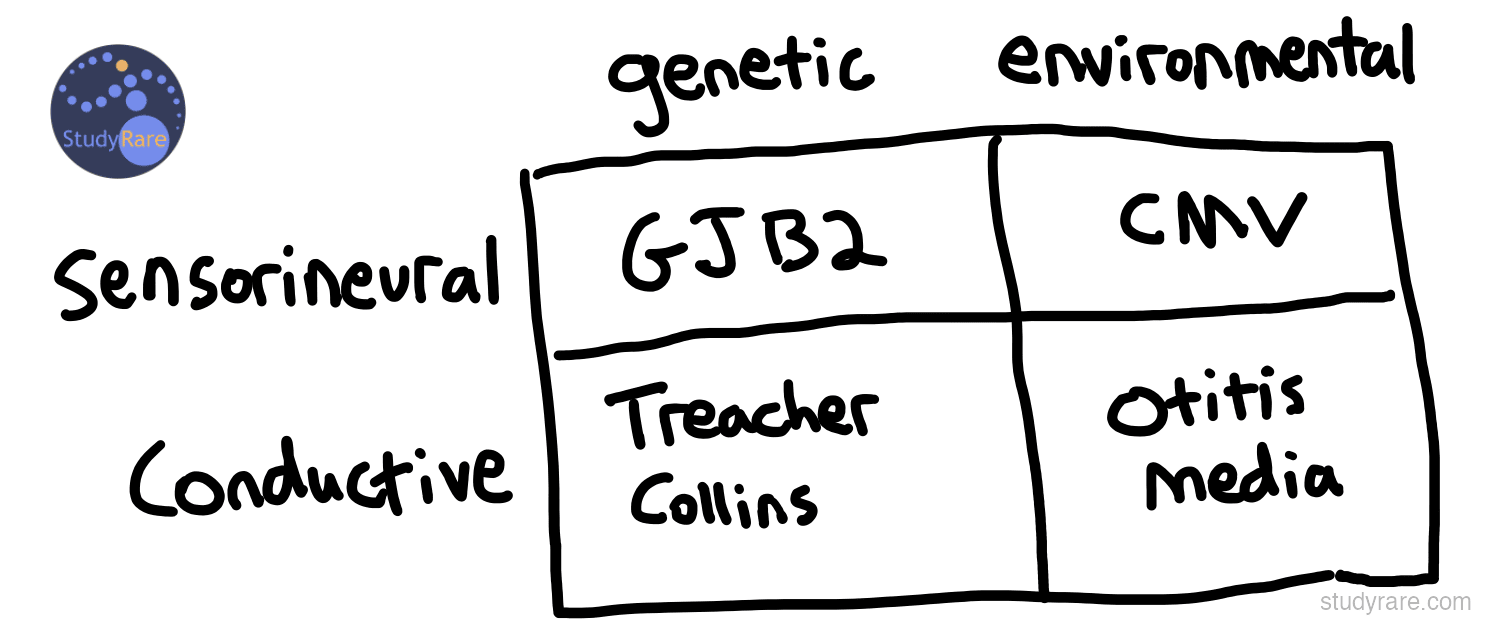
Genetic hearing loss is extremely common (~1/500 newborns). A useful framework classifies hearing loss along two axes: type (sensorineural vs conductive) and etiology (genetic vs environmental). This 2x2 grid helps organize the differential.
Key concepts:
- ~50% of congenital hearing loss is genetic
- GJB2 variants are the most common cause of genetic hearing loss
- Syndromic vs. non-syndromic (70% of genetic hearing loss is non-syndromic)
- Conductive vs. sensorineural
Genetic Hearing Loss
Non-syndromic hearing loss accounts for ~70% of genetic hearing loss, with GJB2 being the most common cause, including ethnic-specific variants. For syndromic hearing loss, the associated features distinguish them: Usher (retinitis pigmentosa), Waardenburg (pigmentary changes), Pendred (thyroid/EVA), and BOR (branchial/renal). Jervell and Lange-Nielsen adds cardiac risk, so an ECG is indicated in children with congenital SNHL.
Summary Table
| Disorder | Gene | Inheritance | Cardinal Features |
|---|---|---|---|
| GJB2 | GJB2 | AR | Non-syndromic SNHL, most common genetic cause |
| Usher type 1 | MYO7A, others | AR | Profound HL + RP + vestibular dysfunction |
| Usher type 2 | USH2A | AR | Moderate HL + RP, normal vestibular |
| Waardenburg | PAX3, others | AD | HL + pigmentary changes + dystopia canthorum |
| Pendred | SLC26A4 | AR | SNHL + enlarged vestibular aqueduct + goiter |
| JLNS | KCNQ1 | AR | Profound SNHL + long QT |
| BOR | EYA1 | AD | Branchial cysts + HL + renal anomalies |