
Cardiovascular Disorders
Overview
Cardiovascular genetics can be divided into cardiac conditions (affecting the heart muscle, valves, conduction system, and structure) and vascular conditions (affecting arteries and blood vessels). The diagram below organizes the major categories, genes, and conditions in this chapter.
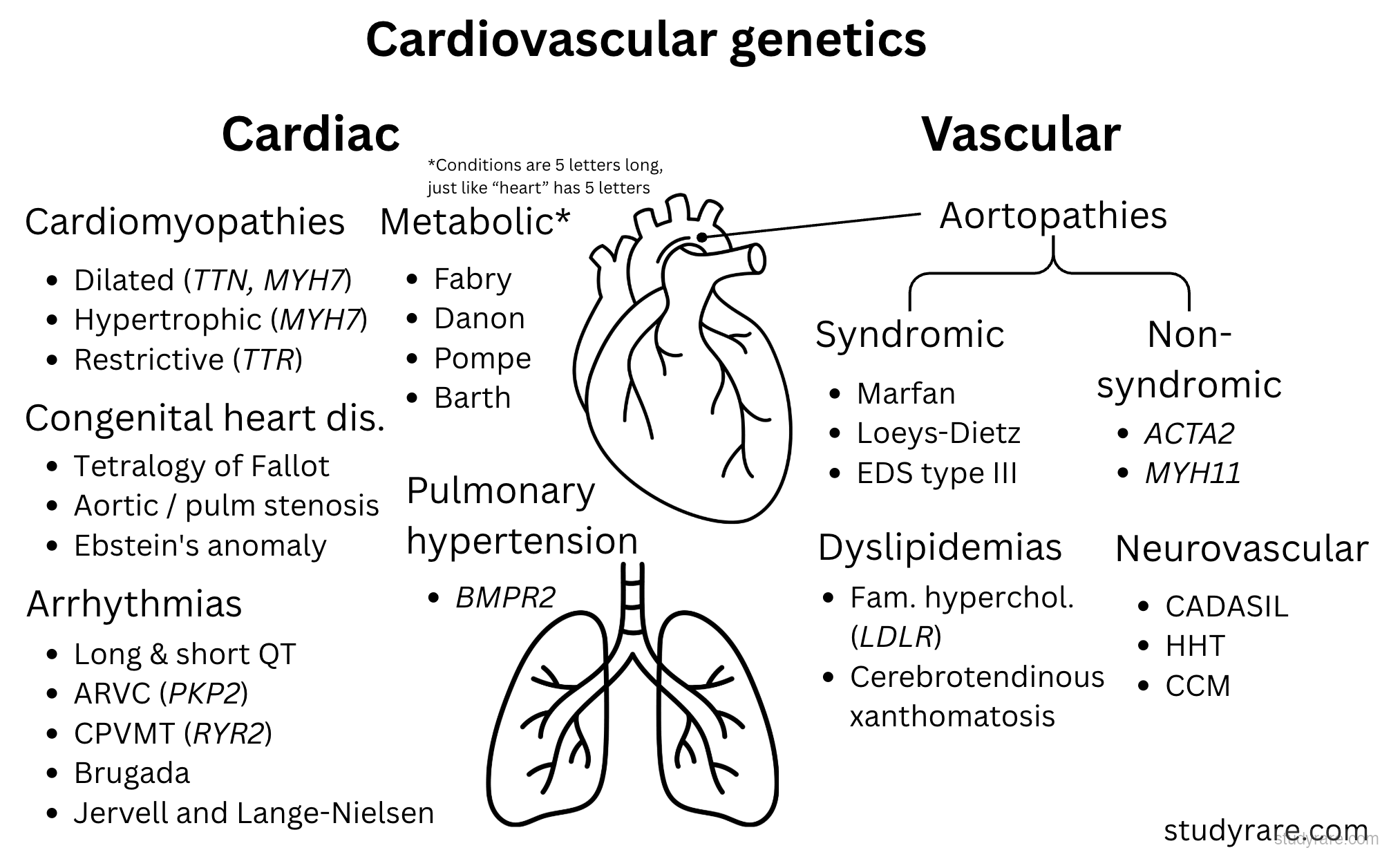
Key themes:
- Aortopathies: TGF-β signaling pathway (Marfan, Loeys-Dietz)
- RASopathies: RAS-MAPK pathway (Noonan, Costello, CFC)
- Congenital heart disease: Structural heart defects (Holt-Oram)
- Arrhythmias: Ion channel genes (LQTS, CPVT, Brugada)
- Cardiomyopathies: Sarcomeric proteins (HCM, DCM) or desmosomal proteins (ARVC)
Aortopathies
Aortopathies involve aneurysm and dissection risk, often through TGF-β pathway dysfunction. The key trio: Marfan (FBN1, ectopia lentis), Loeys-Dietz (TGFBR genes, bifid uvula, NO lens issues), and vascular EDS (COL3A1, organ rupture). Loeys-Dietz is more aggressive than Marfan, so surgery is often needed at smaller aortic diameters.
RASopathies
RASopathies share RAS-MAPK pathway mutations and overlapping features (short stature, cardiac defects, facial features). Distinguish them by: Noonan (most common, PTPN11, pulmonary stenosis), Costello (HRAS, papillomata, tumor risk), and CFC (BRAF, sparse hair, hyperkeratosis, more severe ID). Noonan resembles Turner syndrome phenotypically but occurs with a normal karyotype.
Congenital heart disease
While most congenital heart disease is multifactorial, some syndromes feature CHD as a cardinal finding. Holt-Oram (TBX5) is the classic "heart-hand syndrome," presenting with upper limb defects (radial ray) plus septal defects.
Arrhythmias
Inherited arrhythmias are ion channelopathies causing sudden cardiac death, often in young people. For Long QT, the triggers differ by type: LQT1 (exercise/swimming), LQT2 (auditory/emotion), LQT3 (sleep/rest). CPVT has a normal baseline ECG but exercise-induced VT. Brugada is common in Southeast Asian males and triggered by fever.
Cardiomyopathies
Cardiomyopathies are classified by structure/function: HCM (thick walls, sarcomeric genes), DCM (dilated, thin walls, TTN/LMNA), ARVC (RV fibrofatty replacement, desmosomal genes), and RCM (stiff/restrictive). HCM is the leading cause of sudden death in young athletes. LMNA-related DCM needs early ICD consideration due to arrhythmia risk.
Vascular disorders
Hereditary hemorrhagic telangiectasia (HHT/Osler-Weber-Rendu) is the key vascular genetic disorder. It causes arteriovenous malformations (AVMs) in the lungs, brain, and liver, plus mucocutaneous telangiectasias and recurrent epistaxis. Two main genes: ENG (HHT1, more pulmonary AVMs) and ACVRL1 (HHT2, more hepatic AVMs). Screen for pulmonary AVMs with contrast echocardiography: untreated pulmonary AVMs can cause stroke or brain abscess via paradoxical embolism.
Summary Table
| Disorder | Gene | Inheritance | Key Features |
|---|---|---|---|
| Marfan | FBN1 | AD | Ectopia lentis, aortic root dilation |
| Loeys-Dietz | TGFBR1/2 | AD | Bifid uvula, arterial tortuosity |
| Familial TAAD | ACTA2, MYH11, SMAD3 | AD | Non-syndromic aortic aneurysm/dissection |
| Noonan | PTPN11 | AD | Pulmonary stenosis, webbed neck |
| NSML (LEOPARD) | PTPN11 (dom-neg) | AD | Lentigines, HCM, sensorineural deafness |
| Costello | HRAS | AD | Papillomata, HCM, tumor risk |
| CFC | BRAF, MAP2K1/2 | AD | Sparse curly hair, hyperkeratosis, severe ID |
| Holt-Oram | TBX5 | AD | ASD, radial ray defects |
| LQTS | KCNQ1 | AD | Prolonged QTc, syncope |
| Andersen-Tawil (LQT7) | KCNJ2 | AD | Periodic paralysis, bidirectional VT, dysmorphism |
| Brugada | SCN5A | AD | Type 1 coved ST elevation V1-V3, SCD, fever trigger |
| CPVT | RYR2 | AD | Exercise-induced VT |
| HCM | MYH7 | AD | LV hypertrophy, sudden death |
| DCM | TTN | AD | LV dilation, heart failure |
| ARVC | PKP2 | AD | RV fibrofatty change, VT |
| RCM | TNNI3, DES, TTR | Variable | Diastolic dysfunction, biatrial enlargement |
| ATTR amyloidosis | TTR | AD | Polyneuropathy, restrictive CM, vitreous opacities |
| HHT | ENG, ACVRL1 | AD | Telangiectasias, AVMs, epistaxis |
| Heritable PAH | BMPR2 | AD (low penetrance) | Progressive dyspnea, right heart failure |