Holt-Oram syndrome
Log in to starLast updated 4mo ago
Log in to add personal notes on this page.
A child with a secundum ASD is noted to have asymmetric upper limb abnormalities affecting the thumb and radius.
AD; TBX5
- Upper limb: Radial ray defects (thumb anomalies, absent radius, phocomelia) - asymmetric
- Cardiac: ASD (most common), VSD, conduction defects
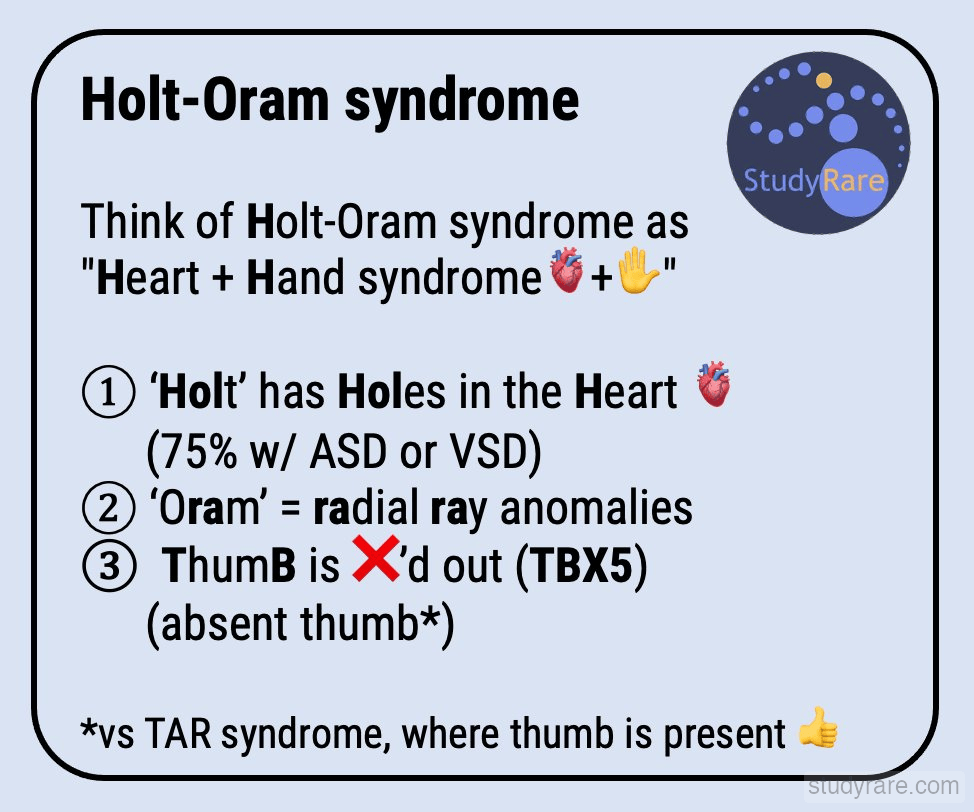
- "Heart-hand syndrome"
- Clinical diagnosis: upper-limb malformation involving the radial ray (carpal bones always affected) plus a personal or family history of congenital heart defect or conduction disease
- Hand/forearm radiographs to define the radial-ray anomaly; echocardiogram and ECG to detect septal defects and conduction abnormalities
- TBX5 sequencing/deletion-duplication analysis confirms the diagnosis and supports cascade testing of relatives
- Echocardiography plus ECG/Holter monitoring; progressive AV block may occur even with structurally minor or repaired hearts, so cardiac follow-up is ongoing
- Surgical or catheter-based repair of significant septal defects; pacemaker for advancing conduction disease
- Orthopedic and hand-surgery evaluation for limb anomalies; occupational therapy for function
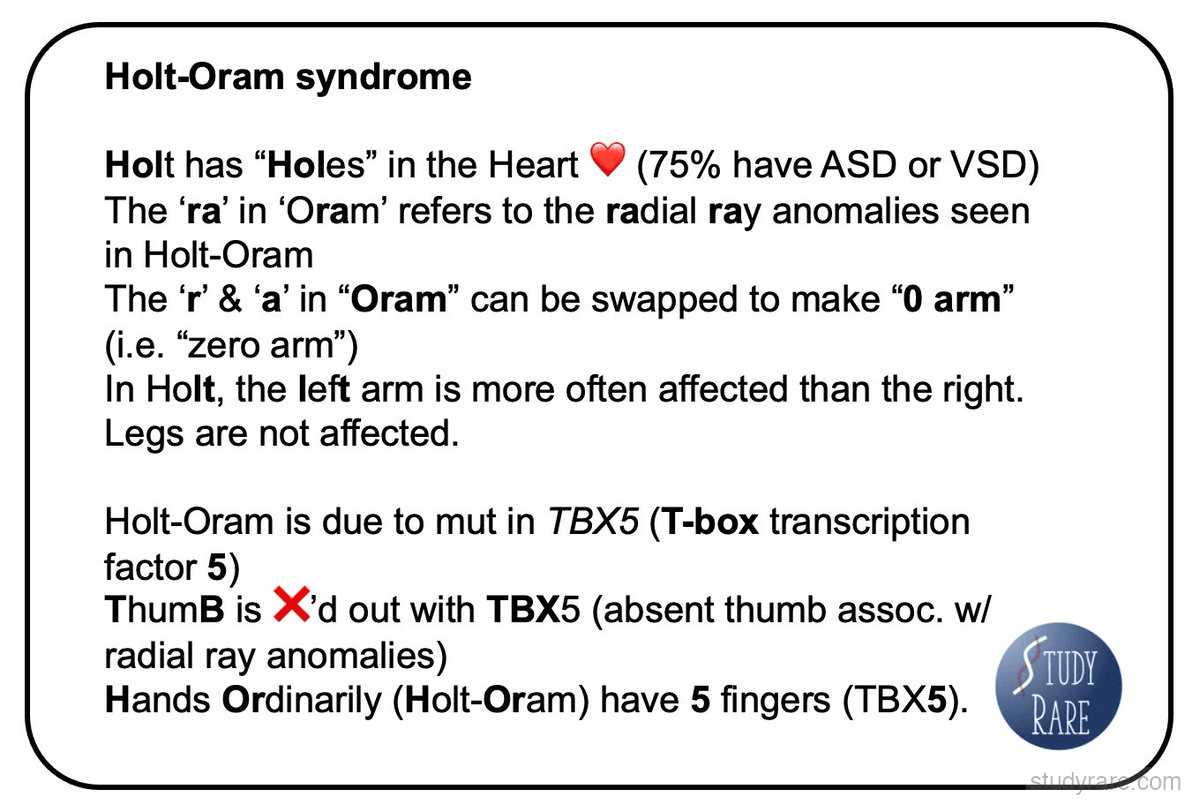
"Holt has Holes in the Heart": ~75% have ASD or VSD (congenital heart defects)
Gene, "ThumB x5": TBX5 = ThumB x 5 fingers. Your Thumb and 5 fingers are altered in TBX5 mutations
"Oram = 0 Arm": Swap the r and a in "Oram" to get "O arm" (i.e. zero arm), representing the radial ray defects (absent thumb/radius). The left arm is more often affected than the right