Last updated Nov 3, 2026
A child with severe feeding difficulties as an infant has coarse facial features, deep palmar creases, and papillomata around the nose and mouth. He has HCM and moderate intellectual disability.
AD (de novo); HRAS (HRAS protein, a RAS GTPase); missense gain-of-function variants, most at glycine 12 or 13, that keep RAS in its active state
HRAS encodes one of the RAS proteins at the inner plasma membrane that pass growth signals into the cell. RAS is active when bound to GTP and inactive when bound to GDP; its own slow GTPase activity, sped up by GTPase-activating proteins such as neurofibromin, switches it off, so most RAS in a cell is normally inactive. Costello syndrome variants are missense gain of function, most often p.Gly12Ser. Changes at positions 12, 13, 59, 61, and 63 reduce GTPase activity and lock RAS in the active state; changes at 116, 117, 119, and 146 speed the exchange of GDP for GTP. Either way active RAS accumulates and signals continuously through the RAS-MAPK and PI3K-AKT-MTOR pathways.
The germline variants are the same ones found somatically in sporadic tumors, which fits the approximately 15% lifetime risk of malignant tumors. In rhabdomyosarcoma from affected people, the normal allele is lost, often by paternal uniparental disomy of chromosome 11, as the second hit.
Some variants predict severity: p.Gly12Ala and p.Gly12Cys carry a more severe neonatal course and a higher tumor risk (38.7% and 37.5%, against 9.2% for p.Gly12Ser), while p.Thr58Ile and p.Gly60Val give milder disease.
- Facial: Coarse features, full lips, curly hair
- Skin: Loose redundant skin (infancy), deep palmar creases, papillomata (face, perianal)
- Cardiac: HCM (~60%), arrhythmias
- Growth: Severe failure to thrive, short stature
- Tumor risk: Increased risk of rhabdomyosarcoma, neuroblastoma, bladder carcinoma
- Molecular confirmation of a (usually de novo) HRAS pathogenic variant in a child with the characteristic coarse facies, deep palmar creases, papillomata, and failure to thrive
- Echo to evaluate for hypertrophic cardiomyopathy and arrhythmia
- Tumor surveillance is central: periodic abdominal and pelvic ultrasound plus urinalysis for the increased risk of rhabdomyosarcoma, neuroblastoma, and bladder carcinoma
- Cardiac monitoring for hypertrophic cardiomyopathy and arrhythmias (notably atrial tachycardia)
- Nutritional support for infantile feeding difficulties and failure to thrive
- Developmental and educational support
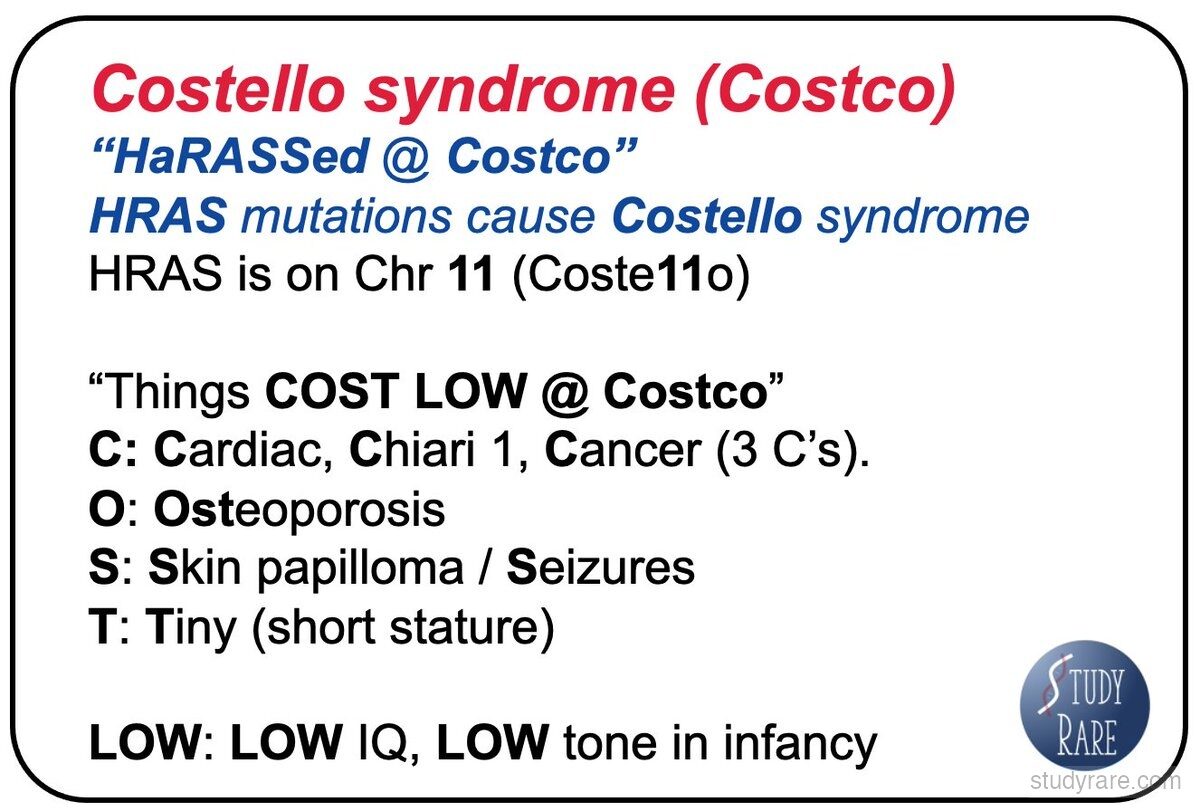
HRAS is on Chr 11 (Coste11o): the "11" is hidden in the name.
"Things COST LOW @ Costco":
- C: Cardiac, Chiari 1, Cancer (3 C's)
- O: Osteoporosis
- S: Skin papilloma / Seizures
- T: Tiny (short stature)
Tumor risk ("Costco BaRN"): Bladder cancer, Rhabdomyosarcoma, Neuroblastoma
This visual ties the "HaRASSed @ Costco" and "Things COST LOW @ Costco" mnemonics together with the HRAS gene and chromosome 11 location.