Last updated 4mo ago
A tall, thin 18-year-old with arm span exceeding height presents with sudden chest pain. CT reveals aortic root dilation and Type A dissection. Family history reveals his father died suddenly at age 35.
AD; FBN1 (fibrillin-1)
- TGF-β signaling dysregulation
- Skeletal: Tall stature, arachnodactyly, pectus deformity, scoliosis, joint hypermobility
- Ocular: Ectopia lentis (upward lens dislocation), myopia
- Cardiovascular: Aortic root dilation → dissection/rupture (leading cause of death), mitral valve prolapse
- Dura: Dural ectasia (lumbosacral)
- Revised Ghent criteria (aortic root + ectopia lentis, or FBN1 variant)
- Beta-blockers or ARBs to slow aortic dilation
- Aortic root surveillance with echo/MRI
- Prophylactic aortic root replacement (>5.0 cm or rapid growth)
- Activity restrictions (avoid contact sports, isometric exercise)
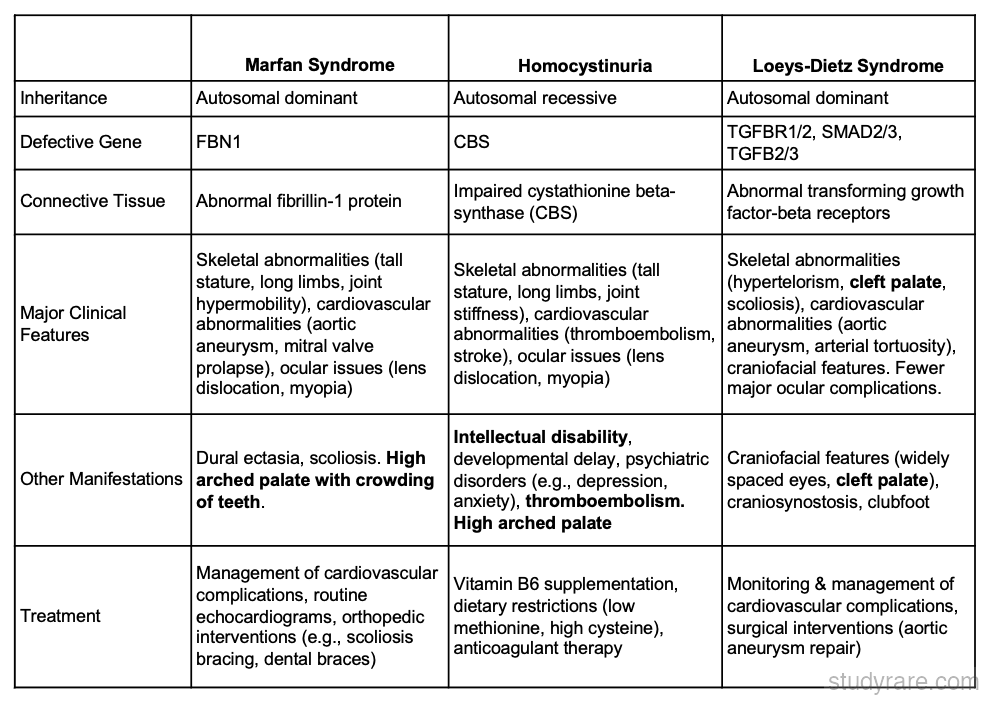
This table compares Marfan, homocystinuria, and Loeys-Dietz: three conditions with overlapping connective tissue features but distinct genetics, inheritance, and key differentiators.
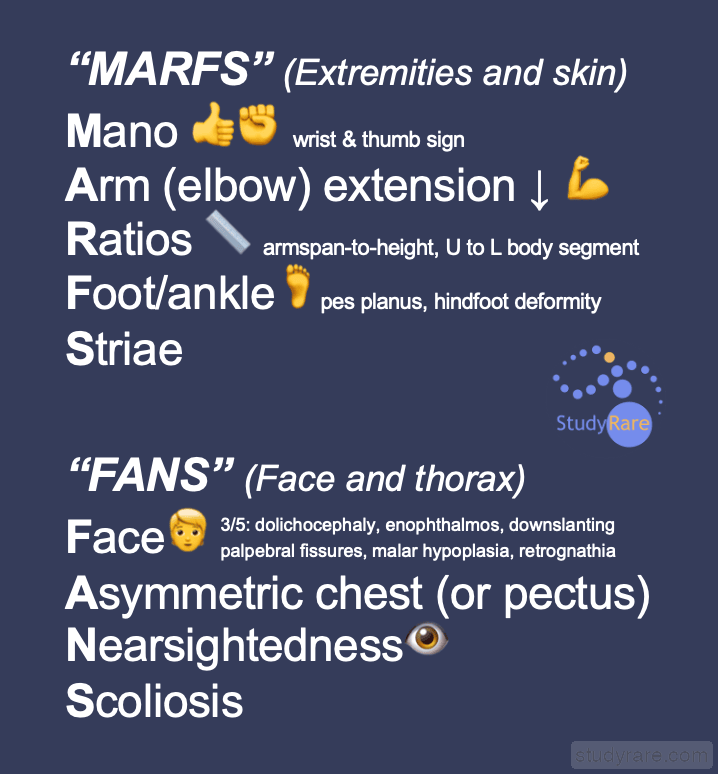
"MARFS FANS": A framework for the Marfan physical exam:
- Measurements (arm span-to-height ratio)
- Arm (elbow extension)
- wRist or thumb sign
- Foot/ankle deformity
- Striae
- Face (3/5 facial features)
- Asymmetry of chest (pectus)
- Nearsightedness (myopia)
- Scoliosis
"Marfan is AD": ArachnoDactyly, Autosomal Dominant, Aortic Dissection
Lens direction, "look up toward Mars": Ectopia lentis is upward in Marfan (vs downward in homocystinuria)
"MARFS" covers the extremity and skin exam (Mano, Arm extension, Ratios, Foot/ankle, Striae) while "FANS" covers face and thorax findings (Face, Asymmetric chest, Nearsightedness, Scoliosis).