Last updated 4mo ago
A child with hypertelorism, bifid uvula, and arterial tortuosity is found to have aortic root dilation at age 5. Unlike Marfan syndrome, he does not have lens dislocation.
AD; TGFBR1, TGFBR2, SMAD2, SMAD3, TGFB2, TGFB3
- TGF-β receptor variants → paradoxical increased TGF-β signaling
- Craniofacial: Hypertelorism, bifid/broad uvula, cleft palate
- Vascular: Arterial aneurysms/dissections throughout arterial tree (not just aorta), arterial tortuosity
- Skeletal: Marfanoid features (but less prominent)
- Other: Cervical spine instability, clubfoot
- NO ectopia lentis (unlike Marfan)
Important: More aggressive vascular disease than Marfan - earlier surgery often needed
- A pathogenic variant in TGFBR1, TGFBR2, SMAD2, SMAD3, TGFB2, or TGFB3 in the setting of arterial aneurysm/dissection and characteristic craniofacial findings
- Imaging extends beyond the aortic root: head-to-pelvis arterial imaging (CTA or MRA) is needed because aneurysms and tortuosity occur throughout the arterial tree, with echo for aortic root surveillance
- Aggressive vascular surveillance with serial echo and whole-body arterial imaging
- Prophylactic aortic surgery at smaller diameters than in Marfan syndrome, because dissection occurs at lower aortic dimensions
- Beta-blockers or ARBs to reduce hemodynamic stress on the arterial wall
- Activity restriction (avoid contact sports and isometric exertion)
"Loey's Diet": To remember the genes, think of "Loey's Diet": TGFB(R) = Too much Gluten Free BRead makes you SMAD (Super MAD / hangry). The genes are TGFBR1, TGFBR2, TGFB2, TGFB3, SMAD2, SMAD3
"Lens OK in Loeys": Unlike Marfan, there is no ectopia lentis in Loeys-Dietz. "Lens Ok in Loeys"
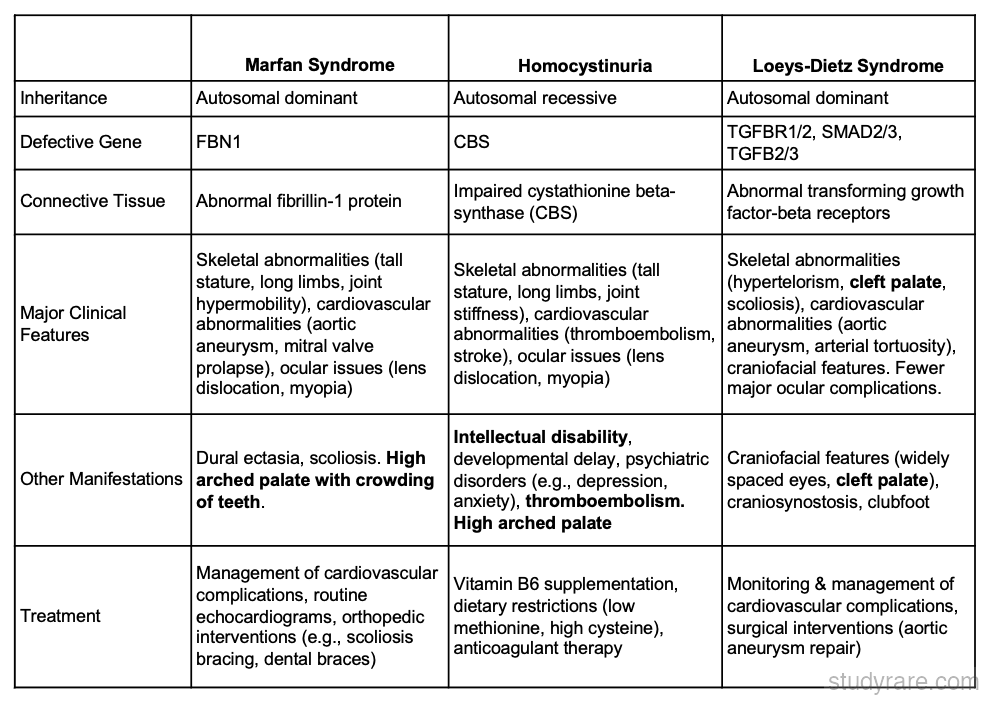
This table compares the three main Marfanoid conditions (Marfan, homocystinuria, and Loeys-Dietz) by inheritance, gene, connective tissue defect, clinical features, and treatment.