Last updated 4mo ago
Log in to add personal notes on this page.
A 14-year-old girl faints while swimming at a swim meet. ECG reveals a QTc of 480 ms. Her mother has a history of syncope and takes beta-blockers.
AD; multiple genes
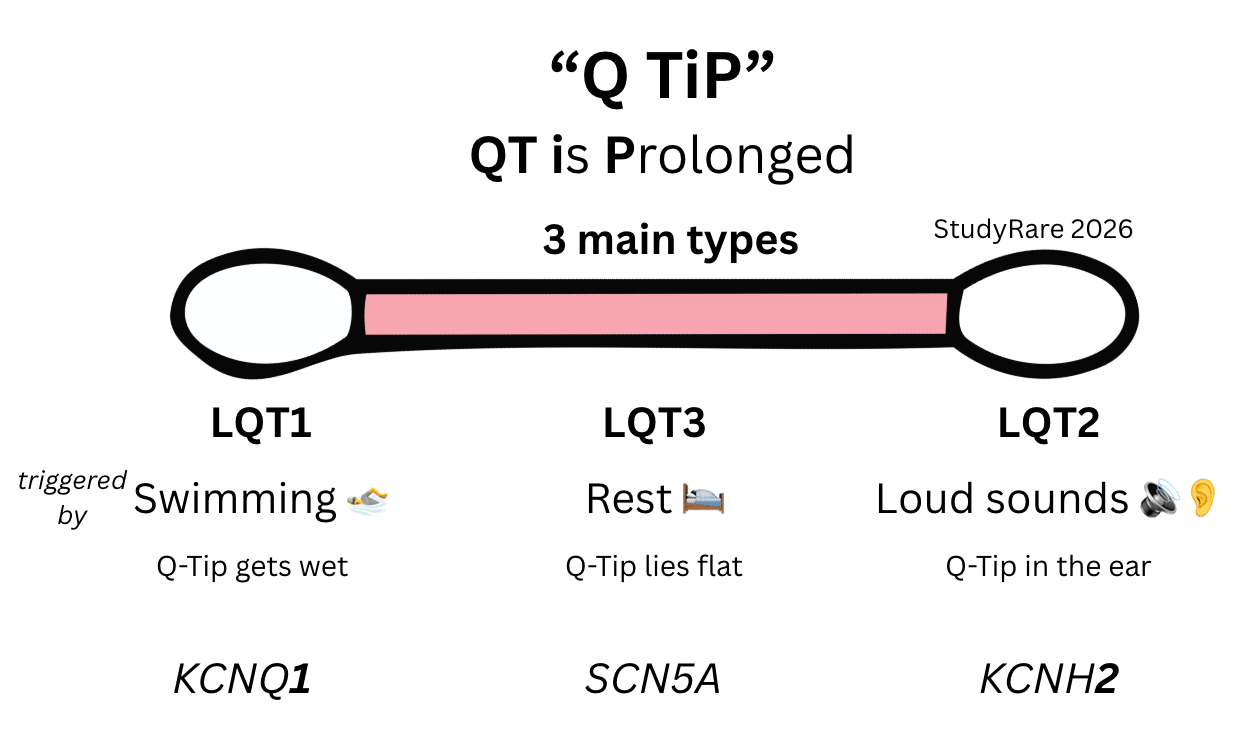
- LQT1: KCNQ1 (35%) - triggers: exercise (especially swimming), emotion
- LQT2: KCNH2 (30%) - triggers: auditory stimuli, emotion, rest
- LQT3: SCN5A (10%) - triggers: sleep/rest
- Prolonged QTc (>460 ms females, >450 ms males)
- Syncope, seizures, sudden cardiac death
- Triggers vary by type (see above)
- Torsades de pointes (polymorphic VT)
- 12-lead ECG with QTc measurement (prolonged at >450 ms in males, >460 ms in females; ≥480 ms is strongly suggestive); the Schwartz score combines ECG, symptom, and family-history criteria
- Exercise or provocative testing and ambulatory monitoring help when the resting QTc is borderline
- Genetic testing (KCNQ1, KCNH2, SCN5A) confirms the diagnosis, defines genotype-specific triggers and risk, and enables cascade screening of relatives
- Beta-blockers, avoid QT-prolonging drugs, ICD in high-risk, gene-specific swimming restrictions
Long eponymous names = Long QT: Syndromes with long, hyphenated names (Jervell and Lange-Nielsen, Andersen-Tawil, Romano-Ward) are all associated with Long QT
SCN5A spectrum: SCN5A GOF = Long QT ("reGain function when you spend a LONG time with your QT"); SCN5A LOF = Brugada ("aBRUpt death in BRUgada"). The symptoms of SCN5A can Sometimes ChaNge, 5Adly, depending on GOF/LOF