Léri-Weill dyschondrosteosis (SHOX deficiency)
Log in to starLast updated Nov 3, 2026
A 10-year-old girl with short stature has mesomelic limb shortening (forearms and lower legs) and a visible wrist deformity (Madelung deformity).
Pseudoautosomal dominant; SHOX gene (PAR1 region), a homeodomain transcription factor; haploinsufficiency, most often from deletions of the whole gene
- Also contributes to short stature in Turner syndrome
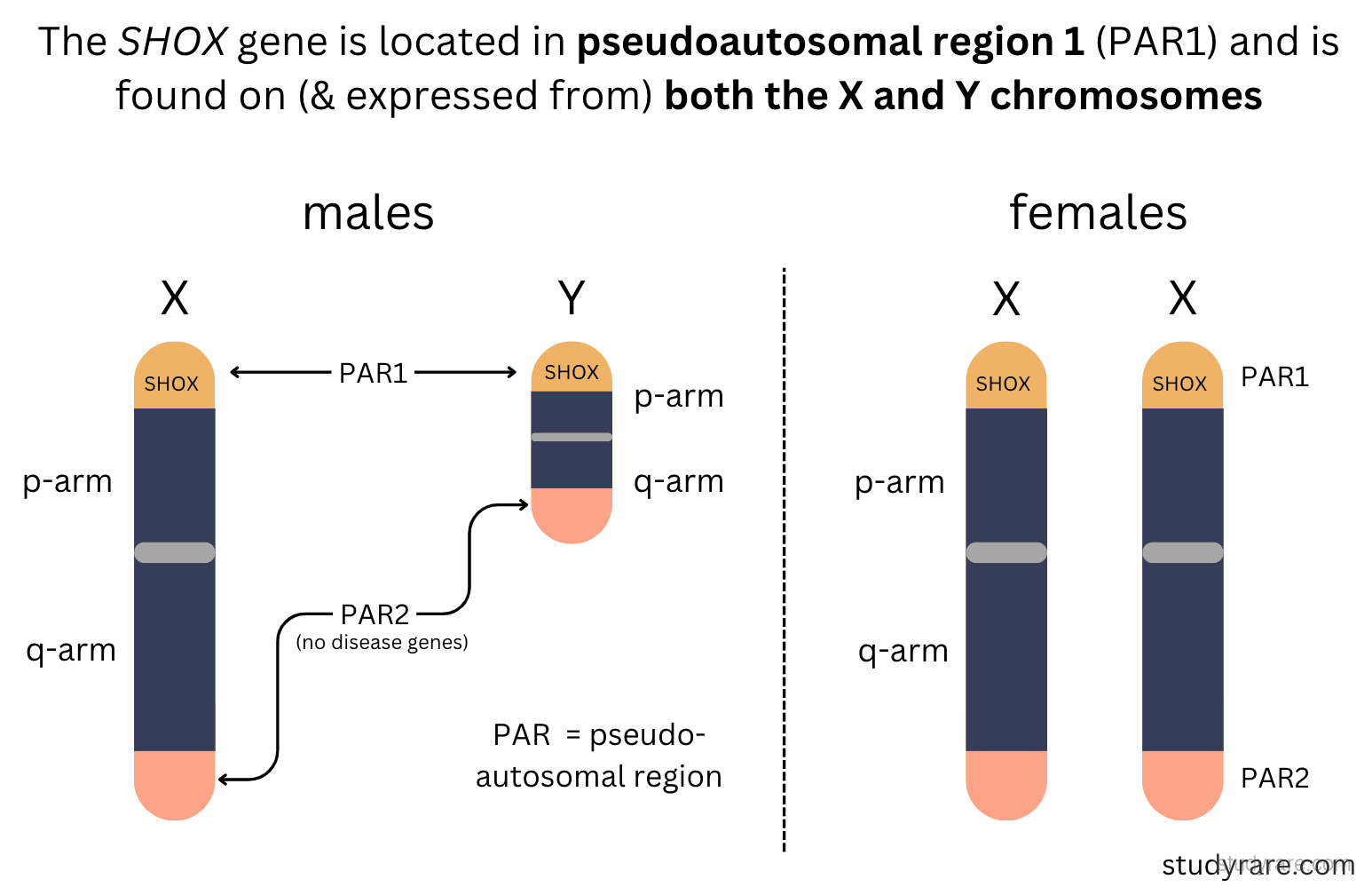
SHOX encodes a homeodomain transcription factor that inhibits cell growth and apoptosis; without it, growth plate chondrocytes may proliferate and differentiate abnormally. The gene lies in the pseudoautosomal region at the tips of Xp and Yp and escapes X inactivation. Loss of one copy (haploinsufficiency) causes the condition, and the same loss explains the shared skeletal features of Turner syndrome. Which sex chromosome carries the variant matters little, because the gene exchanges between X and Y in 50% of male meioses.
Most pathogenic variants are large deletions of the whole gene and neighboring genes; deletions of the enhancers alone also cause it. Homeodomain missense variants disrupt nuclear localization, DNA binding, or protein interaction, and variants outside the homeodomain lower the protein level.
In human embryos SHOX is expressed most strongly in the middle segments of the limbs and in the distal radius, ulna, and wrist, which explains the mesomelic shortening, the Madelung deformity, and the short fourth metacarpals. No genotype-phenotype correlation is established. Expression becomes more pronounced with age and is more severe in females.
- Mesomelic short stature (middle segments shortened)
- Madelung deformity (dorsal bowing of radius, triangular carpals)
- More severe in females
- Homozygous variants → Langer mesomelic dysplasia (more severe)
- Clinical: disproportionate mesomelic short stature with Madelung deformity, often more pronounced in females
- Radiographs of the wrist: dorsal bowing of the radius, triangularized distal radial epiphysis, and pyramidal/triangular carpal arrangement (Madelung deformity)
- SHOX deletion/duplication analysis (most cases are deletions of SHOX or its enhancers) plus sequencing confirms
- Consider in girls evaluated for short stature; exclude Turner syndrome with a karyotype when clinically indicated
- Growth hormone therapy can improve height outcomes in SHOX deficiency
- Orthopedic referral for symptomatic Madelung deformity; surgical correction (for example, dome osteotomy) for pain or functional limitation
- Monitor growth and skeletal proportions through childhood and adolescence
The SHOX gene is located in pseudoautosomal region 1 (PAR1) and is found on both the X and Y chromosomes. SHOX haploinsufficiency contributes to short stature in both LWD and Turner syndrome.