Last updated 4mo ago
Log in to add personal notes on this page.
A newborn has broad thumbs and great toes that deviate medially. There is craniosynostosis and midface hypoplasia. The phenotype is milder than Apert syndrome.
AD; FGFR2 (most cases, including types 2 and 3) or FGFR1 (a subset of type 1)
Types:
| Type | Severity | Features |
|---|---|---|
| 1 | Mild | Normal intelligence, broad thumbs/toes, good prognosis |
| 2 | Severe | Cloverleaf skull, severe proptosis, poor prognosis |
| 3 | Severe | Like type 2 without cloverleaf, poor prognosis |
- Broad, medially deviated thumbs and great toes
- Craniosynostosis
- Midface hypoplasia
- Types 2-3: often de novo FGFR2, early death
- Clinical recognition: craniosynostosis with broad, medially deviated thumbs and great toes
- Skull radiographs or CT confirm suture fusion (cloverleaf skull in type 2); 3D CT guides surgical planning
- Molecular confirmation by FGFR2 sequencing (most cases, including types 2 and 3) or FGFR1 (a subset of type 1)
- Multidisciplinary craniofacial team coordination
- Staged cranial vault expansion, then midface advancement (Le Fort III/monobloc)
- Airway management is high-yield, especially in types 2-3 with severe midface hypoplasia and tracheal cartilaginous sleeve; tracheostomy may be required
- ICP monitoring; surveillance for hydrocephalus and raised intracranial pressure
- Ophthalmology for proptosis and corneal exposure; audiology for hearing loss
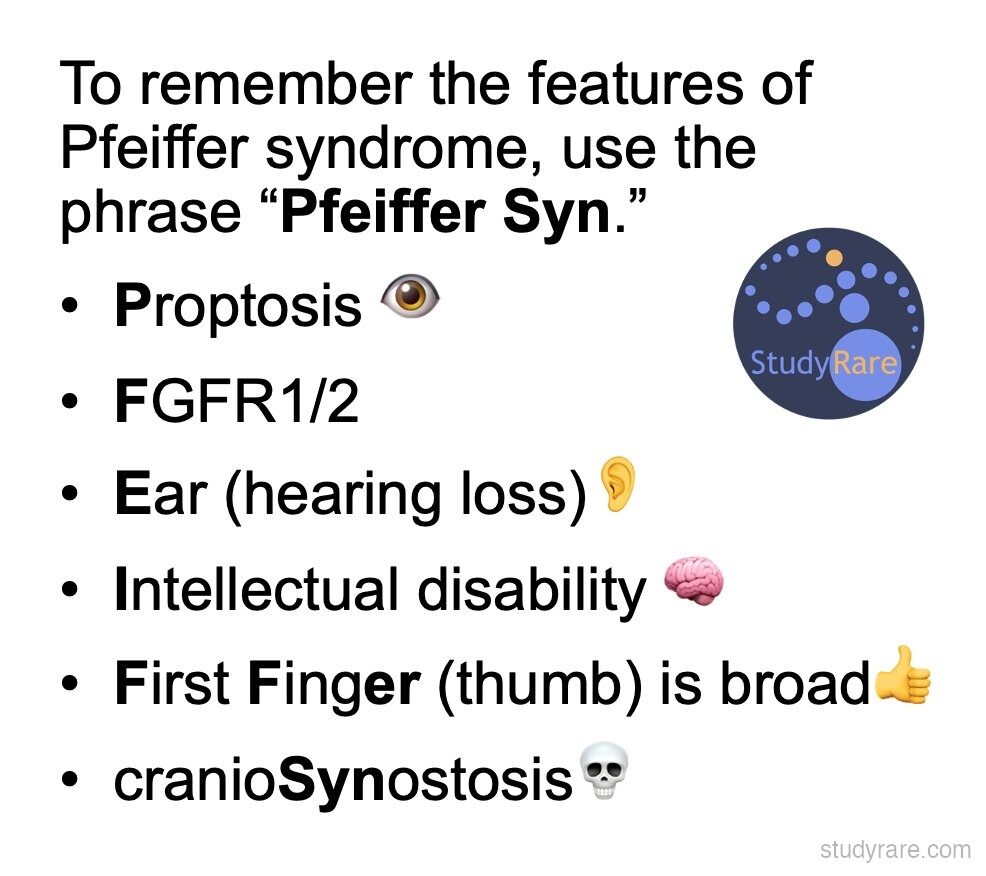
Use the phrase "PFEIFFER SYN" to remember the features:
- Proptosis
- FGFR1/2
- Ear (hearing loss)
- Intellectual disability
- First Finger (thumb) is broad
- cranioSYNostosis