
Last updated Nov 9, 2026
A 2-year-old has macrocephaly, accelerated linear growth (above 97th percentile), and developmental delay with advanced bone age. Facial features include a prominent forehead, downslanting palpebral fissures, and a pointed chin. Parents report the child was large at birth.
- AD, about 95% de novo; NSD1 (histone-lysine N-methyltransferase, H3 lysine 36 specific); loss of function
- NSD1 intragenic variant: sequence analysis detects 45% to 80%
- 5q35 microdeletion including NSD1: 15% to 50%, including a recurrent 1.9-Mb deletion reported in most Japanese individuals
The NSD1 protein is a histone methyltransferase. Its SET domain methylates lysine 36 on histone H3 and lysine 20 on histone H4, chromatin marks that help set which genes are expressed, and the protein can either repress or activate transcription depending on context. Sotos syndrome is loss of function of one copy, by an intragenic variant (missense, nonsense, splice, small insertion or deletion) or by a 5q35 microdeletion that removes the whole gene.
The loss of methyltransferase activity is thought to deregulate growth regulatory genes and cause broader epigenetic change, which together produce the features, chief among them prenatal-onset overgrowth, macrocephaly, and advanced bone age. The precise chain from enzyme to phenotype is not established.
Genotype changes the picture in one respect. In 234 individuals, those with a 5q35 microdeletion had less overgrowth and more severe learning disability than those with an intragenic variant. Heart and kidney anomalies, seizures, and scoliosis do not differ by genotype, and missense and truncating variants give the same phenotype. The recurrent 1.9-Mb deletion arises by nonallelic homologous recombination between low copy repeats that flank NSD1.
- Overgrowth: prenatal onset, tall stature, macrocephaly
- Advanced bone age
- Characteristic facies: prominent forehead, frontal bossing, downslanting palpebral fissures, pointed chin
- Intellectual disability (usually mild to moderate)
- Behavioral issues
- Neonatal hypotonia, poor feeding
- Increased risk for tumors (neuroblastoma, Wilms tumor, leukemia) - mild elevation
- Cardiac defects, renal anomalies, scoliosis possible
- Temporal balding pattern
- CMA for 5q35 deletion
- NSD1 sequencing if CMA negative but clinical suspicion high
- Skeletal survey shows advanced bone age
- Developmental support
- Consider tumor surveillance (individualized based on family history)
- Monitor growth, cardiac, and renal function
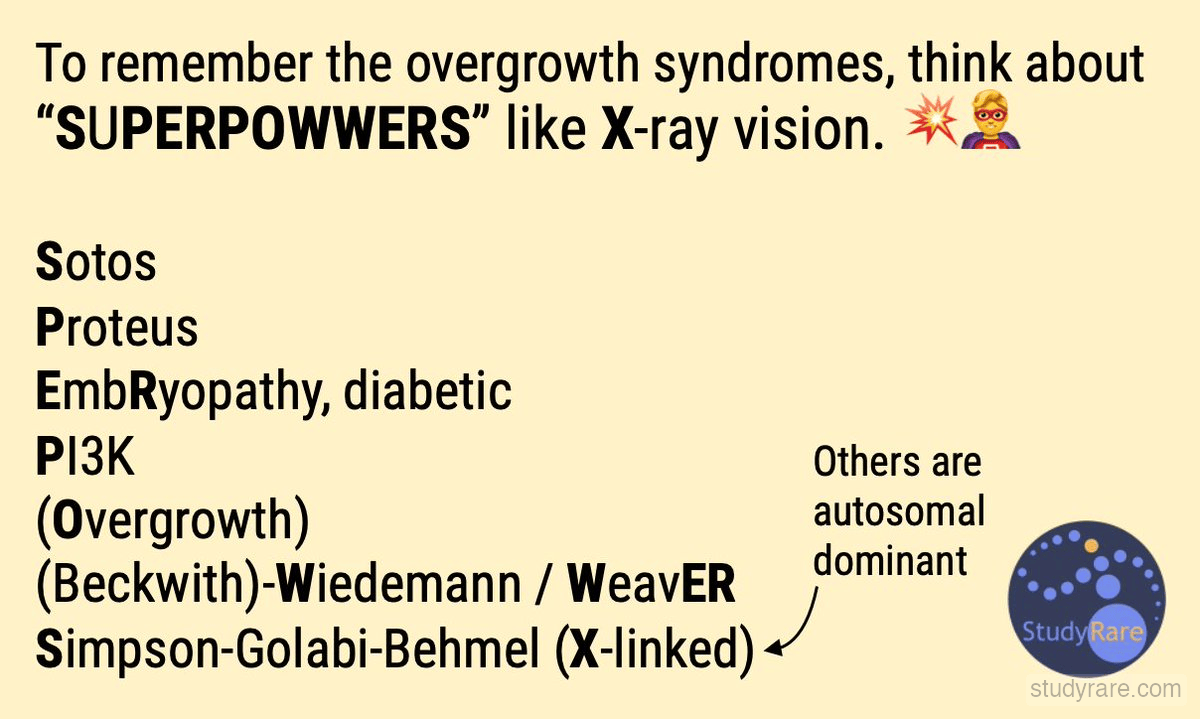
SOTTT♥SSSSSS:
- Serebral gigantism
- Overgrowth (vs undergrowth for most other microdeletions)
- Tinkle (renal anomalies)
- Tall stature
- Tumors (mild increased risk)
- Toupee (baldness)
- ♥ = Cardiac defects
- Scoliosis
- Seizures
- SET domain protein NSD1
- 5q35 (NSD1 locus - "5" looks like an "S")
