Last updated Nov 3, 2026
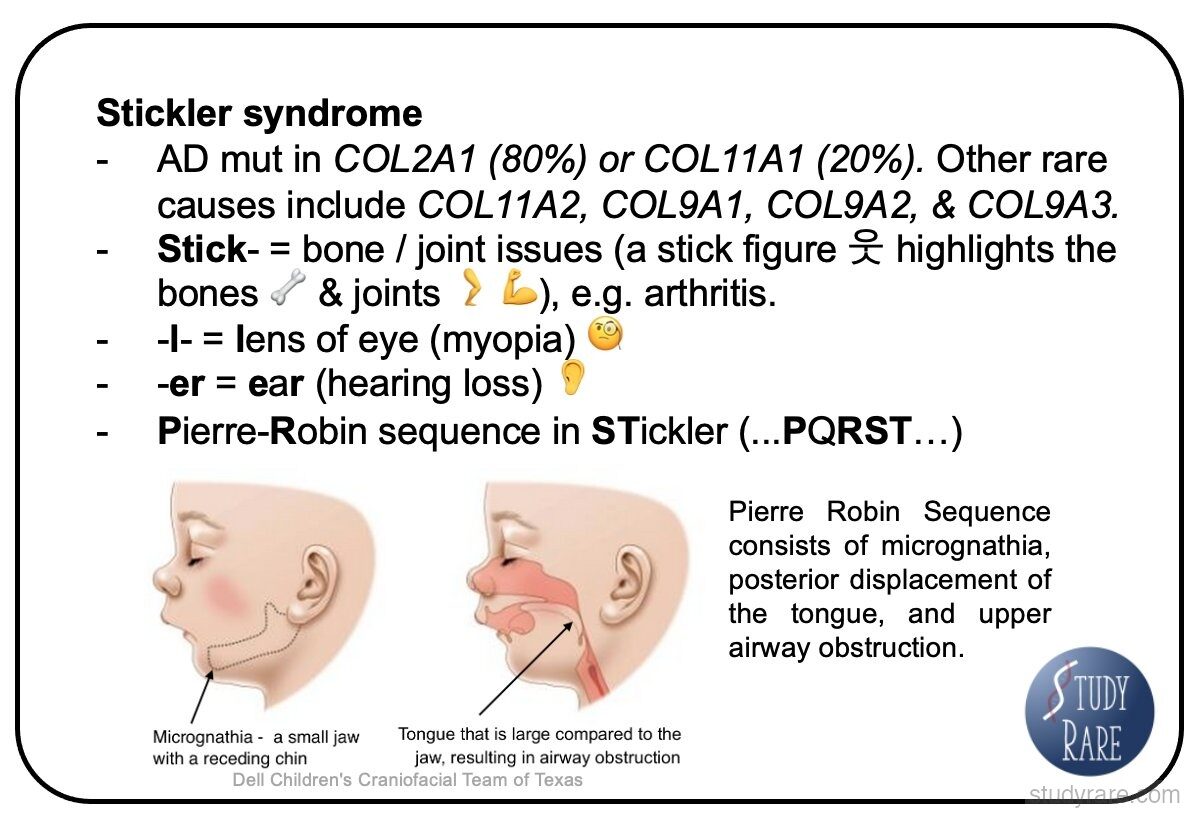
A newborn with Pierre Robin sequence (micrognathia, glossoptosis, cleft palate) fails the newborn hearing screen. Eye exam reveals vitreous abnormalities. Family history reveals a parent with retinal detachment and early arthritis.
AD (most) or AR; genes for the collagens of cartilage and vitreous; COL2A1 and COL9 variants are loss of function, COL11A1 and COL11A2 variants dominant negative
- Type 1 (most common, ~80%): COL2A1 - membranous vitreous
- Type 2: COL11A1
- Type 3: COL11A2 - no ocular findings
- AR forms: COL9A1, COL9A2, COL9A3
Each gene encodes a chain of a collagen in hyaline cartilage and vitreous: type II collagen (COL2A1), the main fibrillar collagen of cartilage; type XI (COL11A1, COL11A2), presumed to control lateral growth of type II fibrils; and type IX (COL9A1, COL9A2, COL9A3), which bridges the fibril to the rest of the matrix.
- COL2A1: loss of function. Nonsense variants, small deletions or duplications, and frameshifting splice variants lower type II collagen output (haploinsufficiency). In-frame variants with a dominant-negative effect cause the more severe type II collagen disorders, such as spondyloepiphyseal dysplasia congenita, which is why Stickler is the mild end of that spectrum. Truncating variants in exon 2 give a mainly ocular form with a high risk of retinal detachment.
- COL11A1: mostly exon-skipping splice variants and glycine substitutions, likely dominant negative on the type XI trimer. Null alleles are rare and give milder disease, such as nonsyndromic hearing loss.
- COL11A2: dominant negative. The gene is not expressed in adult vitreous, which explains why this form has no eye findings.
- COL9A1, COL9A2, COL9A3: biallelic loss of function with complete absence of the protein.
- Ocular: high myopia, vitreous abnormalities, retinal detachment risk
- Orofacial: Pierre Robin sequence, midface hypoplasia, cleft palate
- Hearing loss (sensorineural and/or conductive)
- Skeletal: early-onset arthritis, joint hypermobility
- Marfanoid habitus (some)
- Clinical recognition: ocular, orofacial, auditory, and skeletal findings (Pierre Robin sequence is a common presenting clue)
- Slit-lamp and dilated fundus exam for vitreous abnormalities (membranous vitreous in type 1)
- Audiometry for sensorineural and conductive hearing loss
- Confirmatory molecular testing (COL2A1, COL11A1, COL11A2, or COL9A1/2/3), which also guides retinal detachment risk and inheritance counseling
- Regular ophthalmology (retinal detachment prevention)
- Audiology
- Pierre Robin management (prone positioning, airway)
Break down the name: Stick- = bone/joint issues (think of a stick figure highlighting bones and joints, e.g. arthritis); -l- = lens of eye (myopia); -er = ear (hearing loss).
Pierre-Robin sequence in STickler: think "...PQRST..." (the letters P, Q, R, S, T are sequential, linking Pierre-Robin with STickler).
COL2-Stickler affects the eyes; COL11-Stickler does not affect the eyes but can cause cleft palate.
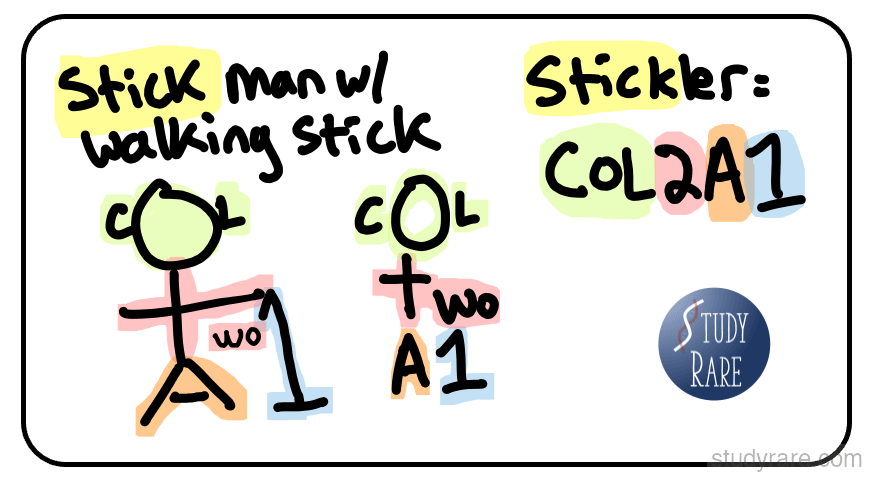
The "Stick man with a walking stick" visual encodes the COL2A1 gene: the "sticker" on his body spells COL2A1.
This overview connects bone/joint issues (stick figure), lens/eye findings (myopia), ear problems (hearing loss), and Pierre-Robin sequence to the Stickler name, with collagen gene details.