Last updated 1d ago
Log in to add personal notes on this page.
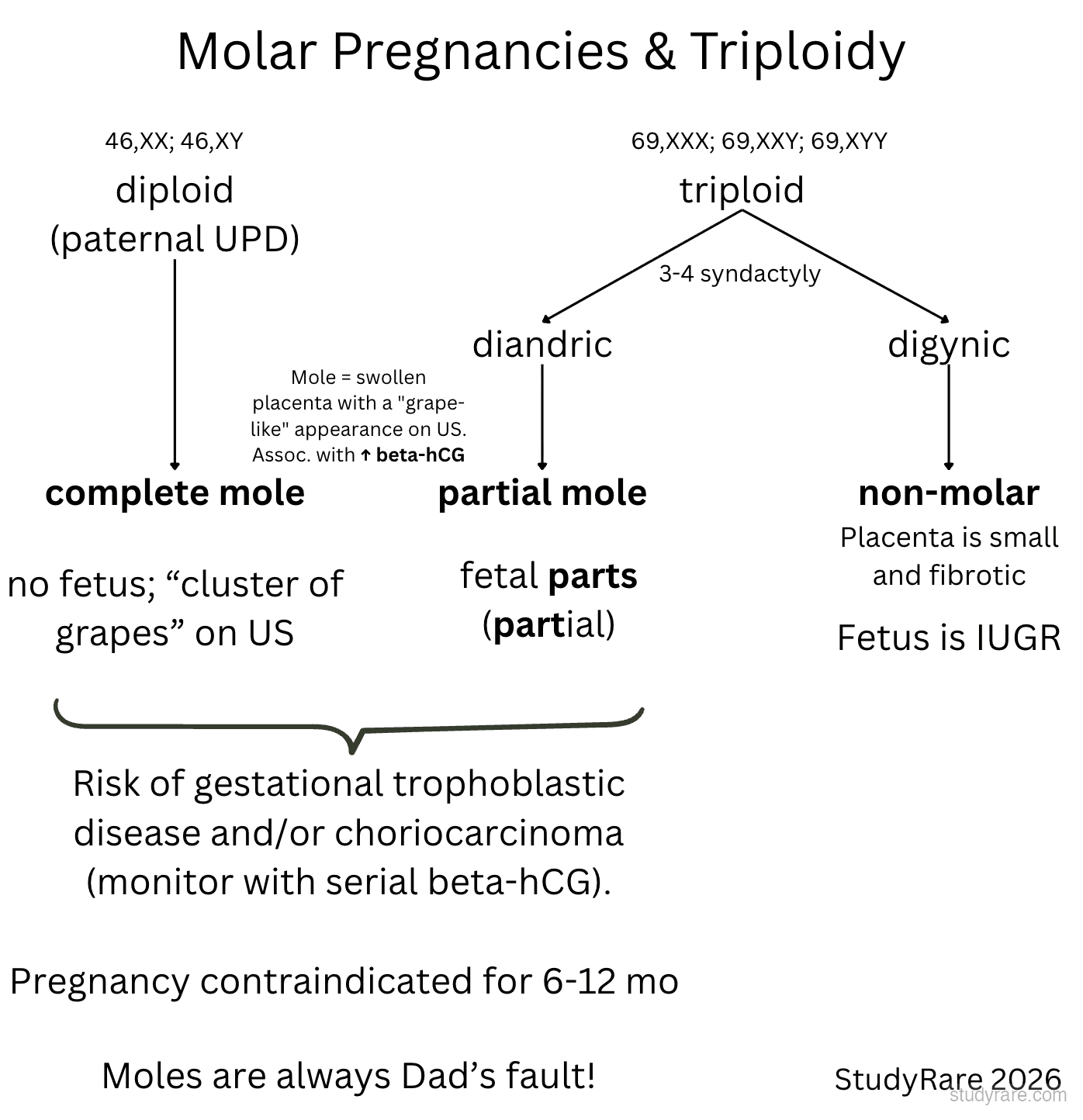
A first trimester pregnancy shows a large, cystic placenta on ultrasound with a normal-sized fetus. Serum screening shows markedly elevated hCG. CVS reveals 69,XYY.
69,XXX or 69,XXY or 69,XYY. Almost always sporadic with low recurrence risk (< 1%). Patients with biallelic variants in NLRP7 have oocytes that are unable to prevent polyspermy → recurrent partial hydatidiform moles.
- Almost always lethal (spontaneous loss or stillbirth)
- Diandric: partial hydatidiform mole (ultrasound shows a large, cystic placenta).
- Digynic: severe asymmetric IUGR, 3-4 syndactyly, small placenta. No molar pregnancy.
- Karyotype from sample obtained from CVS, amniocentesis, or products of conception. Ultrasound findings (partial mole vs IUGR) can suggest parental origin.
- Follow hCG post-pregnancy (risk of gestational trophoblastic disease with molar pregnancy)
Moles are always the Male's (Dad's) fault! True for partial (triploid) and complete (diploid) moles. In contrast to partial moles, complete moles are 100% from Dad (2 sperm fertilize an enucleated egg; or 1 sperm duplicates its DNA) and are more aggressive (higher risk of choriocarcinoma) with very high beta-HCG.