
Last updated 1d ago
Log in to add personal notes on this page.
A 16-year-old female presents with short stature and primary amenorrhea. Physical exam reveals a webbed neck, widely spaced nipples, and cubitus valgus. She has normal intelligence.
- Karyotype: 45,X (complete monosomy ~50%)
- Mosaic forms: 45,X/46,XX or 45,X/46,XY
- Structural X abnormalities: isochromosome Xq, ring X, deletions
- Not associated with advanced maternal age (unlike autosomal trisomies)
Genotype-phenotype: which piece of the X is missing
The karyotype is not just a label. What is lost predicts what the patient has.
- Isochromosome Xq (loss of Xp): short stature and the classic somatic features, since SHOX and the rest of Xp are lost. Higher rate of autoimmune thyroid disease
- Xp deletions: short stature with few other features when the deletion is small and distal, because SHOX haploinsufficiency is what drives the height
- Xq deletions: gonadal failure and primary amenorrhea with normal stature, since the ovarian maintenance region sits on Xq
- Ring X, 45,X/46,X,r(X): the important exception to everything else on this page. A small ring that has lost the X-inactivation center (XIST) cannot be inactivated, so genes on the ring are expressed from both the ring and the normal X. The resulting functional disomy produces a phenotype more severe than standard Turner syndrome, including intellectual disability and a syndromic facial appearance. When a ring X is reported, ask the laboratory whether XIST is present and whether the ring is inactivated. That answer, not the presence of the ring, is what predicts cognition
- Short stature (SHOX haploinsufficiency)
- Gonadal dysgenesis → primary amenorrhea, infertility
- Lymphedema in newborns (hands/feet)
- Webbed neck (cystic hygroma remnant)
- Congenital heart defects: bicuspid aortic valve (30%), coarctation of aorta (10%)
- Renal anomalies (horseshoe kidney)
- Normal intelligence (may have visuospatial learning differences). The exception is a small ring X that has lost XIST, which does cause intellectual disability
- Karyotype (increased cell count may be needed to detect mosaicism)
- Prenatal: cystic hygroma, coarctation, hydrops
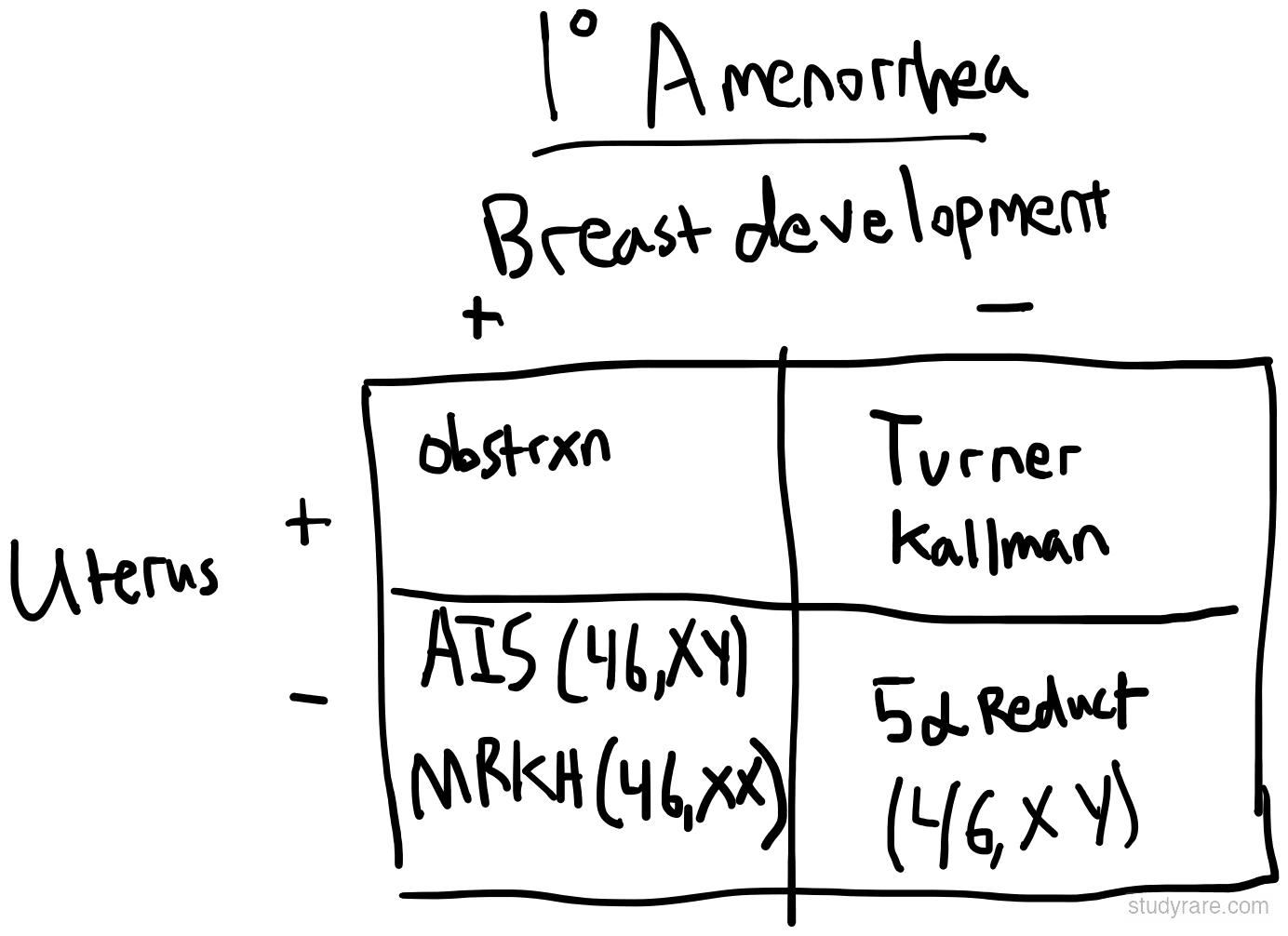
The differential for primary amenorrhea is organized by presence/absence of breast development and a uterus. Turner sits in the "no breasts, uterus present" cell.
- Noonan syndrome: Turner-like phenotype (short stature, webbed neck, congenital heart disease, lymphedema) but normal karyotype, autosomal dominant PTPN11 and related RAS-MAPK genes, affects both sexes. Historically called "male Turner."
- 45,X/46,XY mixed gonadal dysgenesis: overlapping somatic features but Y-line material present; gonadoblastoma risk and variable genital phenotype.
- Swyer syndrome (46,XY pure gonadal dysgenesis): streak gonads with primary amenorrhea but normal female stature, uterus present (Müllerian structures retained because dysgenetic gonads produce no AMH). High gonadoblastoma risk.
- Androgen insensitivity syndrome (complete AIS): 46,XY, breast development present, uterus absent (AMH suppression). Distinguishes by karyotype and pelvic imaging.
- Müllerian agenesis (MRKH): 46,XX, normal breast development, uterus absent. Ovaries normal, so puberty proceeds normally except for amenorrhea.
- Primary ovarian insufficiency (non-Turner): FMR1 premutation, autoimmune oophoritis, prior chemotherapy/radiation. Normal stature, no syndromic features.
- Growth hormone therapy for short stature
- Estrogen replacement at puberty
- Cardiac surveillance (risk of aortic root dilation/dissection)
- Screen for Y chromosome material (gonadoblastoma risk)
Cardiac: The aorta takes a large Turn: bicuspid aortic valve (30%) and coarctation of the aorta (10%).
"All Turntables have a Disc Jockey": Turner patients have increased risk for dysgerminoma (Disc Jockey = DJ = Dysgerminoma in the setting of a turntable/Turner).