Last updated 4mo ago
Log in to add personal notes on this page.
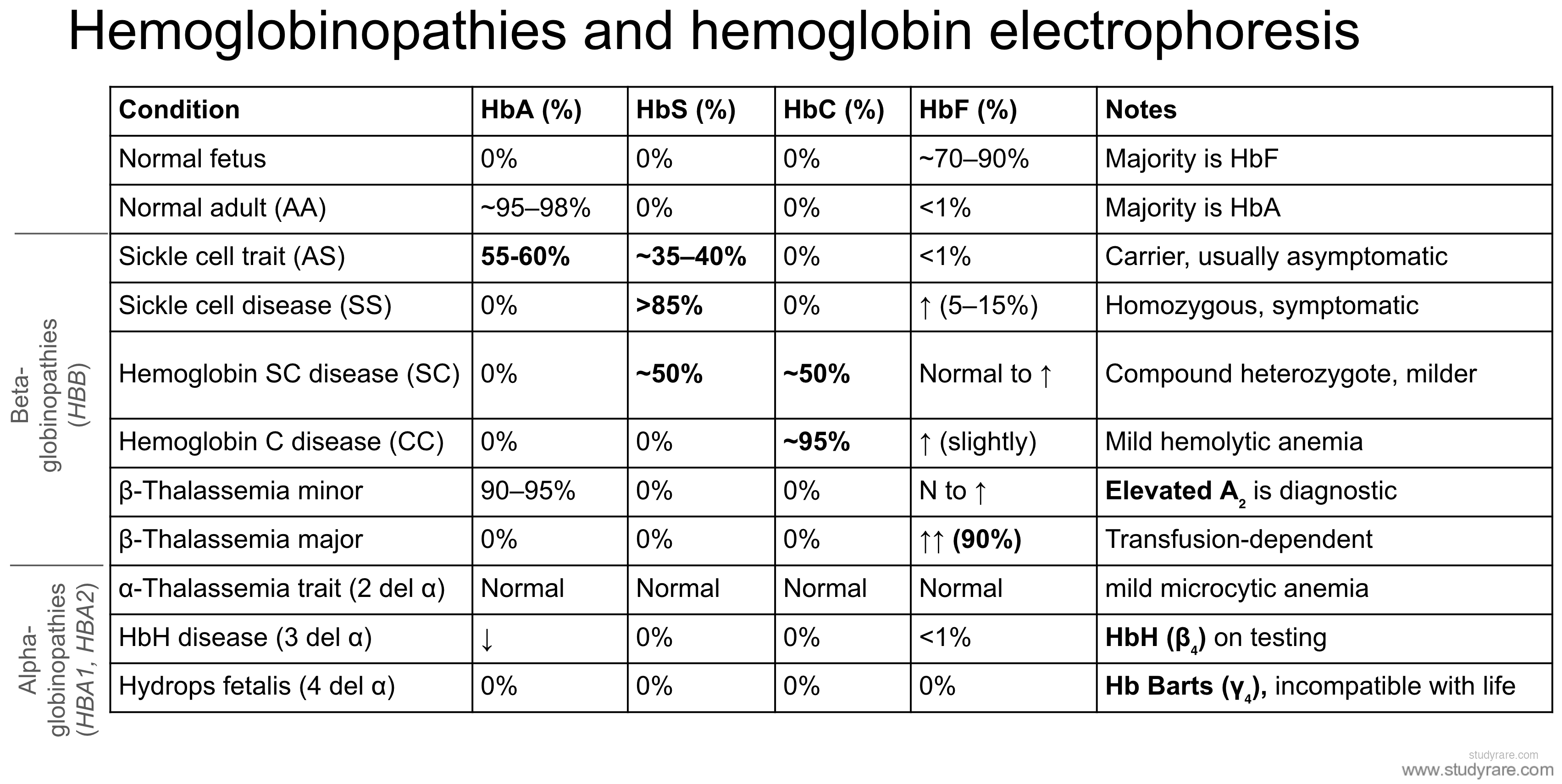
A Southeast Asian couple has a stillborn infant with hydrops fetalis. Hemoglobin electrophoresis shows only Hb Bart's (γ4). The parents are both α-thalassemia trait carriers with --/αα genotype.
AR; HBA1 and HBA2 (chromosome 16)
- Usually deletions
Types (by # of functioning α genes):
| Condition | Genotype | Phenotype |
|---|---|---|
| Silent carrier | -α/αα | Normal |
| α-thal trait | --/αα or -α/-α | Mild microcytic anemia |
| HbH disease | --/-α | Moderate hemolytic anemia, HbH (β4) |
| Hb Bart's hydrops | --/-- | Lethal, hydrops fetalis, Hb Bart's (γ4) |
- --/αα (cis deletions) common in Southeast Asian populations → risk for Bart's hydrops
- -α/-α (trans deletions) common in African populations → lower risk for Bart's hydrops
- CBC shows microcytic, hypochromic anemia (low MCV) with normal or elevated RBC count and normal iron studies (distinguishes from iron deficiency)
- Hemoglobin electrophoresis or HPLC: HbH (β4) in HbH disease, Hb Bart's (γ4) at birth or in hydrops; HbA2 is normal or low (unlike beta-thalassemia)
- HBA1/HBA2 deletion analysis (MLPA or gap-PCR) confirms genotype and identifies cis (--/αα) vs trans (-α/-α) for reproductive risk
- Carrier testing and prenatal diagnosis indicated when both partners carry α-globin deletions
- Silent carrier and trait: no treatment; genetic counseling and avoidance of unnecessary iron supplementation
- HbH disease: folic acid, intermittent transfusion during hemolytic or aplastic crises, splenectomy in selected cases, iron monitoring
- Hb Bart's hydrops: usually lethal in utero; rare survivors require intrauterine transfusion and lifelong transfusion support
- HSCT is potentially curative for transfusion-dependent disease
Hb Barts = Bad. Hb Barts is seen in an unborn Baby with fetal hydrops due to 4-gene deletion of alpha-thalassemia.
The letter "H" in HbH has 4 points. Represents the beta-globin tetramer.
Alpha is the most "social" Hb. Alpha-globin pairs with all other globin chains (β, γ, δ), which is why alpha-thalassemia affects multiple hemoglobin types.