Hirschsprung disease
Log in to starLast updated 2d ago
Log in to add personal notes on this page.
A newborn fails to pass meconium in the first 48 hours and develops abdominal distension. Contrast enema shows a transition zone in the rectosigmoid. Rectal biopsy confirms absent ganglion cells.
Complex/multifactorial or syndromic
- RET variants (AD with incomplete penetrance) - most common single gene
- Associated syndromes: Down syndrome, Waardenburg type 4, Mowat-Wilson, CCHS
- Absent enteric ganglion cells (aganglionic segment)
- Failure to pass meconium, constipation, abdominal distension
- Risk of enterocolitis
- Short segment (rectosigmoid) vs. long segment
- Contrast enema suggests the diagnosis (transition zone, rectosigmoid index)
- Rectal suction biopsy is the gold standard (absent ganglion cells, hypertrophied nerve fibers)
- Anorectal manometry shows absent rectoanal inhibitory reflex
- Surgical pull-through (resect aganglionic segment, anastomose ganglionic bowel to anus)
- Decompression and bowel irrigation pre-operatively to relieve obstruction
- Monitor for and treat Hirschsprung-associated enterocolitis (a major source of morbidity)
- Long-term follow-up for constipation, soiling, and continence
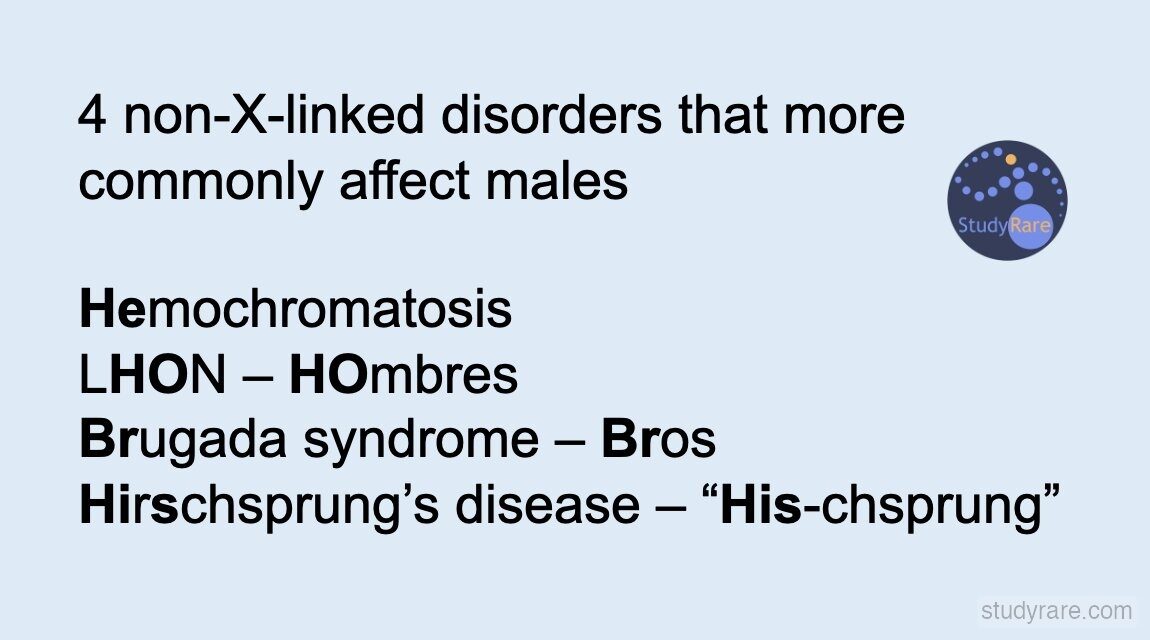
RET = REcTum: RET is the major susceptibility gene for isolated Hirschsprung disease (RET = REcTum). Hirschsprung disease results from failure of neural crest cell migration. "His-chsprung" is more common in males (5:1 M:F ratio), a "He" disease (like Hemochromatosis and Hemophilia).
Hirschsprung disease is a useful example to group with other non-X-linked disorders that more commonly affect males. "His-chsprung" contains "His," highlighting the male predominance.