
Hypophosphatasia
Log in to starLast updated 1d ago
A neonate presents with severe skeletal undermineralization, respiratory distress, and hypercalcemia. Alkaline phosphatase level is very low. The baby has "punched out" lesions on skull X-ray.
AR (severe) or AD (mild); ALPL (tissue non-specific alkaline phosphatase)
Alkaline phosphatase (ALP) degrades three phosphate-containing molecules. With low ALP, all three build up, and each maps to a finding:
- Pyridoxal 5'-phosphate (PLP) → serum biomarker
- PLP is the active form of vitamin B6, but it cannot cross the blood-brain barrier with its phosphate attached. ALP removes the phosphate to make pyridoxal, which crosses and is rephosphorylated to PLP inside the brain, where it is the cofactor for GABA synthesis.
- Low ALP leaves blood PLP high and brain B6 low → B6-responsive seizures in severe perinatal and infantile forms. Pyridoxine treats them, often only temporarily, and seizures predict a poor outcome.
- Not the same as pyridoxine-dependent epilepsy (ALDH7A1), where ALP is normal.
- Phosphoethanolamine (PEA) → urine biomarker
- No known toxic effect; a diagnostic marker only.
- Inorganic pyrophosphate (PPi) → inhibits bone mineralization
- Calcium that cannot enter bone stays in the blood → hypercalcemia, suppressed PTH, hypercalciuria → nephrocalcinosis, mainly in infants. The kidney deposits are calcium, not pyrophosphate.
- The pyrophosphate crystals form in joints instead → calcium pyrophosphate (CPPD) deposition: chondrocalcinosis and pseudogout, mainly in adults.
- Defective bone mineralization
- LOW alkaline phosphatase (opposite of most bone disorders)
- Elevated serum pyridoxal 5'-phosphate (PLP) and urine phosphoethanolamine (PEA)
Severity runs from lethal perinatal disease to teeth-only disease. Age at onset sorts the forms:
Perinatal and infantile (in utero to 6 months):
- Profound undermineralization, rachitic changes; can be lethal (stillbirth, or respiratory failure in infancy)
- Failure to thrive, hypotonia
- Hypercalcemia, nephrocalcinosis
- B6-responsive seizures
- Craniosynostosis
Childhood:
- Premature loss of deciduous teeth (roots intact), before age 5
- Rickets, short stature, delayed motor milestones
Adult:
- Osteomalacia with recurrent, poorly healing metatarsal stress fractures and pseudofractures
- Chondrocalcinosis, pseudogout
- Chronic musculoskeletal pain
Odontohypophosphatasia: dental disease only, with no rickets or osteomalacia
- LOW serum alkaline phosphatase for age is the key biochemical clue
- Elevated substrates: pyridoxal 5'-phosphate (PLP) in serum, phosphoethanolamine (PEA) in urine
- Radiographs: undermineralization, rachitic-appearing metaphyses, "punched out" skull lucencies in severe forms
- ALPL sequencing confirms and clarifies inheritance (AR in severe, AD in milder forms)
Both cause defective bone mineralization with rachitic changes, and the names differ by two letters. The labs separate them: X-linked hypophosphatemia (PHEX) has low serum phosphate and normal ALP; hypophosphatasia (ALPL) has low ALP, high PLP, and high urine PEA, with normal phosphate.
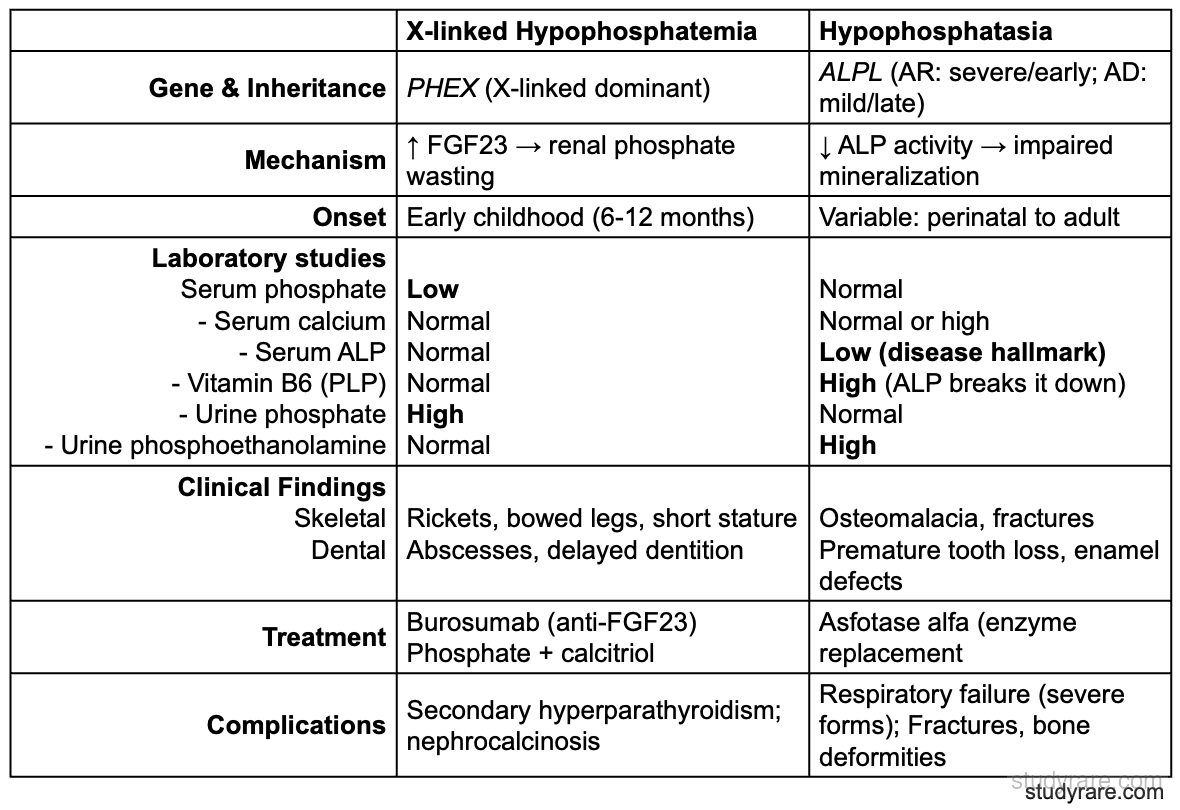
- Asfotase alfa (enzyme replacement therapy)
Hypophosphatasia = "hypo" (low) + alkaline "phosphatase" (ALP). The name is the hallmark lab: low ALP. Do not confuse it with hypophosphatemia ("-emia," blood), the low serum phosphate of X-linked hypophosphatemia.